


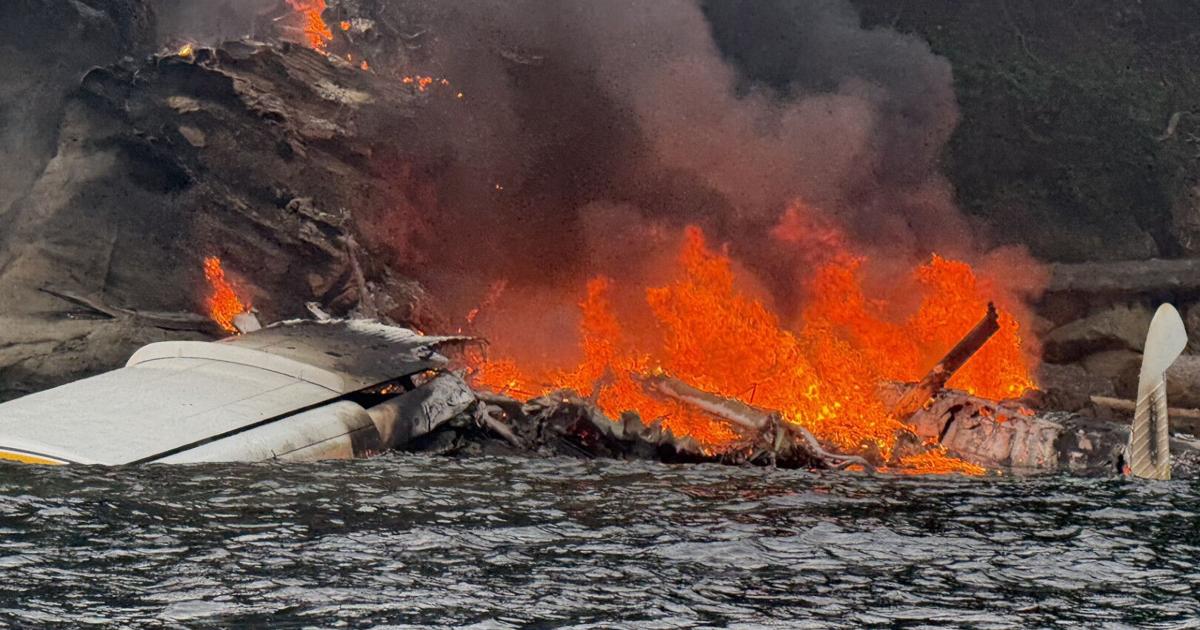
A Kenmore Air seaplane carrying 11 people crashed and caught fire on a rocky island in Washington state’s San Juan Islands on Thursday evening, yet all aboard survived the harrowing incident. The de Havilland DHC-3 Otter, operating as Flight 140, went down in Shallow Bay near Sucia Island at approximately 5:15 p.m. After departing from Lake Union in Seattle just before 4:30 p.m., bound for Roche Harbor in the island chain.
Dramatic video captured by nearby boaters shows the aircraft banking sharply to one side as it flew low over the water. The plane then made a hard landing, initially touching down on just one float before briefly skipping into the air and striking the rocky coast near the shoreline.
A swift multi-agency rescue operation sprang into action immediately. The U.S. Coast Guard, local emergency personnel, and numerous civilian Good Samaritan boaters responded to the scene. The San Juan County Sheriff’s Office confirmed that everyone aboard was rescued from the water. Three airlift ambulances were deployed to assist with patient transport.

All 11 people—10 passengers and one pilot—were transported to area hospitals. According to the San Juan County Sheriff’s Office, patients suffered injuries ranging from head trauma to broken bones and lacerations. One person was in critical condition following the crash. As of Friday morning, at least five passengers had been discharged from hospitals, with two more expected to be released later in the day. Three others remained hospitalized, including two patients transferred to Harborview Medical Center in Seattle.
Kenmore Air CEO David Gudgel stated: “We are grateful that everyone aboard has been accounted for, and our immediate focus is ensuring our passengers and pilot receive the care and support they need.” The airline canceled all scheduled flights for Friday, stating the decision came as the team focused on supporting passengers, families, employees, and emergency response efforts.
The aircraft itself caught fire after the impact. The de Havilland DHC-3 Otter is a single-engine turboprop floatplane model that has been in service since the 1950s. There were 466 of these planes manufactured between 1951 and 1967, with many having undergone overhauls and enhancements over the decades. Kenmore Air, based near Seattle, is the largest seaplane airline in the United States, flying over 90,000 passengers annually to more than 45 destinations throughout the Pacific Northwest and British Columbia.
The crash occurred less than three weeks after a seaplane carrying eight people made a rough landing in New York City’s East River in early July, which caused minor injuries. The incident also raised fresh concerns about the DHC-3 Otter model. In September 2022, a similar aircraft operated by Friday Harbor Seaplanes crashed into Puget Sound near Whidbey Island, killing all 10 people aboard. The National Transportation Safety Board later determined that a disconnected actuator—a component that controls the aircraft’s horizontal tail and pitch—caused that fatal crash. That 2022 incident prompted federal regulators to issue inspection directives for all DHC-3 Otters operating in the United States, requiring operators to verify that critical components were properly installed. Kenmore Air, the largest operator of Otter seaplanes on Puget Sound, had stated that its aircraft had passed inspection.
The cause of Thursday’s crash remains undetermined. The Federal Aviation Administration and National Transportation Safety Board are both investigating the incident. Weather conditions at the time included ground-level wind gusts of approximately 20 mph from the south and rain showers moving into the area, though investigators have not yet identified these as contributing factors.
Kenmore Air stated it will not speculate on the cause out of respect for those involved and said it is fully cooperating with investigating authorities and will continue providing verified information as it becomes available. The National Transportation Safety Board is expected to release a preliminary report within approximately 30 days, with a final report anticipated within 12 to 18 months.