

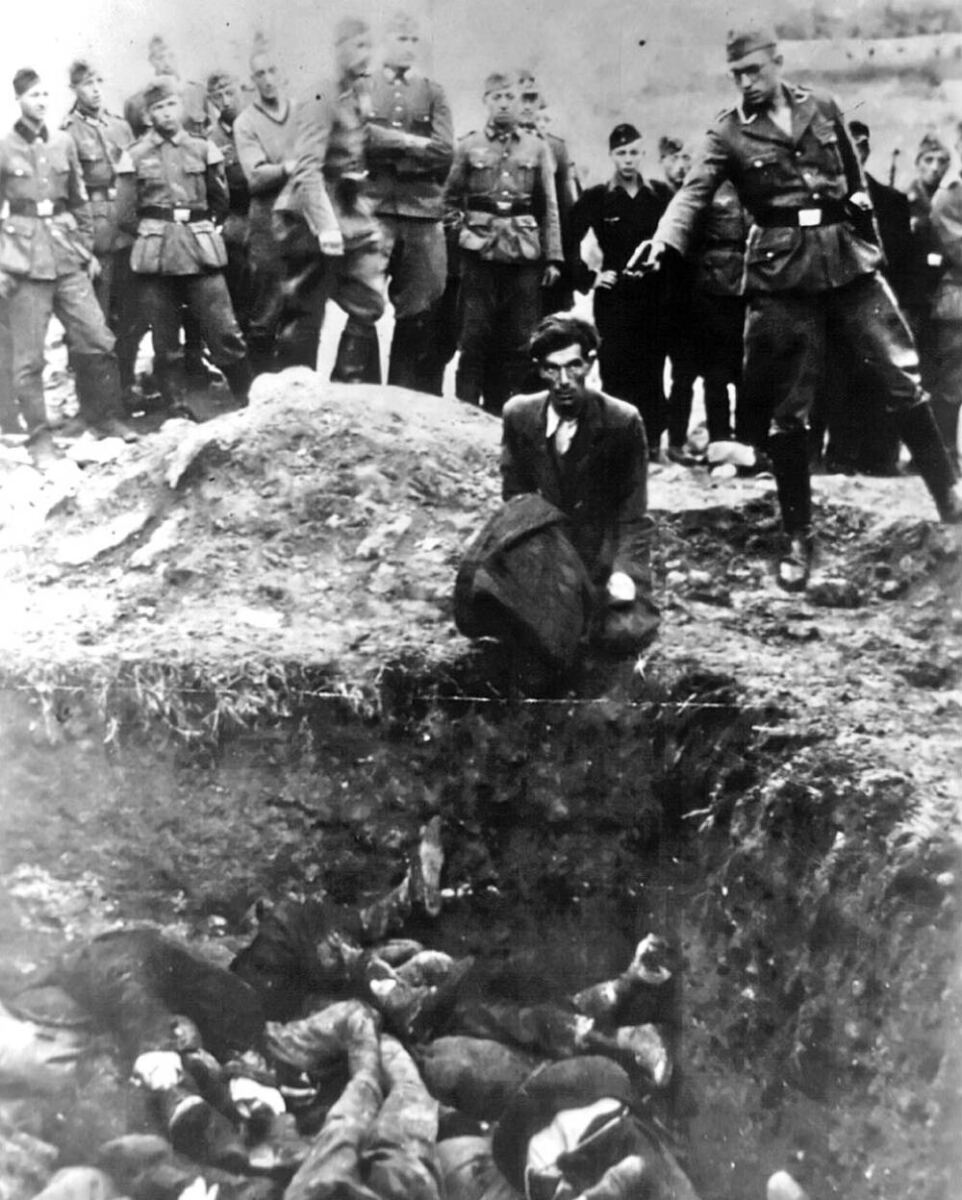
A German historian has used artificial intelligence to identify a notorious Nazi executioner in a World War II photograph more than 80 years after it was taken.
Jürgen Matthäus, a historian specializing in Holocaust research, made the breakthrough after a reader came forward with family correspondence following media coverage of the massacre’s real location. The image, long known as the “Last Jew of Vinnitsa,” shows a bespectacled SS soldier aiming a pistol at a kneeling man before a mass grave as other troops watch.
“The match, from everything I hear from the technical experts, is unusually high in terms of the percentage the algorithm throws out there,” Matthäus said. The historian’s study, published in the Journal of Historical Studies, upended decades of assumptions about the photograph.
The massacre actually took place July 28, 1941 in the citadel of Berdychiv, not Vinnitsa as previously believed. The unit responsible was Einsatzgruppe C, tasked with eradicating Jews and partisans in the newly occupied Soviet region ahead of a visit by Adolf Hitler.
The gunman is believed to be Jakobus Onnen, born in 1906 in Tichelwarf, Germany. Before the war, Onnen worked as a French, English and gym teacher. He joined the Nazi party in 1931 and, enlisted in the SS Death’s Head Unit at Dachau concentration camp in August 1939.
“These mass executions in this format continued until the very last day of the German occupation in the east,” Matthäus said. “I think this image should be just as important as the image of the gate in Auschwitz, because it shows us the hands-on nature, the direct confrontation between killer and person to be killed.”
By 1940, Onnen was working for the Nazi “Order Police” in occupied Poland. He joined Einsatzgruppe C in 1941 shortly after the Nazi invasion of the Soviet Union. The unit reportedly eliminated all but 15 of the 20,000 Jews in the region upon their arrival.
Matthäus happened upon the revelation when a reader, after hearing about the corrected location, date and unit in German media last year, came forward with family correspondence. The reader noted the shooter bore a striking resemblance to his wife’s uncle, Onnen, and provided biographical details.
The photographs were then sent to volunteers at Bellingcat, the open-source journalism group, who conducted forensic analysis using AI. Combined with the strong likeness and circumstantial evidence, Matthäus deemed it a sufficient match to publish.
While AI proved integral to the identification, Matthäus maintained that the technology is “not the silver bullet” but “one tool among many” and that “the human factor remains key.”
A bespectacled Nazi soldier aims his pistol at a kneeling victim beside a mass grave as fellow SS troops observe. The image became one of the most haunting visual documents of the Holocaust, yet the executioner’s identity remained unknown for over eight decades. The location was long misidentified as Vinnitsa, lending the photograph its common name, until Matthäus’s research established the true site as Berdychiv.
Despite his dedication to the Nazi cause, Onnen never rose beyond a low rank. He was killed fighting partisans in the Zhytomyr region of Ukraine in 1943. His kneeling victim has yet to be identified, though Matthäus said he plans to remedy that as part of his next project using Soviet-era records and possibly AI.
Matthäus intends to continue his research into identifying victims of Nazi atrocities through historical documentation and emerging technology.