


Among the great unanswered questions of the 20th century – alongside the JFK assassination and the fate of hijacker DB Cooper – the disappearance of celebrated pilot Amelia Earhart remains one of the most compelling.
Nearly 88 years after Earhart and her navigator, Fred Noonan, vanished during their attempt to fly around the world, enormous time and money have been poured into determining where their aircraft, the ‘Electra’, ultimately ended up.
The prevailing account holds that after they missed a planned landing on Howland Island in the Pacific – about six weeks and roughly 20,000 miles into the trip on July 2, 1937 – a chain of mechanical issues and radio problems left them unable to pinpoint the tiny outpost, forcing the plane down into the ocean.
Search efforts in the waters around Howland began immediately and have continued for decades, yet no confirmed trace of the ‘Electra’ or its occupants has ever been recovered. But a 2019 expedition led by oceanographer Robert Ballard introduced evidence that raised the possibility Earhart may have survived the initial incident.

Ballard, a retired Navy officer, is no ordinary researcher – he is widely regarded as one of the most significant figures in modern ocean exploration.
He has been credited with locating iconic shipwrecks, including the Titanic, the battleship Bismarck, and the USS Yorktown. Beyond wreck-hunting, his work also helped reveal deep-sea geothermal vents, reshaping scientific understanding of ocean ecosystems.
Rather than focus solely on the Howland Island scenario, Ballard looked into another longstanding theory: that Earhart and Noonan managed an emergency landing on a coral reef about 350 miles southeast of their intended destination.
The island in question is Nikumaroro, a narrow and remote strip of land that has long been viewed as one of the more plausible places the ‘Electra’ could have reached as fuel ran low.
Some contested accounts have claimed that distress transmissions originated from that region in the days following the disappearance. Skeptics, however, argue the reports may have been fabricated, given the intense global interest sparked by Earhart going missing.
As Ballard searched the surrounding waters for wreckage, a National Geographic team combed Nikumaroro itself, looking for anything that might indicate Earhart or the plane arrived there nearly nine decades ago.
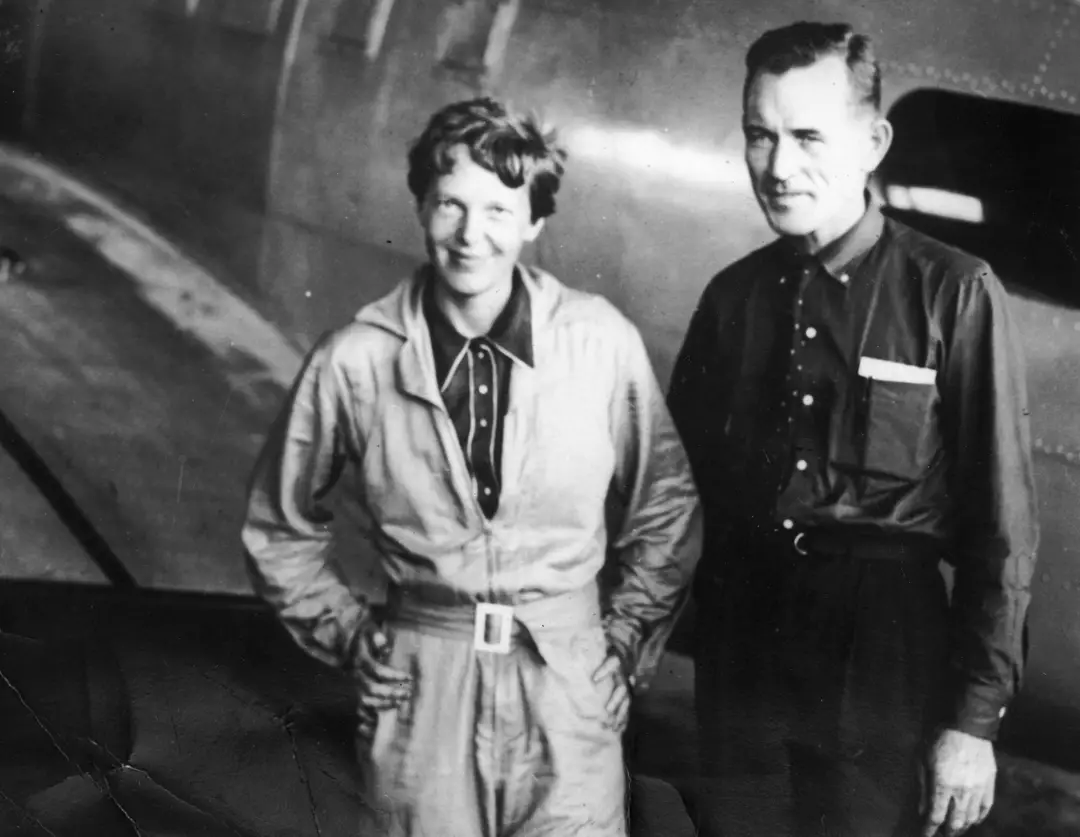
Their work revisited an idea dating back to 1940, when British officials reportedly found 13 bones on the island, including part of a skull, and suspected they could be linked to the missing aviator.
Investigators then considered why so little remained in one place. Observing the island’s large coconut crabs, they left a pig carcass to see what would happen – and watched the animals drag bones as far as 60 feet away.
That behavior fueled a grim possibility: if Earhart lived long enough to reach Nikumaroro, her remains might have been scattered by crabs over time or carried away into the sea.
Even so, Ballard’s underwater search did not uncover the ‘Electra’ near the reef. And because the bones discovered in 1940 were relocated long ago, confirming the National Geographic hypothesis has proven difficult.
In fact, when the outlet’s archaeologist Frank Hiebert later located a fragment believed to be from the skull found on Nikumaroro, the follow-up analysis undercut hopes of a breakthrough.
Although the piece appeared to come from an adult female, tests suggested it belonged not to Earhart but to a Polynesian woman who had died on the island more than 1,000 years earlier – leaving the Nikumaroro theory unresolved, and the aviator’s fate still shrouded in uncertainty.