

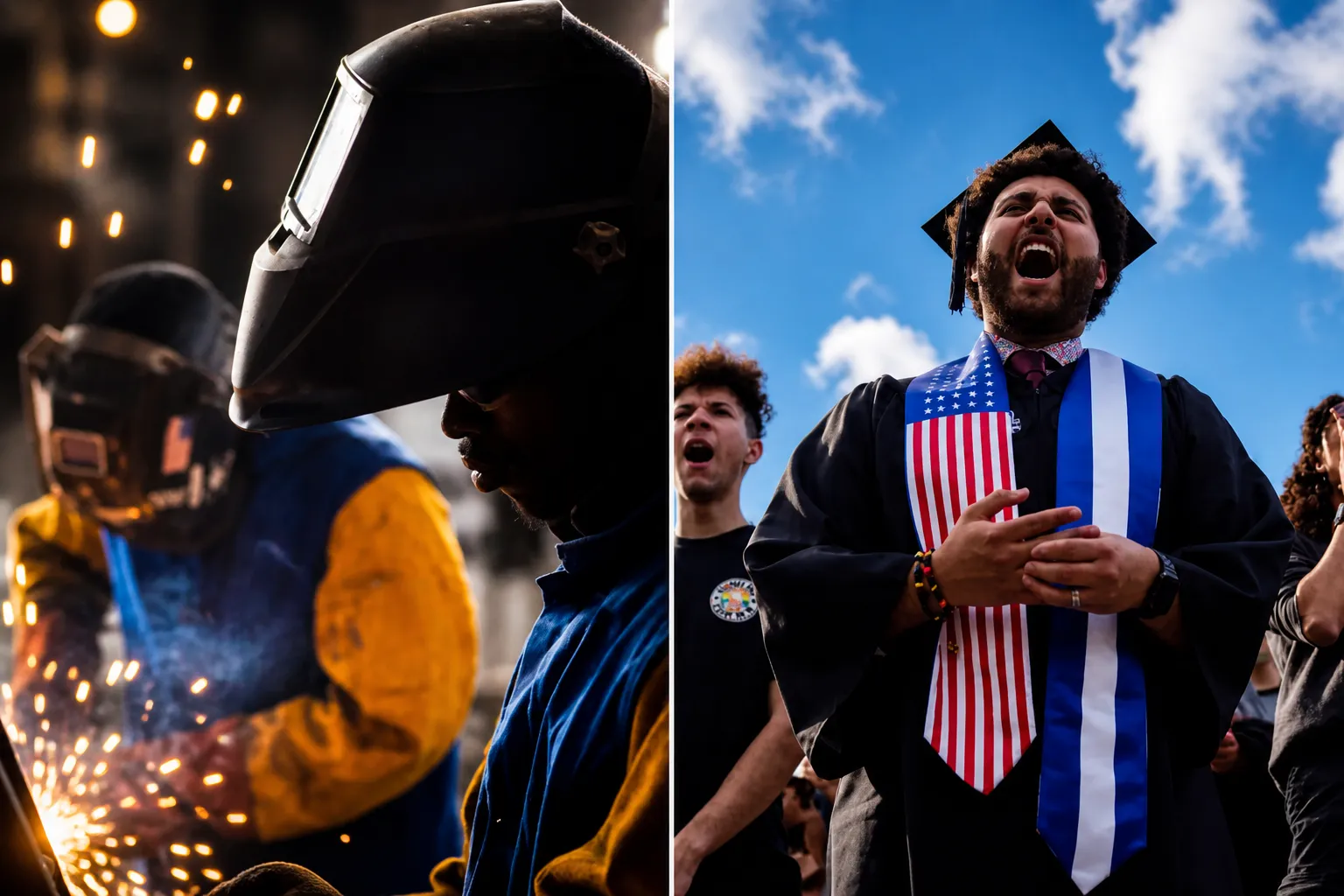
American colleges are facing an enrollment crisis as more young people opt for vocational schools and trade jobs.
The number of high school grads enrolling in traditional colleges could decline 13% over the next 15 years, the Western Interstate Commission for Higher Education predicts. Part of that drop stems from falling birth rates after 2008, meaning fewer Americans will turn 18 in coming years. However, students increasingly cite steadier career prospects, higher relative pay and less debt as reasons to skip four-year degrees.
Benjamin Davis of Los Angeles decided to learn to cut hair instead of earning a traditional college degree. He now works steadily at Floyd’s Barbershop and can find work anywhere he goes.
“People always ask me, ‘Should I go to barber school?’ And I always tell them to go for it. It’s the best career decision I ever made,” Davis said.
That mobility stands in contrast to many college graduates stuck with degrees more impressive than their real-world job prospects. Unemployment and underemployment among recent college graduates — which had rebounded after the pandemic — has steadily risen in the last four years, according to recent data from the Federal Reserve Bank of New York.
Meanwhile, enrollment in two-year vocational programs has risen around 20% since 2020, according to the National Student Clearinghouse Research Center. The shift reflects a broader reassessment of what paths actually deliver financial stability.
Cynthia Moreno, 50, manages a hair salon in California and teaches cosmetology at Pasadena City College. She said her students are attracted to clear, straightforward job prospects in a steady industry.
“[Trade school] is very direct,” Moreno said.
She noted they face none of the stress of huge student debt coupled with breaking into the corporate world. Her own son majored in communications, a field with a 52% underemployment rate and median early-career wage of only $52,000 per FRBNY data. He ended up managing a major grocery store — a rewarding, decent-paying job that he enjoys, she told The Post.
A healthy market and “wage compression” — higher wages for jobs requiring less or no education — are big draws for the trades, said Dr. Nathan Grawe, Professor of Economics at Carleton College.
“If you go down to your local Aldi and they offer you 20 dollars an hour plus benefits, or you can get a certificate in a high-paying trade and find a job, all of a sudden the idea of spending four years in college becomes less attractive for some students who are on the fence,” Grawe told The Post.
Bucking the trend for now are Ivy League schools, where applications remain strong, according to the National Center for Education Statistics, as reported by the Wall Street Journal. Grawe said this is because parents today who grew up being told they must go to college are pushing their kids to apply to top-tier schools. The elimination of standardized test requirements, application fee waivers, and other provisions has also led to more youngsters applying to the Ivy League.
Caught in the middle are public universities and expensive two-year degrees, which could be a more expensive and less efficient alternative to simply entering the workforce after high school.
“And some of them might be thinking they’ll go back. They’re saying, ‘I wasn’t entirely sold on this education journey, and the trades are a good alternative. But I can always go back and get my associates later, if that’s what I want,” Grawe said.
Davis’s straightforward endorsement of barber school over traditional higher education captured growing Gen Z skepticism toward degree paths that once seemed mandatory. His testimony joined a chorus of young workers discovering that skilled trades offer both immediate income and long-term flexibility without the burden of tens of thousands in student loans. The data backed up the anecdotes: while vocational program enrollment climbed sharply, traditional college faced its steepest demographic headwinds in modern history, with birth-rate declines compounding the preference shift among those who did graduate high school.