

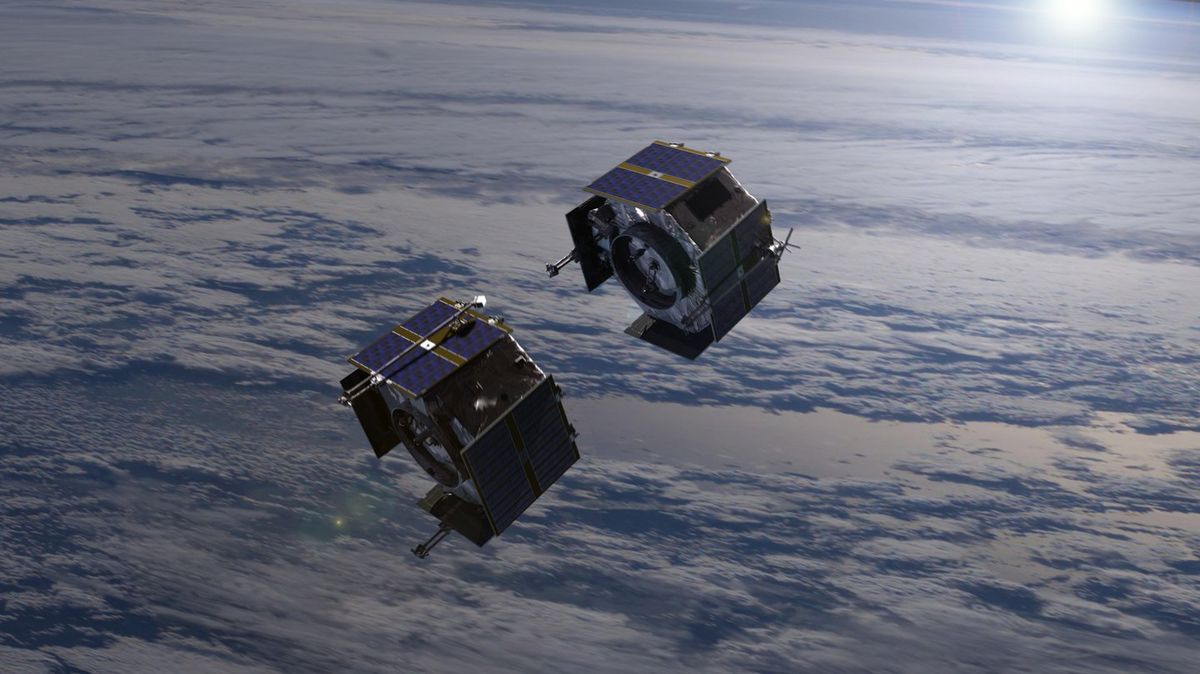
An astronomer has explained why a 1,300 pound NASA space probe has probably already fallen to Earth, and we’ve likely missed it.
Earlier this week, the US space agency revealed that one of its Van Allen probes was expected to make an early return to Earth, ending its time in orbit around eight years sooner than anticipated.
The two spacecraft, Van Allen A and B, were launched in 2012 with the goal of studying the Van Allen radiation belts — two vast, doughnut-shaped regions filled with high-energy charged particles.
Located roughly 40,000 miles above the planet, these particles are held in place by Earth’s magnetic field and help shield us by absorbing and deflecting solar wind.
Although the mission was originally planned to last two years, the probes continued operating for nearly seven, delivering data until their fuel supplies were depleted.
Last night (Tuesday March 10), Van Allen probe A — weighing 1,323 pounds — was expected to re-enter Earth’s atmosphere, leaving probe B to continue alone until its own return later on.

The remaining twin probe is expected to come back down by 2030.
NASA said it anticipates most of Probe A would burn up during re-entry, though it cautioned that “some components are expected to survive re-entry.”
The agency also stated: “The risk of harm coming to anyone on Earth is low – approximately 1 in 4,200.
“NASA and Space Force will continue to monitor the re-entry and update predictions.”
So far, there have been no official updates confirming exactly when or where the spacecraft came down.
Astrophysicist Jonathan McDowell, who works at the Harvard–Smithsonian Center for Astrophysics’s Chandra X-ray Center, shared on X (formerly Twitter) why that lack of clarity isn’t unusual in a case like this.

In his thread, he wrote: “For multi-tonne satellites we usually get a final ‘prediction’ with an accurate location and an error bar of one minute that is really a detection from secret infrared satellites. VAP A [Van Allen Probe A] may not be big enough to get one of these…”
He added: “Instead we may be left with, ‘umm, we saw it on Sunday and by Wednesday, our failure to see it again on the radars makes us pretty sure it came down sometime on Monday or Tuesday.’ – We may never get better than that. We’ll see.”
NASA's Van Allen Probes A and B were two half-ton spacecraft launched in Aug 2012 to elliptical 600 x 30000 km orbits to study the radiation belts. In 2019 their perigees were lowered to 200 km so that they would eventually reenter and they were switched off. (1/n)
— Jonathan McDowell (@planet4589) March 10, 2026
McDowell noted that a widely witnessed fireball could help narrow things down. If the spacecraft broke apart over a populated area at night, then ‘someone may see the reentry and we can say “that’s exactly where VAP A would have been at that moment IF it were still in orbit.”‘
But he pointed out why that still might not be definitive: “That coincidence in time and space would give us confidence we’d seen the VAP A reentry and not some other reentry.
“Odds are, though, that it came down over the ocean or in daytime and no-one saw it.”

How disappointing…
McDowell also explained why NASA highlighted this re-entry publicly, beyond the symbolic end of a long-running mission.
“NASA say the estimated risk of debris from this reentry causing casualties is about 1 in 4000, which is tiny but not as tiny as the 1 in 10000 threshold that they use to go ‘we’re not gonna worry about it’, which is why this is popping up on the news,” he said.
He continued: “Even if you live in the target area within 10 degrees of the equator, with perhaps half a billion people in that area, a 1 in 4000 chance of *someone* getting hit is something like a 1 in 2 trillion chance of *YOU* getting hit,” McDowell added.
He concluded with a broader warning: “Uncontrolled reentries resulting in entry at an unpredictable time and location are not a good thing for larger spacecraft, and we need to do better in general about designing our spacecraft so they can be deorbited in a controlled way.”
The more you know!