


Emma Heming Willis has addressed a widespread misunderstanding about Bruce Willis’ condition, explaining that the actor does not have Alzheimer’s disease and still knows the people closest to him.
During an appearance on The Bossticks podcast on Monday, Emma spoke about how many people incorrectly assume that every form of dementia involves forgetting family members and loved ones. She said the confusion is especially common when people hear the word “dementia” and immediately think of memory loss, even though frontotemporal dementia can affect language, behavior, personality, judgment and communication long before it looks like the memory problems many people associate with Alzheimer’s.
“When people say, ‘Oh, you know, does he remember who you are?’ Well, he does because he doesn’t have Alzheimer’s; he has FTD,” she said.
“I think that’s a very common misconception that, when you think of dementia, we think of memory loss.”

Bruce was first diagnosed with aphasia in 2022, prompting him to step away from acting. The following year, his family revealed that his condition had progressed to frontotemporal dementia, or FTD. Emma has continued to use her public platform to explain the disease, support other caregivers, and push back against misconceptions about what FTD does and does not look like.
Emma emphasised that FTD is not the same as Alzheimer’s, even though Alzheimer’s is the type of dementia most people are familiar with. FTD is generally associated with younger patients than Alzheimer’s and often presents with changes in speech, behavior and personality rather than early, obvious memory loss.
“Alzheimer’s is the most common form of dementia, but FTD is the most common form of dementia for people under the age of 60,” she explained.
Since Bruce’s diagnosis became public, Emma has increasingly used her platform to speak on his behalf and to highlight the reality faced by caregivers. In 2025, she released her memoir, The Unexpected Journey: Finding Strength, Hope, and Yourself on the Caregiving Path, expanding on the emotional and practical challenges of caring for a loved one with a progressive neurological disease. In March 2026, she and Bruce were also honored by The Association for Frontotemporal Degeneration, and she announced the launch of the Emma & Bruce Willis Fund for Dementia Research and Caregiver Support to help fund research and support families dealing with FTD.
She has also spoken openly about the emotional toll of caring for someone with dementia, describing it as an ongoing process of grief.
“These diseases, they take and they take and they take, sometimes very slowly, and you are grieving different losses all the time. So you are consistently in grief.”
Emma said the experience becomes more manageable with time, though it is not something a family simply gets over. Instead, it becomes something you learn to live alongside.
One of the more notable details she has shared is that Bruce himself does not realise he has the condition, something she has said brings her a sense of comfort. She has previously explained that he is living with anosognosia, a neurological symptom that can occur with FTD and other brain disorders, which means a person may be genuinely unable to recognize their own illness.
The condition prevents the brain from properly recognising the illness, meaning the person is truly unaware of what is happening rather than refusing to accept it.
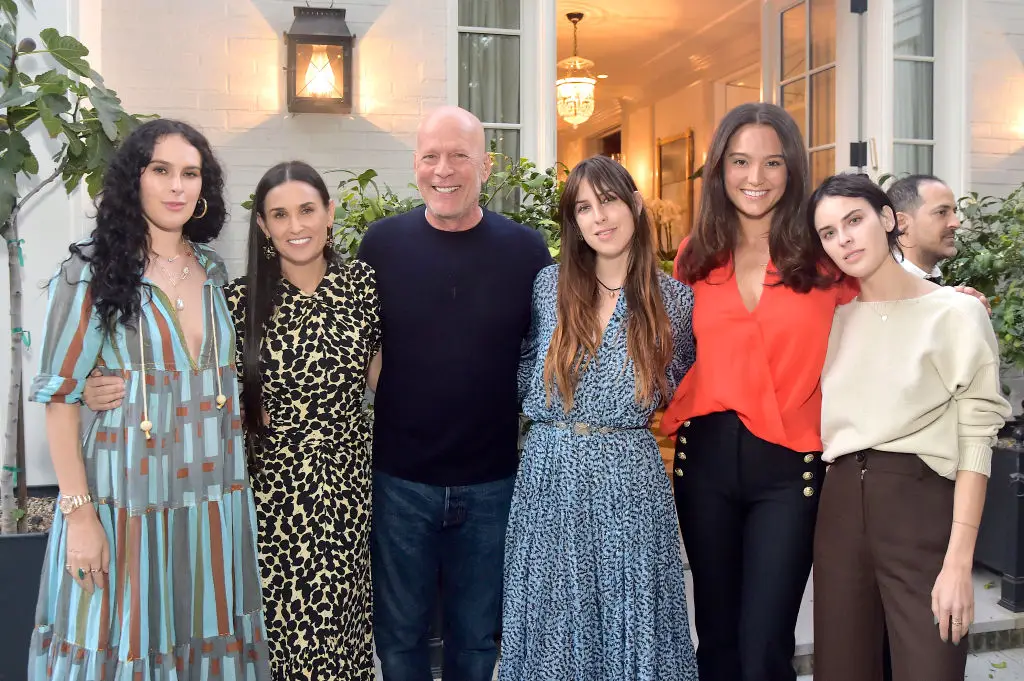
“He never connected the dots that he had this disease, and I’m really happy about that,” Emma said. “I’m happy he doesn’t know about it.”
Bruce and Emma share two daughters, Mabel, 14, and Evelyn, 12.
He is also a father to Rumer, Scout and Tallulah, his three adult daughters from his previous marriage to Demi Moore.