

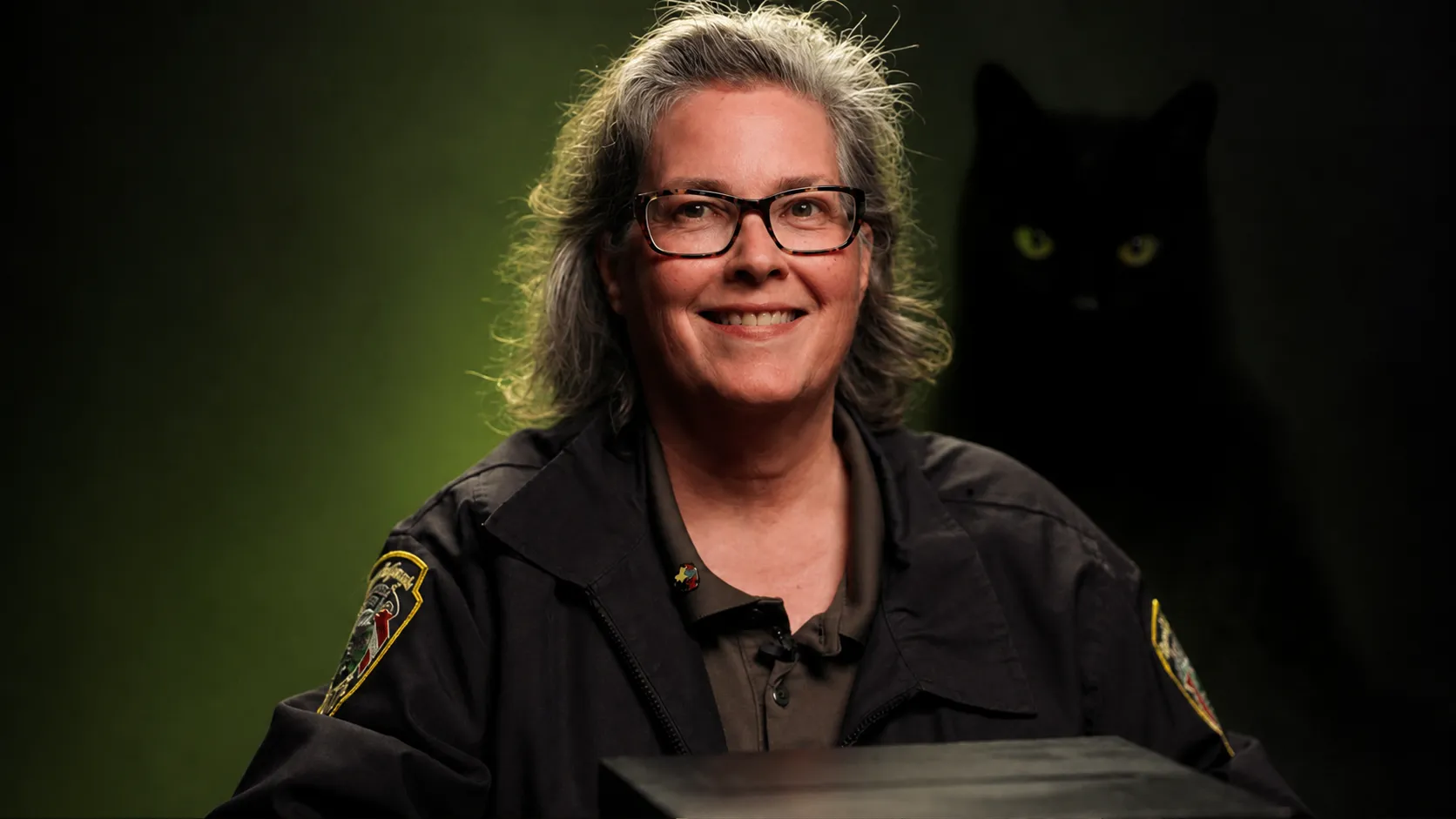
Dog owners may feel vindicated after a veteran crime scene investigator shared her blunt view on why cats are the pets you should be wary of.
The debate over cats versus dogs has lasted for generations, with each side convinced their favorite companion comes out on top.
For anyone firmly in the pro-cat camp, the warning from Sheryl ‘Mac’ McCollum may be difficult to hear.
McCollum works as a crime scene investigator with the Metro Atlanta Police Department. Her role involves examining scenes ranging from everyday incidents to the most serious violent crimes, gathering evidence, and piecing together exactly what took place.
Over the years, she has dealt with some deeply disturbing cases. During an appearance on the Honesty Box series, she spoke about several of the grim situations she has encountered while working.
Among the cases that stayed with her was the Adamsville killing in Atlanta, where, as she explained, “an entire family was murdered, and there was a young child that survived and played dead until they could go for help”.
She also recalled seeing a badly decomposed body that had been dismembered and stored inside a cooler.
That naturally raised a different question: what does any of this have to do with cats?
When the topic turned to the long-running belief that cats may consume their owners after death, McCollum did not hesitate.
“Yeah, don’t trust your cat,” she said. “Your dog will sympathise and lay down beside you, but your cat will not.”
As tough as that may be for cat owners to accept, experts say there is at least some basis for the claim, though not quite in the way many people think.
Recent forensic research has added more detail to that grisly idea. A 2024 review of indoor scavenging cases found that both cats and dogs can feed on human remains after death, but cats generally tended to focus on skin and soft tissue, while dogs were more likely to cause more extensive damage if they had time and access. The same research highlighted that pet scavenging can complicate trauma analysis, the estimation of time since death, and the recovery of complete remains.
In other words, the difference is less about affection and more about opportunity, confinement, and survival. If an animal is trapped indoors with a body and no other food source, it may begin scavenging simply because it is hungry, not because it has suddenly turned on its owner.
Lena DeTar, an associate clinical professor at Cornell University College of Veterinary Medicine, told Popular Science that in extreme situations, pets may feed on a body simply because they are trying to survive once all other food is gone.
“The drive is not that all of a sudden your pet doesn’t like you anymore,” she said. “The drive is you’re smelling like meat, you’re no longer moving, and I’m really hungry and I need to eat.”
DeTar did not single out cats as being uniquely likely to do this.
In fact, forensic anthropologist and bioarchaeologist Carolyn Rando of the University College London Institute of Archaeology suggested dogs may actually pose the bigger risk in that scenario.
“Cats are going to maybe chew at the soft tissue of your nose, chew at your face, chew at your fingertips, but dogs will consume the whole corpse if given a chance and enough time,” Rando told the outlet.
She added that dogs are highly domesticated and natural scavengers, whereas cats still retain stronger hunting instincts and may be better able to cope for longer without depending on food from a human.
As unsettling as the subject is, the key point is that when cats or dogs have done this after an owner’s death, it is understood as survival behavior rather than affection suddenly disappearing.
Elsewhere in the same Honesty Box conversation, McCollum was asked whether constant exposure to horrific scenes had made her emotionally numb.
Check out the full Honesty Box episode below:
“No, actually, this job has made me more grateful,” she said.
“I think I’m a better wife, I’m a better mom, I’m a better sister, I’m a better friend because of what I’ve seen.
“If anything, I’m much more sentimental and can cry more than I did before this job.”