

If you’ve spent time browsing true crime spaces online, chances are you’ve seen the name Wade Wilson.
The 30-year-old from Fort Myers, Florida drew intense attention after his 2019 arrest — in part because he shares a name with Marvel’s Deadpool, but more so because of something much more unsettling: the dramatic change in his appearance during nearly five years behind bars.
On 12 June, 2024, Wilson was convicted of murdering two women in Cape Coral, Florida, in October 2019: Kristine Melton, 35, and Diane Ruiz, 43. Both were killed by strangulation just hours apart.
Then, on 25 June, jurors supported imposing the death penalty on both counts. Ten of the 12 jurors recommended execution for Ruiz’s murder, while nine of 12 did so for Melton’s — a decision the victims’ families had been waiting years to hear.
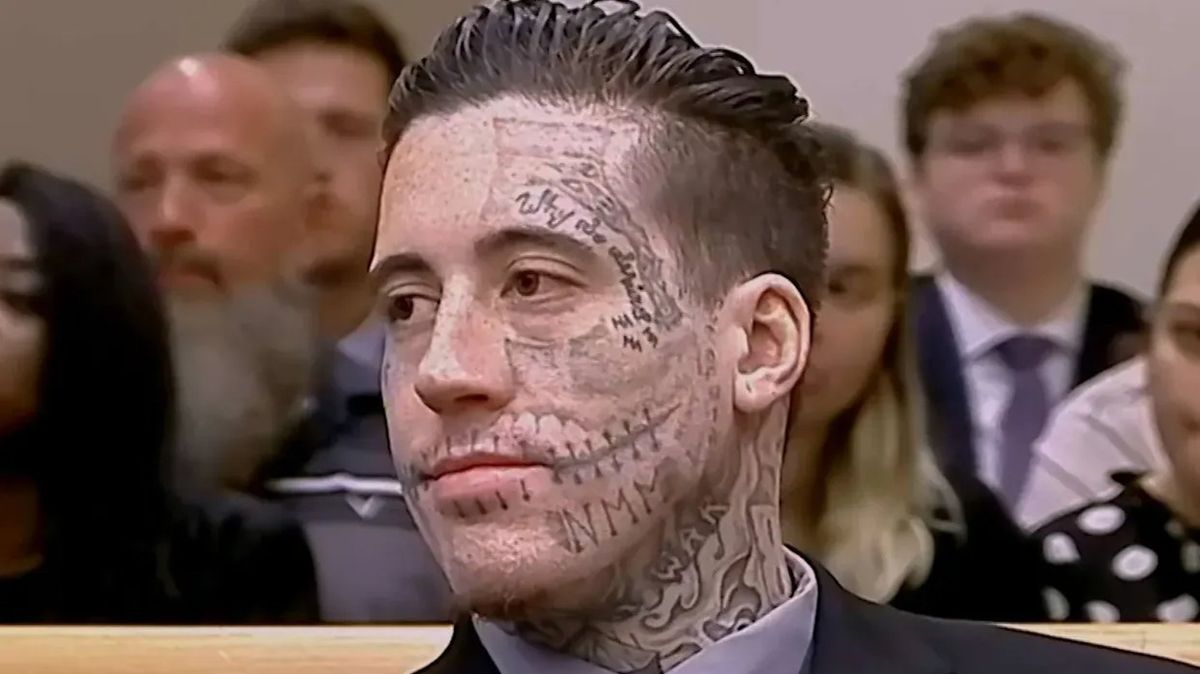
With sentencing approaching, public focus has shifted back to Wilson himself — and, in particular, the condition of his face.

At the time of his 2019 arrest, his facial tattoos appeared to end around his chin.
Now, his face is almost entirely covered, and much of the imagery has drawn alarm because of what it represents.
In his earliest mugshot, Wilson — then 25 — already had extensive ink reaching his jawline, including the phrase ‘bred for war’ printed prominently beneath his chin.
Later that year, a court appearance revealed a swastika tattoo on the right side of his scalp, a Nazi symbol associated with extremist ideology and racial hatred — an early glimpse into beliefs many found disturbing.
Five years on, the shift is far more extreme.
He now has ‘HA HA HA’ tattooed beneath his left eye, along with the Joker line from The Dark Knight — ‘why so serious’ — inked around the same area.

Prosecutors said that on the night of 7 October, 2019, Wilson returned home with Kristine Melton and her friend after a night at a bar. After the friend left, Melton was strangled while asleep, and Wilson took her car and drove off.
Not long after, he came across Diane Ruiz, a mother of two who was walking to work.
Authorities said he persuaded her to get into the vehicle by asking for directions. When Ruiz realized the danger and tried to get away, she was strangled, beaten, and then run over with the car up to 20 times.
During the trial, Wilson’s lawyers pointed to mental illness and substance abuse, and a forensic psychiatrist testified that Wilson suffered from ‘some kind of psychotic disorder’. The jury ultimately rejected that as a reason to spare him, convicting him and later recommending the death sentence.