

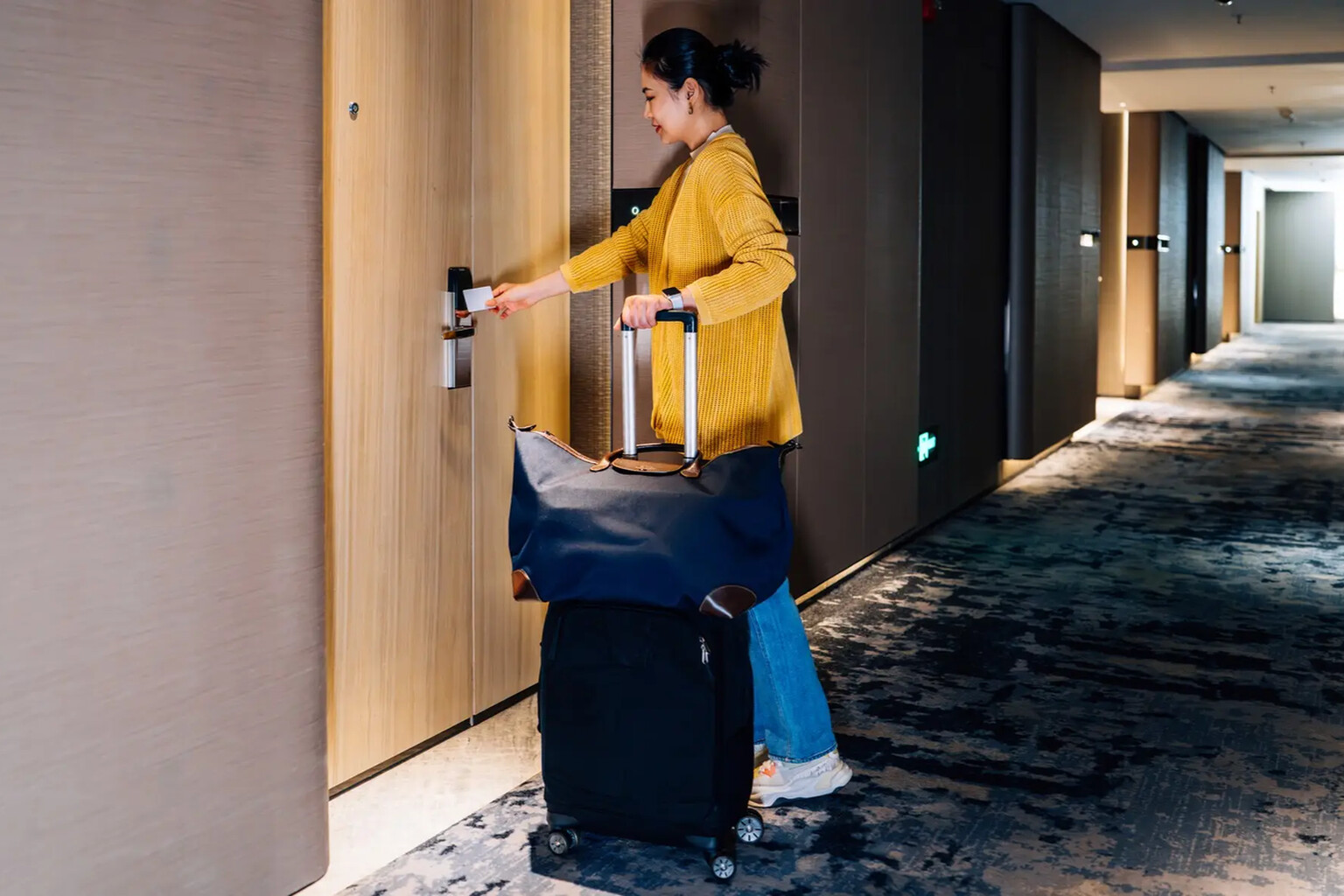
A veteran flight attendant has detailed the 90-second “hotel room autopsy” she performs at every check-in to stay safe on the road.
Aura Martinez, a New York-based crew member with nearly two decades in the air, said she treats the routine as essential preparation, not paranoia. The practice, now being promoted across the aviation industry through the online crew resource CabinCrew24, breaks down into six rapid steps designed for travelers constantly landing in unfamiliar cities with varying security standards.
The first move is a full-room scan conducted with the door still propped open. Martinez said she wants to confirm housekeeping has finished and no one else is inside before she commits to the space.
“I just want to familiarize myself with the space and make sure everything looks as it should,” she said. “It doesn’t need to become a 20-minute inspection.”
That initial sweep leads directly into a targeted inspection of common hiding spots. Crew members are trained to check the bathroom, closets, and behind curtains to verify they are truly alone.

Once the room is cleared, attention shifts to emergency preparedness. Martinez emphasized studying the evacuation map on the back of the door immediately, well before any crisis could unfold.
“Know whether you turn left or right when you leave your room, approximately how far the stairwell is and, if possible, how many doors you would pass before reaching it,” she added.
The fourth step involves testing all locks. Crew members verify that dead bolts, security latches, and window locks function properly, eliminating the most direct physical vulnerabilities in the room.
Phone reliability comes next. A quick check that the hotel room line connects to the front desk ensures a backup communication path if a mobile phone dies, gets stolen, or loses signal in a foreign network.
The final layer is a portable door alarm, a small device that sounds if someone attempts entry while the occupant is inside. Martinez also flagged a compact flashlight as what she called an “incredibly underrated” addition to any travel kit.
The CabinCrew24 post that recently circulated the routine pushed back against any perception that this behavior reflects anxiety. “This is not a nervous habit,” the author insisted. “It comes from years of sleeping in strange rooms, in different countries, under different fire rules and different levels of hotel security.”
Aviation professionals spend hundreds of nights annually in transit lodging across multiple continents, where fire codes, building standards, and front-desk protocols shift dramatically from one property to the next. The autopsy framework condenses years of accumulated risk awareness into a protocol brief enough to complete before unpacking a suitcase.
Martinez’s guidance mirrors the same passenger-safety logic flight attendants deliver during pre-flight demonstrations, where locating the nearest exit is framed as a responsibility rather than an optional precaution. The hotel adaptation simply redirects that mindset ground-level, where crew members have no colleagues nearby and no standardized aircraft environment to rely on.
The six-step checklist has gained traction as crew-specific forums and travel-safety educators repackage it for broader audiences, though its origins remain rooted in the particular vulnerabilities of airline staff who check into anonymous rooms at all hours across time zones.