

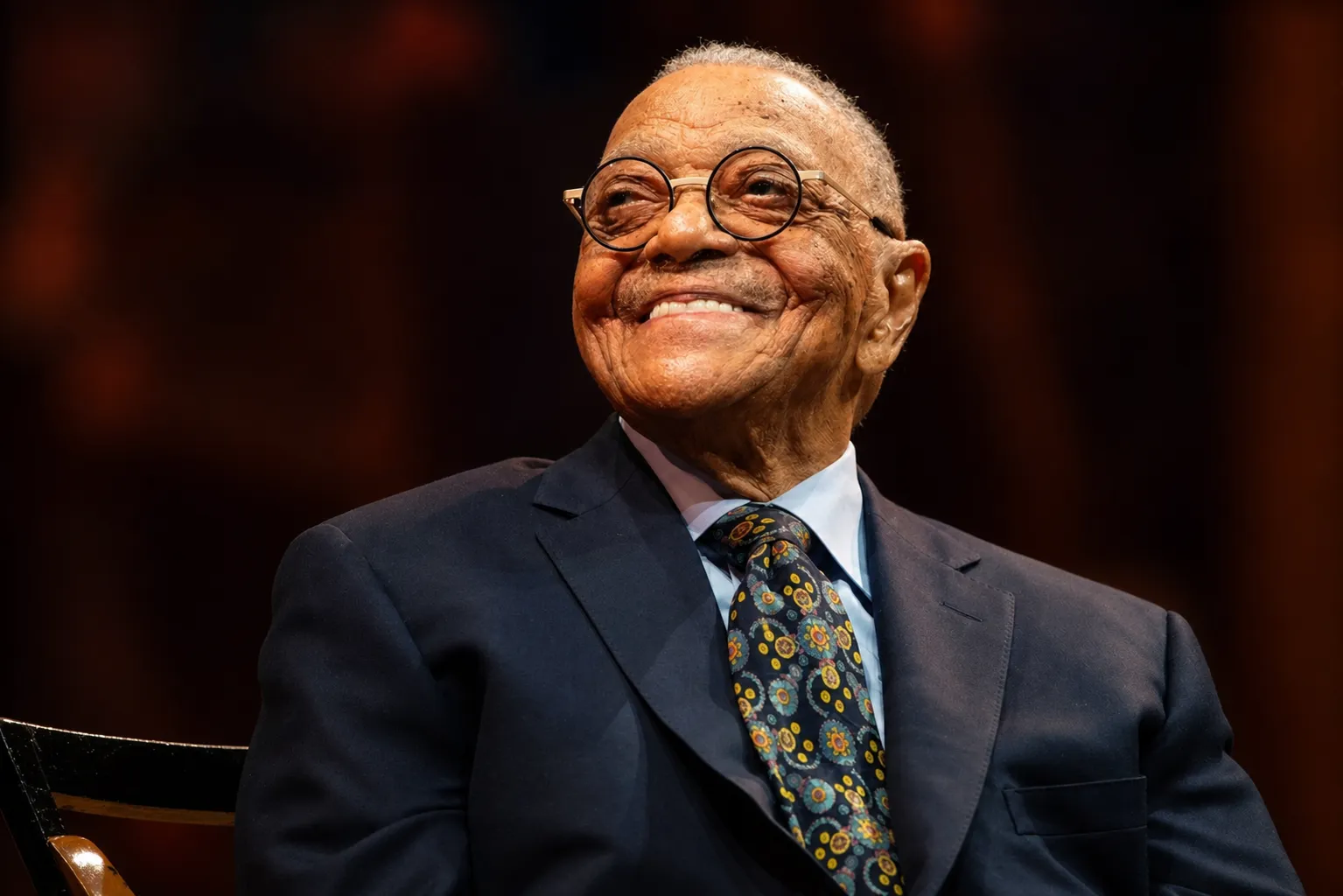
George E. Johnson Sr., the pioneering Black entrepreneur who transformed the hair care industry and built one of the nation’s most influential Black-owned businesses, died Monday at his home in Chicago. He was 99.
Born June 16, 1927, in a three-room sharecropper’s shack in Richton, Mississippi, Johnson moved to Chicago with his mother at age two after his parents separated. As a child, he worked multiple jobs to help support his family, shining shoes at age eight while attending school, then later bussing tables and setting pins in a bowling alley. These early experiences, he said, shaped his lifelong commitment to humility, determination, and what he called the Golden Rule: treating everyone with dignity and respect.
Johnson left high school to work full-time and in 1944 joined Fuller Products, a Black-owned cosmetics firm, as a production chemist. The experience proved formative. In 1954, encouraged by a colleague, he left to start his own company with his wife, Joan Henderson, whom he had met while they were students at Wendell Phillips High School.
The couple faced immediate obstacles. When they applied for a business loan to launch Johnson Products, their first bank rejected them. Johnson then visited a different branch of the same bank and told a white loan officer a different story: he needed the money for a family vacation to California. As he later recalled in his 2025 memoir “Afro Sheen: How I Revolutionized an Industry with the Golden Rule, from Soul Train to Wall Street,” he understood the psychology at play. “I knew this request wouldn’t rattle [the loan officer’s] belief that he was superior to me,” he wrote. Thirty minutes later, he walked out with a check for $250 in his hand.
Johnson used the money, combined with another $250 loan from Orville Nelson, a barber who had approached Fuller Products with the idea for a better hair straightener before being rejected. Working with chemist Herbert Martini, Johnson developed Ultra Wave, a hair relaxer for men that wouldn’t burn scalps. By 1957, the company had introduced Ultra Sheen for women, a revolutionary home-use straightener that became an instant success.
The company’s timing proved perfect. As Black Americans pushed back against pressure to assimilate, they increasingly sought hair care products designed specifically for their needs. Johnson Products seized the opportunity by creating products tailored to an underserved market that larger corporations had ignored. By 1960, Johnson Products controlled nearly 80 percent of the Black hair care market. By 1966, the company had annual sales of about five million dollars and controlled nearly half the professional relaxer market.
When the Black Power movement and natural hair aesthetic gained prominence in the late 1960s, Johnson Products adapted rather than declined. The company introduced Afro Sheen, which helped Black consumers style natural hair texture with pride. Johnson pioneered sophisticated marketing techniques that set his company apart. He hired Black advertising firms, including those run by Vincent Cullers and Tom Burrell, to create campaigns that depicted Black people as glamorous, modern, and professional—a stark contrast to the demeaning stereotypes that had long dominated advertising.
Johnson Products became the first Black-owned company listed on the American Stock Exchange in 1971, a historic milestone. By 1974, the company generated annual sales exceeding 31 million dollars and manufactured a full range of products including Ultra Sheen, Afro Sheen, Classy Curl, and Black Tie men’s cologne.
The company’s influence extended far beyond hair care. In 1964, Johnson founded Independence Bank, which by the 1980s had become the largest Black-owned bank in America. During the 1970s, Johnson Products became the first national sponsor of “Soul Train,” the groundbreaking television music and dance show that became a cultural institution. The partnership proved transformative: Johnson Products commercials became as iconic as the show’s legendary performances, and Afro Sheen became one of the most recognizable Black-owned brands of the era.

Johnson’s vision of business extended beyond profit. He offered his employees tuition reimbursement, paid sick leave, maternity leave, and profit-sharing programs—unusually generous benefits for the era. He also established a million-dollar scholarship fund for Black students majoring in business and contributed substantially to the United Negro College Fund.
His accomplishments earned numerous honors, including Ebony magazine’s American Black Achievement Award in 1978, the Horatio Alger Award in 1981, and the Babson Medal in 1983. Harvard University awarded him the W.E.B. Du Bois Medal in November 2025, the institution’s highest honor in African and African American studies. He also received honorary degrees from multiple institutions and served on the boards of Commonwealth Edison and other major corporations.
Johnson’s personal life included significant challenges. He and Joan divorced in 1989, with Joan taking controlling interest in the company as part of the settlement. The two later remarried in 1995. Joan died in 2019 at age 89. Johnson married Madeline Murphy Rabb in 2022.
Johnson Products eventually faced intense competition from large multinational corporations and regulatory challenges, and ownership changed hands multiple times. Yet Johnson’s legacy remained undiminished. He published his memoir in 2025 and continued to be recognized as a foundational figure in Black entrepreneurship and business history.
He is survived by his wife, Madeline Murphy Rabb, four children, several grandchildren, and great-grandchildren. His family said he “passed away peacefully at home, leaving behind an extraordinary legacy of entrepreneurship, faith, perseverance, philanthropy, and family.”