

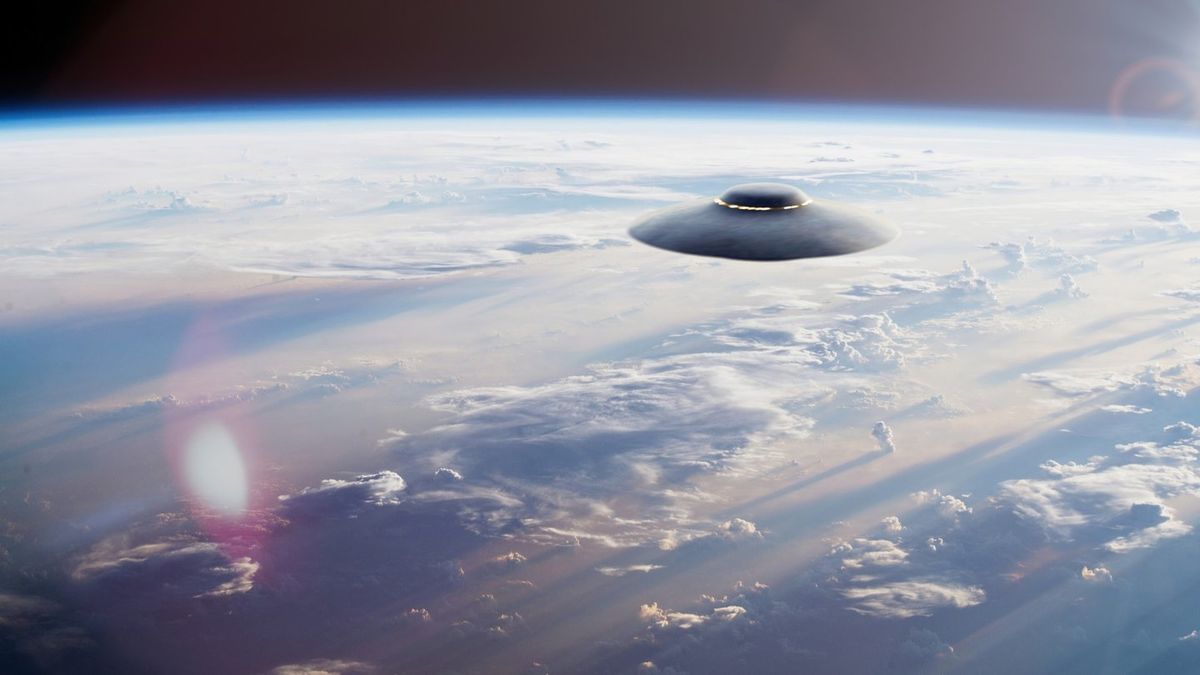
A scientist who theroized unusual space object 3I/ATLAS could have been an alien probe now reckons an extra-terrestrial breakthrough is on the horizon.
One of the most talked-about space stories of the past year centered on a puzzling interstellar comet that ripped through the inner solar system at remarkable speed, leaving many researchers debating what they were seeing.
Measurements showed it moving at over 41 miles per second — fast enough that the Sun couldn’t keep it bound by gravity like ordinary comets and asteroids.
Harvard astrophysicist Avi Loeb highlighted what he viewed as several odd features and argued that 3I/ATLAS might not be purely natural, even floating the possibility it could be a ‘hostile’ object or some kind of alien probe.
NASA and other scientific organizations, however, maintained that the simplest explanation fit best: a rare interstellar visitor. In that view, it was identified as the oldest interstellar comet ever observed and only the third such object detected to date, following 1I/Oumuamua in 2017 and 2I/Borisov in 2019.
On December 19, 3I/ATLAS reached its nearest point to Earth, but the distance — about 270 million kilometers — meant there was never any realistic chance of interaction.

Even after that uneventful flyby, Loeb continued entertaining the idea that the object could be unusual, and he publicly criticized NASA after it released what he described as ‘boring’ images of the comet-like body.
Now 3I/ATLAS is continuing its outbound path into deep space and is not expected to return. It’s forecast to pass Jupiter around March 16 as it departs the solar system for good.
Of course, that timeline only holds if it’s behaving like a normal interstellar comet — and not something capable of turning around by design.
In the wake of the debate, Loeb has gone further, making a wager that some form of confirmed alien visitation will occur within the next four years.
The bet is formal and hosted through Long Bets, where Loeb is matched against skeptic Michael B. Shermer, who says the opposite is far more likely.
Podcaster and author Sherman predicted: “The Discovery or disclosure of alien visitation to Earth in the form of UFOs, UAPs, or any other technological artifact or alien biological form, as confirmed by major scientific institutions and government agencies, will not happen by December 31, 2030.”
But Loeb argues: “The search for technological artifacts has just started in earnest in 2025 with the discovery of the anomalous interstellar object 3I/ATLAS, the launch of the Rubin Observatory and the construction of three Galileo Project Observatories.
“Given that there are billions of Earth-Sun analogs in the Milky-Way galaxy – most of which are billions of years older than the solar system, and that it will take less than a billion years for our Voyager spacecraft to cross the Milky-Way disk, we must engage in the scientific search for extraterrestrial technological artifacts.”
Loeb concludes: “It is better to be an optimist because life is sometimes a self-fulfilling prophecy. This is why I am engaged in the search with the hope that we will find a partner on our blind date with interstellar objects.”
The winner of the wager will direct $1,000 to the Galileo Project Foundation.
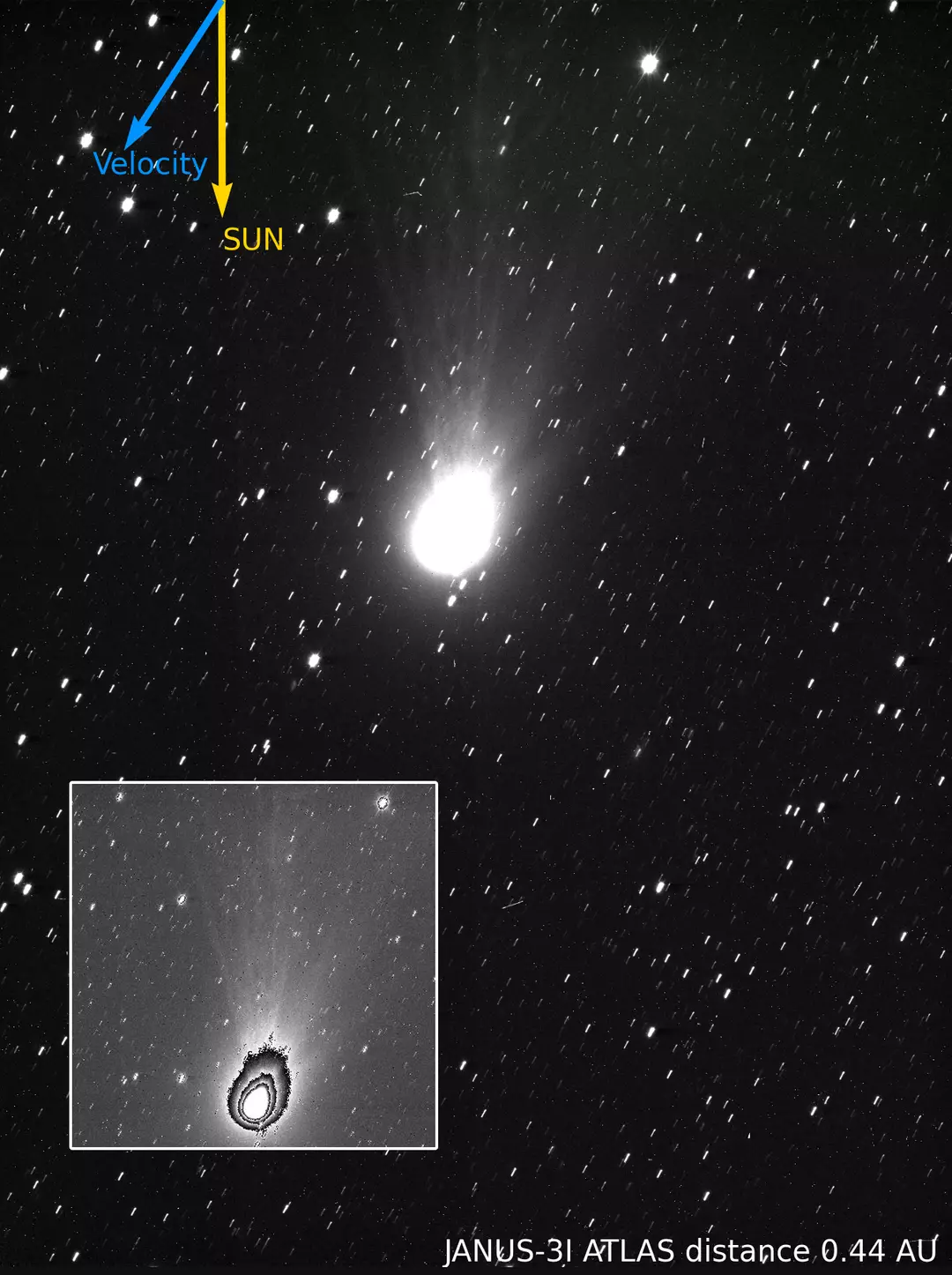
Attention around Loeb’s prediction has also coincided with newly released imagery from the European Space Agency (ESA), which published fresh photos of 3I/ATLAS captured by the JANUS camera aboard its Juice spacecraft — a mission heading to Jupiter to study the gas giant’s icy moons.
The new image shows the comet actively releasing dust and gas. Its small nucleus is embedded in a bright, cloudlike region called the coma.
“A long tail stretches away from the comet, and we see hints of rays, jets, streams and filaments,” the ESA explains.
The photo was taken on 6 November, a week after the object’s closest approach to the Sun.
At that moment, Juice was roughly 66 million km away from 3I/ATLAS.