

The bagel’s American story represents far more than just the evolution of a breakfast food—it is a window into the immigrant experience, labor rights, technology, and cultural assimilation that defines the nation itself. What began as a humble boiled bread brought by Eastern European Jews has transformed into one of America’s most recognizable and beloved staples, consumed by hundreds of millions annually across the country.

The bagel’s journey to America began in the 17th century in Poland, where it emerged within Jewish communities as a practical and durable food. According to historical records, the earliest documented mention of bagels appears in 1610 from the Jewish community of Krakow, where they were described as customary gifts for women after childbirth. This practice reflected the symbolic meaning embedded in the bagel’s circular shape—representing continuity, wholeness, and good fortune. The boiled-then-baked preparation method served practical purposes as well, creating a dense exterior crust that kept the bread fresher longer, an invaluable advantage before modern refrigeration.
As waves of Eastern European Jewish immigrants fled poverty and persecution in the late 19th century, they carried their bagel-making traditions across the Atlantic. Most settled in New York City, particularly on the Lower East Side, which quickly became the epicenter of American bagel culture. By 1900, over 70 bagel bakeries operated in that single neighborhood. Street vendors sold bagels stacked on poles or hung from strings—a practical design that not only allowed for easy transport and display but also explains why bagels have their distinctive hole in the center.
For decades, bagels remained largely confined to Jewish immigrant neighborhoods. As historian Matthew Goodman noted, “bagels existed in America for decades as a purely ethnic phenomenon, virtually unknown to society at large.” Outsiders rarely encountered them. The bread occupied its own cultural and geographic space, sold in small neighborhood bakeries and consumed primarily within the Jewish community.
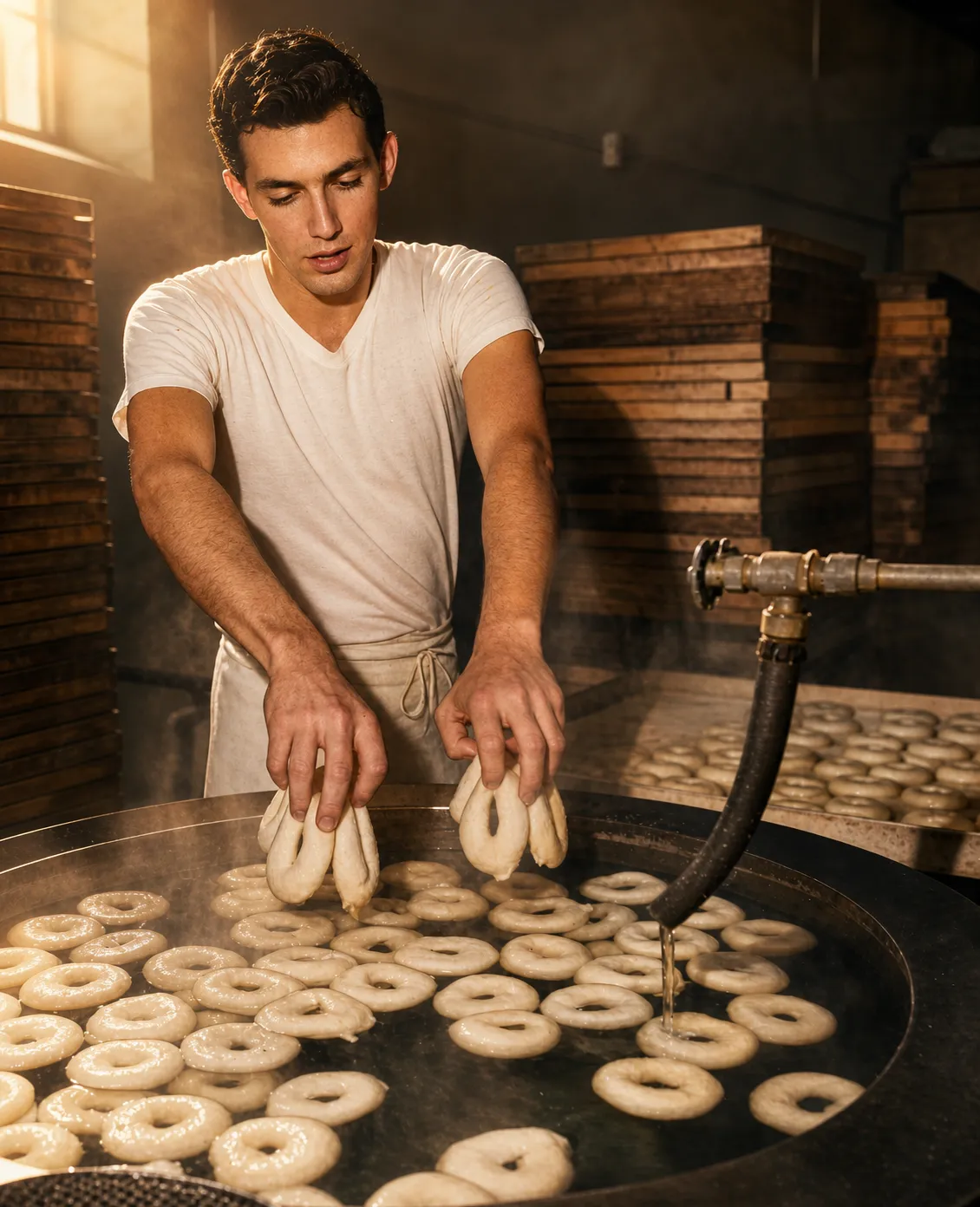
The bagel industry in New York became institutionalized and politicized through labor activism. In 1907, Jewish bagel bakers founded the International Beigel Bakers Union in an attempt to protect workers from exploitation and to standardize production. The union grew powerful, eventually controlling nearly every bagel produced in New York City. Bagel makers were considered elite artisans, with the union carefully guarding the secrets of their craft. Bakers would hand-roll dough, let it proof overnight, boil it in water sometimes infused with malt, and bake it in high-heat ovens. The complexity of the process meant workers specialized in single steps, and knowledge passed down through apprenticeships within families.
The transformation of bagels from ethnic specialty to American breakfast staple accelerated dramatically in the 1960s, driven by technological innovation. Murray Lender, who grew up working in his family’s Jewish bakery in New Haven, Connecticut, faced a common problem: uneven demand, with far fewer customers during weekdays but demand for thousands of bagels on weekends. In 1954, the Lenders pioneered frozen bagels by converting part of their garage to a storage freezer, allowing them to bake continuously and store product for peak times. This innovation revolutionized distribution possibilities.
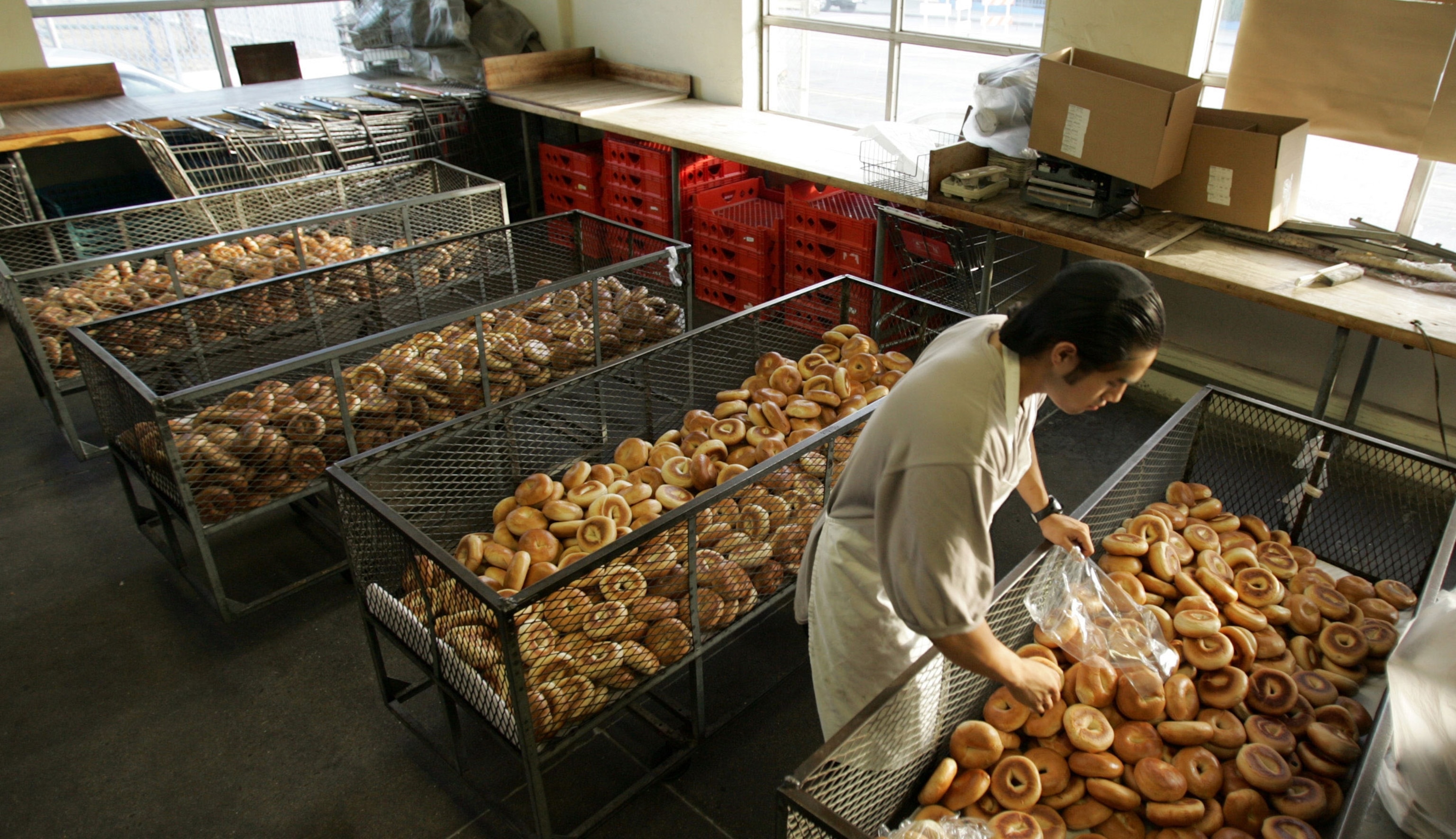
The introduction of automated bagel-making machines in the early 1960s further accelerated change. These machines could produce 200 to 400 bagels per hour, compared to the painstaking hand-rolled process. By 1965, bagels had become a phenomenon. The New York Daily News called them the “fastest-drawing bun in the yeast,” predicting they would soon take their place “alongside the hot dog and the pizza as an American delicacy.”
Yet this industrialization came with tradeoffs. As automated production took hold, boiling times were shortened, altered, or eliminated entirely. Dough was softened to speed manufacturing. Commercial ovens replaced traditional wood-fired ones. By 2003, bagels had tripled in size from their original two ounces. Mass-produced bagels became softer, fluffier, and less chewy than their predecessors—fundamentally altered products that retained the bagel’s form but not its character.
By 1987, bagels had entered mainstream American grocery stores and fast-food chains. By 1988, Americans were consuming an average of one bagel per month. Within five years, consumption had doubled to one every two weeks. The transformation accelerated further when chains like Dunkin’ Donuts added bagels to their menus in 1996, becoming the nation’s largest bagel retailer within two years.
The pairing of bagels with lox and cream cheese became iconic during this period. Food historians trace the combination to at least the early 20th century, when Jewish delis began selling preserved salmon using recipes from Scandinavian immigrants. For Jewish families living in crowded tenements without adequate cooking facilities or stoves, a bagel with lox from the local bakery became a convenient meal, particularly important on the Sabbath when observant families abstained from cooking.
Today, the numbers are staggering. In 2020 alone, 202 million Americans consumed bagels. Recent surveys indicate that over 61 percent of Americans eat bagels at least twice weekly for breakfast, with approximately 77 percent of the time bagels serving as the central component of the meal. The average American consumes nearly 39 bagels per year. New York and New Jersey remain the nation’s bagel strongholds, with average New Yorkers eating 111 bagels annually compared to the national average of 38.7.
Yet beneath the statistics lies a cultural tension. Some observers have criticized the mass-produced bagel as a symbol of assimilation and cultural erasure. A 2011 Time Magazine article lamented what it called the “American-ization of the bagel,” describing it as “a symbol of assimilation at any cost.” The once-chewy, dense, artisanal creation became pillowy soft and bland—transformed to appeal to broader American tastes but stripped of its Jewish heritage and connection to immigrant communities.
However, a new generation of bakers and consumers is rediscovering traditional bagel-making methods. From New York to Boston, Chicago to Tel Aviv, smaller bakeries are returning to hand-rolling, boiling, and authentic preparation techniques. The story of the bagel ultimately reflects something deeper about American immigration, labor, technology, and identity—a circular piece of boiled bread that carried the dreams and traditions of millions, transformed through American innovation, yet never entirely severed from its roots.