

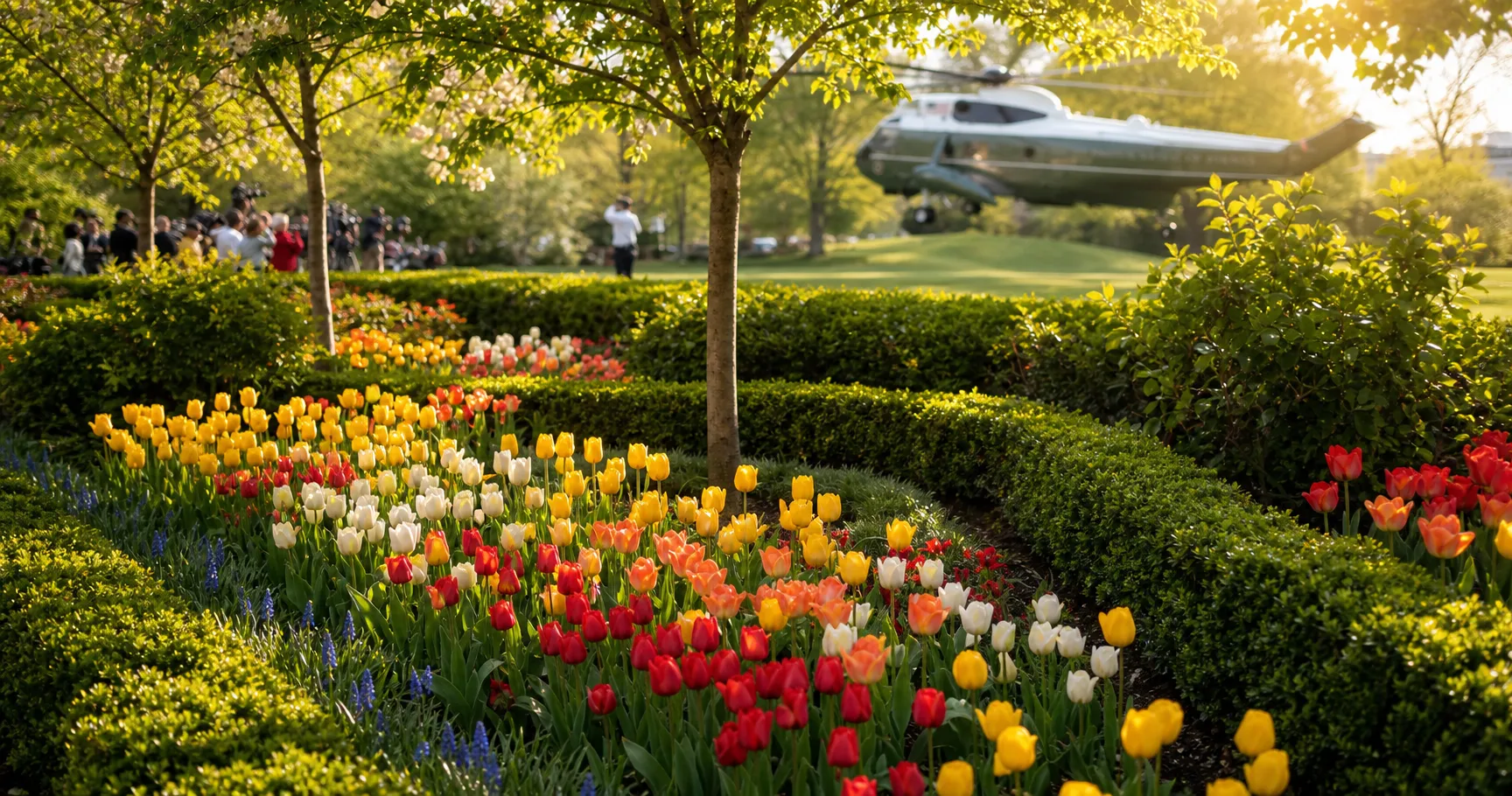

The White House Rose Garden, one of the nation’s most iconic outdoor spaces, has undergone a remarkable transformation over the past century, with each presidential administration leaving its own horticultural imprint on the celebrated grounds. From its establishment in 1913 to its latest renovation in 2025, the garden’s evolution reflects both changing tastes and the practical demands of maintaining one of the most visible symbols of American power.
The garden’s story began when President Woodrow Wilson’s wife, Ellen Louise Axson Wilson, worked with landscape architect George Burnap to establish the Rose Garden in 1913. The space replaced Edith Roosevelt’s Colonial Garden, which had been planted a decade earlier. Before that, greenhouses had occupied the area. Ellen Wilson’s vision transformed the spot into a dedicated rose garden, a decision that would ultimately define the space for over a century.
The original design remained largely unchanged for nearly fifty years. In 1935, President Franklin D. Roosevelt commissioned landscape architect Frederick Law Olmsted Jr. To redesign portions of the garden and add cast iron furniture pieces. The changes were relatively modest, preserving the essential character of Ellen Wilson’s creation while making the space feel more open and airy.
The most significant transformation came in 1961, when President John F. Kennedy and his wife Jacqueline Kennedy envisioned something grander. Drawing inspiration from European gardens they had seen during a state visit to France, the Kennedys brought in their friend Rachel “Bunny” Mellon to oversee a comprehensive redesign. Mellon, a horticulture expert, worked with landscape architect Perry Wheeler and White House Head Gardener Irwin Williams to create what they called an “outdoor room” designed for press conferences, meetings with dignitaries, and ceremonial events.
The new Kennedy-era design featured an expansive central lawn inspired by the croquet scene in Lewis Carroll’s “Alice in Wonderland.” Magnolia trees anchored the four corners, while roses interplanted with culinary herbs, spring-blooming bulbs, seasonal annuals, and young Katherine crabapple trees flanked the lawn in twelve-foot-deep borders. The design emphasized French formal garden styling while showcasing American botanical specimens. This classic aesthetic, with its palette of pale pink and white tones, remained the dominant design for the next fifty-nine years.
For decades, while individual plantings changed seasonally according to presidential preferences, the fundamental layout established by Mellon remained constant. Rose varieties included ‘Queen Elizabeth’ grandifloras and hybrid tea roses with names like ‘Pascali’, ‘Pat Nixon’, and ‘King’s Ransom’. Spring brought bulbs such as tulips, daffodils, and grape hyacinths. Summer annuals changed nearly yearly, while fall contributed chrysanthemums and flowering kale.
However, by the early 2000s, the aging garden faced mounting challenges. The crabapple trees, which had thrived for decades, began to fail. In 2003, some trees were removed to allow more sunlight to reach struggling roses. As years passed, the trees’ expanding root systems made it difficult to plant annuals without disturbing them. The boxwood shrubs bordering the flower beds became threatened by boxwood blight disease. Most troubling was the lawn itself, which suffered from poor drainage and required annual replacement. The once-thriving rose bushes dwindled dramatically, to the point where only about a dozen remained.
When First Lady Melania Trump began planning a renovation in 2019, the assessment was clear: the garden needed comprehensive intervention. In August 2020, she commissioned two architectural firms—Perry Guillot Inc. Of Southampton, New York, and Oehme van Sweden & Associates of Washington, D.C.—along with the Committee for the Preservation of the White House and the National Park Service, to address the garden’s structural and horticultural problems.
The 2020 renovation aimed to restore the garden to its iconic 1962 Kennedy-era aesthetic while incorporating modern infrastructure. Workers removed and relocated the remaining crabapple trees and replaced the dwindling plantings with over 200 new rose bushes, a dramatic increase from the roughly dozen that had survived. New plantings included pastel-colored varieties such as the “White House Rose,” the cream-colored “JFK Rose,” the “Pope John Paul II Rose,” and the “Peace Rose.” The team also upgraded critical infrastructure, adding electricity for televised events and laying new limestone walkways thirty-six inches wide to comply with the Americans with Disabilities Act.
The new blight-resistant boxwood varieties replaced the susceptible ones that had failed. The project drew mixed reactions. Some criticized it as sterile and lifeless, with presidential historian Michael Beschloss calling it an “evisceration” of the garden. Others, including the outlet, praised it as “long overdue,” noting that the renovation had allowed roses to thrive where they had previously struggled.
By 2025, the Rose Garden underwent yet another transformation. President Donald Trump had the central lawn paved over with white limestone tiles arranged in a diamond pattern, sourced from Indiana limestone quarries. He added solar-powered lighting, tables, umbrellas, and bronze statues of George Washington, Benjamin Franklin, and Alexander Hamilton. Trump dubbed the new space the “Rose Garden Club,” hosting dinners and describing it as a gathering place for senators, congresspeople, and Washington leaders. On the perimeter, the roses continue to bloom.
From Ellen Wilson’s original vision to today’s reimagined space, the Rose Garden has evolved from a simple flower garden into a multifunctional venue that serves simultaneously as a botanical display, a ceremonial stage, and a reflection of presidential taste. Through renovations spanning a century, the garden has remained central to American political life, hosting countless significant moments while its plantings have adapted to the demands of climate, disease, and the changing needs of the modern presidency.