

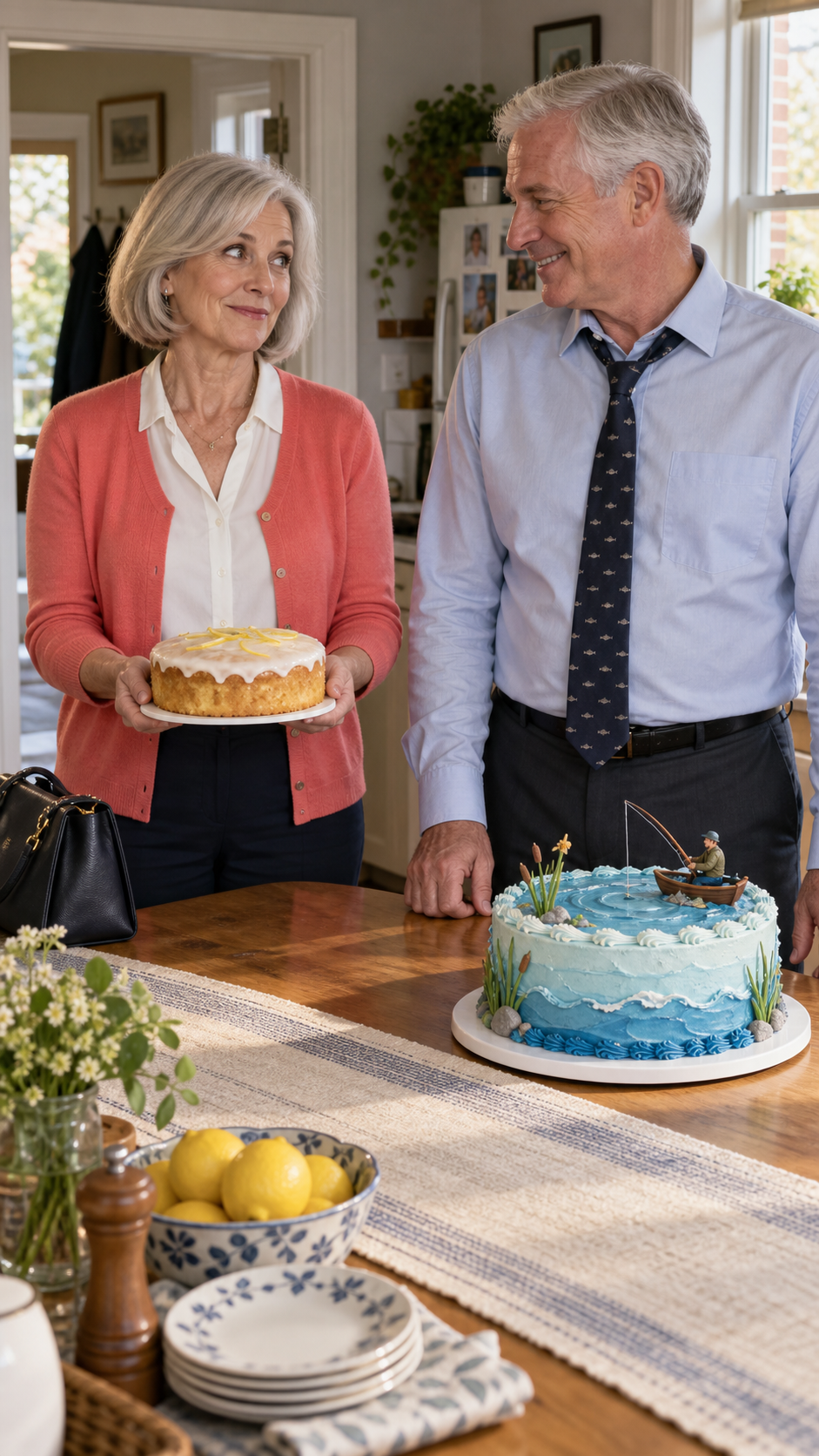
Martin put his retirement cake in the middle of the kitchen table. It had his name in blue icing and a small plastic fishing rod leaning against the lettering.
Thirty-eight years at the same company. There had been speeches, a watch and a photograph of everyone gathered around his desk.
“Finally retired,” he said.
Helen set a smaller cake beside his.
“So have I.”
Martin laughed. “From what? You don’t have a job.”
She picked up her handbag.
“You’ll find out at six.”
The front door closed before he decided whether she was joking.
At six, Martin opened the fridge.
There was food in it. That was the first thing he would admit later. This was not a story about an empty refrigerator or a wife secretly throwing away the dinner ingredients. There were eggs, chicken, vegetables, yesterday’s soup and a note on a container telling him when it had been opened.
There was simply no dinner.
He called Helen. She answered over the sound of people talking.
“Where are you?”
“At the restaurant with June and Anita.”
“Are you eating there?”
“Yes.”
He waited for the rest of the answer.
Helen let him wait.
“What am I supposed to do?” he asked finally.
There was a small pause.
“What I’ve done most evenings for thirty-four years. Decide.”
Martin looked at the open fridge. He nearly said that she could have told him. Then he remembered the cake.
Helen had worked at a travel agency before their second child was born. They had agreed she would stay home while the children were small. When she talked about returning to paid work, Martin’s mother needed help after a fall. Then the school hours didn’t match the available jobs. Then his travel increased.
There had always been a reason to leave things as they were.
Martin had brought home the larger income. Helen had kept their lives running around it. Somewhere along the way, the first fact became something he mentioned proudly, and the second became something he stopped noticing.
He made an omelet. It stuck to the pan. He ate it anyway.
That could have been the whole evening. He was perfectly capable of feeding himself. What unsettled him was what happened afterward.
Their daughter called to ask whether the spare school uniform was still at their house. Their grandson had outgrown the one in his bag.
“I don’t know,” Martin said. “Ask your mother.”
“She said you’re home now. Could you check?”
He opened three cupboards before finding it in a labeled basket in the utility room.
Then his sister sent a message about their aunt’s birthday lunch. Was the table booked? Had anyone checked whether the restaurant had a step at the entrance?
Martin started typing Helen’s name into the reply.
He stopped.
Beside the kettle lay a notebook he had seen hundreds of times. Usually it was under Helen’s elbow while she drank her morning tea. He opened it.
It was not a dramatic invoice for the entire marriage. It was an ordinary week.
Call plumber again. Check prescription delivery for Aunt May. Find replacement school trousers. Cancel old insurance renewal. Ask June about Friday. Order filter. Ring garage before ten.
Some items were crossed out. Others had arrows pointing to another day. Beside the restaurant booking was a note: side entrance has ramp — confirm unlocked.
He turned back a page. Then another.
For years he had thought Helen remembered things. He was beginning to see how much work went into making that look effortless.
When she came home, he was still sitting at the table.
“I found your notebook.”
“I wondered when you would.”
“I can help with all this.”
Helen put down her bag, but she didn’t sit.
“Help whom?”
He frowned.
“You live here, Martin. They’re your children, too. Your aunt. Your dirty towels. I don’t want to spend retirement handing you little jobs and checking whether you’ve done them.”
“I didn’t mean—”
“I know what you meant.” She pulled out a chair. “That’s what I want us to change.”
He looked at the two cakes. Hers was plain lemon, still in its cardboard tray. She had bought it herself on the way home from taking their grandson to the dentist.
“Were you angry this morning?”
“Yes.”
“How long?”
Helen considered the question.
“Not every day. Not all the time. But long enough that I didn’t want to make another joke about it.”
He nodded slowly.
There were things about their marriage she liked. He made her laugh. He had sat beside her through frightening appointments without once telling her not to worry. He loved their children. She wasn’t laying those things on one side of a scale to prove they counted for nothing.
She wanted the years ahead to feel different from the ones she had been expected to organize for everybody else.
“I want Tuesdays,” she said.
“What happens on Tuesdays?”
“A pottery class. I’ve been looking at it for two years.”
“Then book it.”
“I have. I’m telling you because school pickup needs sorting. I’m not asking whether I can go.”
Martin picked up a pen.
They stayed at the table for an hour. They didn’t divide the notebook into jobs Helen would still have to explain every morning. They chose whole responsibilities.
Martin would own the shopping and dinner on three weekdays: noticing what was missing, planning, buying, cooking and clearing up. He would handle his aunt’s appointments and birthday arrangements. They would agree on childcare before either of them promised their time.
Helen would keep some responsibilities she preferred, and they would revisit the arrangement after a month. Nothing about the conversation made them suddenly experts at being fair.
The following Tuesday, Martin forgot the shopping bags. He bought too many potatoes. He called the school to check the pickup entrance himself instead of interrupting Helen’s class.
At six, she came home with clay under her nails.
There was a saucepan on the stove and a wet tea towel on the floor. Their grandson was setting out forks.
“How was it?” Martin asked.
Helen took out her phone and showed him a bowl with one side much higher than the other.
“That’s excellent,” he said.
“It’s dreadful. I’m going back next week.”
After dinner, he cut the last slices of the retirement cakes. The blue icing had stained the knife.
He put the larger slice of lemon cake on her plate.
“What?” she asked, noticing him looking at her.
“I should have bought yours.”
Helen took a bite.
“Yes,” she said. “You should.”
Then she passed him the notebook. His aunt’s birthday was on Saturday, and there was a restaurant he needed to call.