

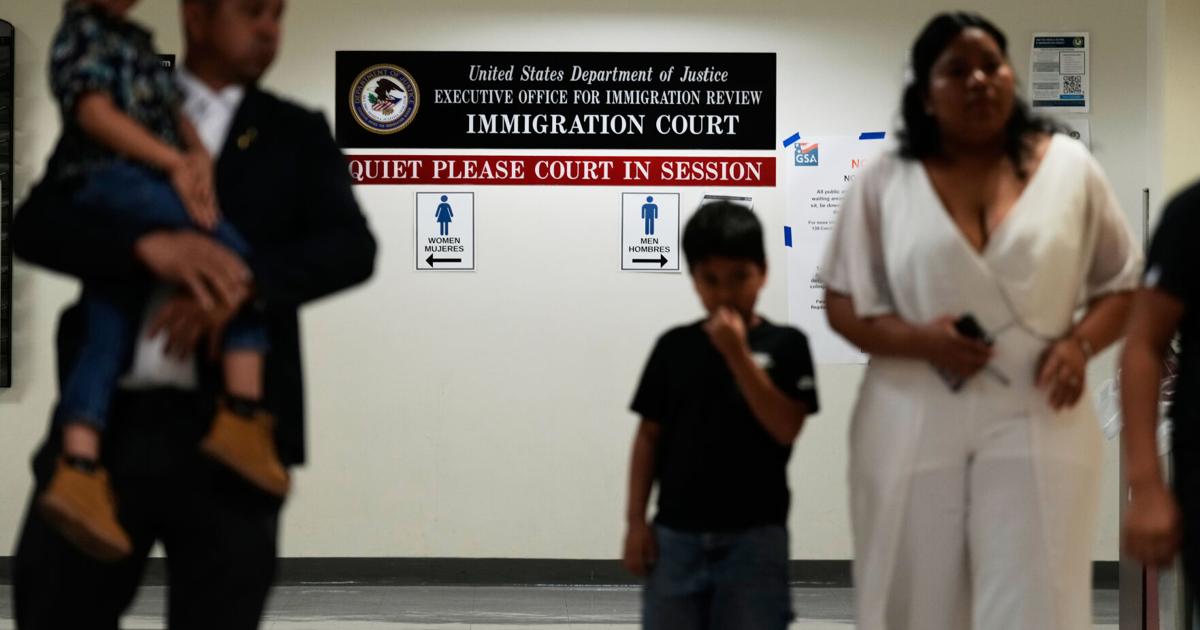
Immigration courts across the United States are moving at a breakneck pace that is dramatically driving up the number of deportation orders, even as the system struggles to keep up with the volume of cases, according to new data released this week.
The Trump administration is packing immigration courtrooms and reducing the time given to immigrants to prepare for hearings in an effort to clear a decades-long backlog. The result is a historic rise in people missing court dates and being immediately ordered deported, with more immigrants appearing in court without legal representation or proper notice of their proceedings.
So-called “mega” master hearings, where dozens or even hundreds of immigrants’ cases are assigned to individual judges in a single day, have skyrocketed. More than 1,300 such hearings were held in June alone, nearly tripling the number from June of the previous year. The courts define a “mega” day as when a judge has more than 50 cases scheduled.
The acceleration in court activity is producing striking numbers. In January 2025 when the second Trump administration began, approximately 33,000 deportation orders were issued nationwide. By June of this year, that number had jumped to nearly 79,000, according to data analyzed by Mobile Pathways, a nonprofit organization that tracks immigration court records.
Simultaneously, the rate at which immigrants are missing scheduled hearings has doubled. At the start of the Trump administration in January 2025, roughly 20 percent of people nationwide missed their scheduled immigration court hearings. As notice times for hearings have shrunk dramatically, that figure doubled to 40 percent by June, according to Mobile Pathways.
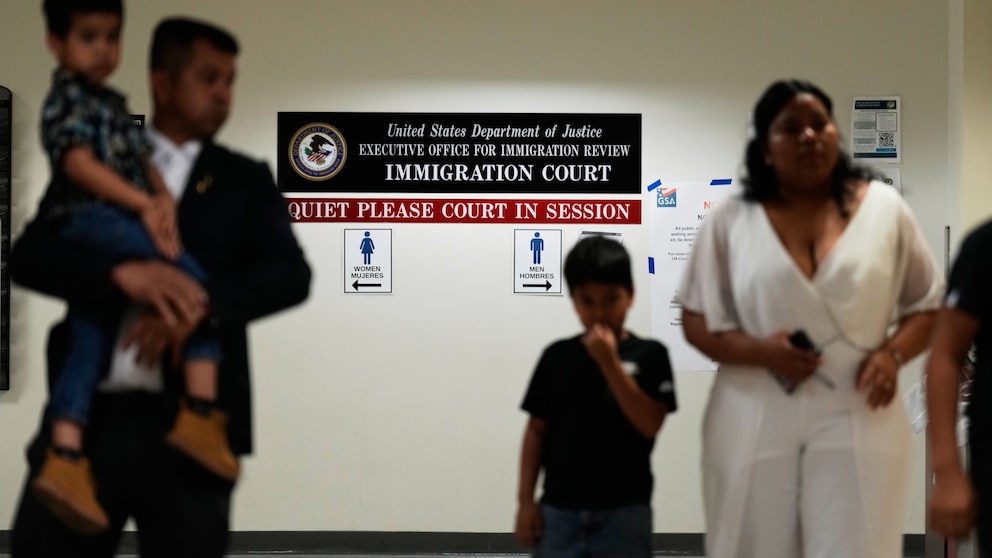
The compressed timelines have created chaotic scenes in courthouses. At the Harlingen, Texas immigration court on mega hearing days, immigrants must wait outside in hot, crowded conditions for over an hour until the lobby can accommodate another wave of people. Adults attending hearings are often accompanied by relatives and attorneys, while detained children arrive with shelter case managers and legal advocates.
One Chicago immigration attorney reported that some individuals have been issued deportation orders while physically inside the Chicago immigration court building but confused about where to go for their hearing. According to Alex McGriff, an attorney for the National Immigrant Justice Center, the court ordered them removed despite the fact that they were not absent.
In one documented case, a man with a fractured leg confined to a wheelchair, who was unable to travel from Illinois to Seattle for a mega master hearing, was issued a removal order by the court despite his documented injury.
Veteran immigration attorney Jaime Diez, based in Brownsville, Texas, recently had nearly 20 cases called in a single day—nearly 10 times his previously normal pace. “Due process is being thrown out of the window,” Diez said, standing outside a courtroom with a six-inch thick file for one client. “It’s very worrisome, I don’t know how long it’s going to last.”
The accelerated schedule is creating severe hardships for legal representatives of immigrants. Attorneys representing immigrants are struggling to keep up as their own caseloads intensify. Many are unable to adequately prepare cases, gather evidence, or prepare clients for testimony under such compressed timeframes.
The situation is particularly concerning because only about 21.5 percent of immigrants, including unaccompanied children, had an attorney to assist them in immigration court cases when removal orders were issued in June 2026, according to case records.
In June 2026 alone, immigration judges issued removal orders in 87.1 percent of all completed deportation cases, with many of those orders coming in the chaotic mega master hearings. Organizations tracking the system argue that the combination of shortened notice periods and packed hearing blocks creates a schedule designed to prevent people from having their cases heard fairly.
The Trump administration and the Justice Department’s Executive Office for Immigration Review say the aggressive scheduling is necessary and justified. A Justice Department statement noted that judges are adjusting their schedules to resolve cases more quickly while maintaining fairness and lawfulness. The department said that court delays harm immigrants who have valid claims and that the public interest is served when the government deports people without legal grounds to remain.
Supporters of the accelerated approach argue it is an effective strategy for managing the backlog. A fellow at the Center for Immigration Studies said the strategy “really is economizing the judge’s time” and “is increasing the number of final orders that are going out, so that’s decreasing the backlog entirely.” The immigration court backlog, which grew significantly during the Biden administration, has decreased for the first time in at least a decade.
However, critics and immigration advocates warn that prioritizing speed over process creates serious due process concerns. They point out that reduced notice times leave immigrants with insufficient opportunity to secure legal representation, gather necessary documentation, or properly prepare their defense. Many immigrants waiting years for a hearing suddenly find themselves in court with little warning.
The underlying challenge facing the immigration court system remains fundamental: there are simply not enough immigration judges and court resources to handle the massive caseload. As of June 2026, more than 3.1 million cases were pending before immigration courts nationwide. Immigration judges face enormous pressure to move cases quickly, and some have expressed concerns about the politicization of the courts as judges are evaluated based on their completion rates rather than the quality or fairness of their decisions.