

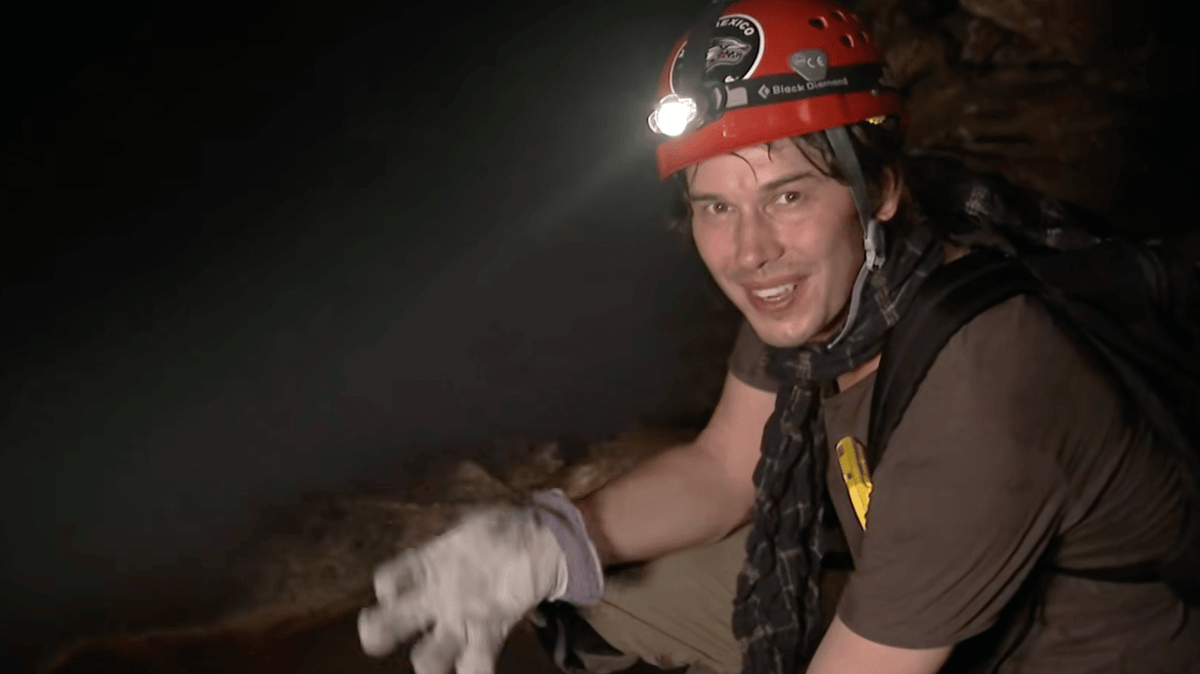
Professor Brian Cox has shared footage from inside a perilous cave — and it’s probably not one to add to your travel wishlist.
Known for heading off the beaten path, Cox has explored plenty of unusual locations over the years, but this ranks among the most unnerving.
Typically, the physicist uses his journeys to make big scientific ideas feel accessible, whether that’s explaining cosmic scales or demonstrating concepts like the speed of light.
This time, though, the setting itself is actively unfriendly to human visitors.
In Tabasco, Mexico, Cox ventured into the shadowy and fascinating Cueva de Villa Luz — a name commonly translated as “the cave of the house of light.”
Caves can be intimidating at the best of times, but this one adds a far more serious hazard: toxic gases and bacteria that make entering it a genuine risk.

Yet for life adapted to extremes — including the cave’s pink fish and single-celled microbes nicknamed “Snottites” — it functions as a surprisingly active ecosystem.
Cox documented the experience for BBC Earth Science as part of Wonders Of The Solar System, illustrating how the cave challenges the humans working inside it while sustaining the organisms around them.
He described it as ‘the definition of a hostile environment’ because it’s ‘full of hydrogen sulfide gas’ — a colorless, highly flammable gas that’s often recognized by its distinctive rotten-egg smell.
Because of the gas, Cox explained that the team had to take precautions: shielding equipment that could be damaged by the acidic conditions, wearing masks, and using a monitor to track where concentrations were higher or lower.
Hydrogen sulfide exposure can cause a range of symptoms. The Illinois Department of Public Health lists ‘fatigue, loss of appetite, headaches, irritability, poor memory and dizziness’ among possible effects.
At higher concentrations, it can be deadly in only a couple of breaths.
Unlike Cox and the crew, however, the Snottites he was keen to observe are perfectly suited to this environment — not just surviving in it, but flourishing.
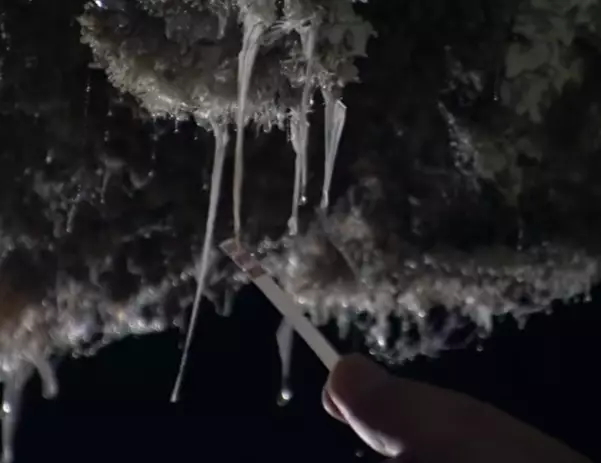
Cox said the ‘guys breathe in hydrogen sulfide and oxygen and produce sulfuric acid’, which is how they earned the name ‘Snottites’.
That sulfuric acid becomes a metabolic byproduct, forming thick biofilms that coat the cave walls in a snot-like layer and speed up the corrosion of limestone.
And it isn’t just rock that can be affected — it can damage skin as well, making it a very good idea to keep hands well away from the residue.
“One type of biofilm, called a snottite because of its appearance, has a pH of zero or one,” said Daniel S. Jones, graduate student in geosciences told Penn State University. “This is very, very acidic.”
Still, Cox appeared unfazed. He handled a pH test strip with his bare hand, dabbed the biofilm, and noted that it was as ‘strong as battery acid’, describing the Snottites as a kind of ‘strange organism’.
That might be putting it mildly.