

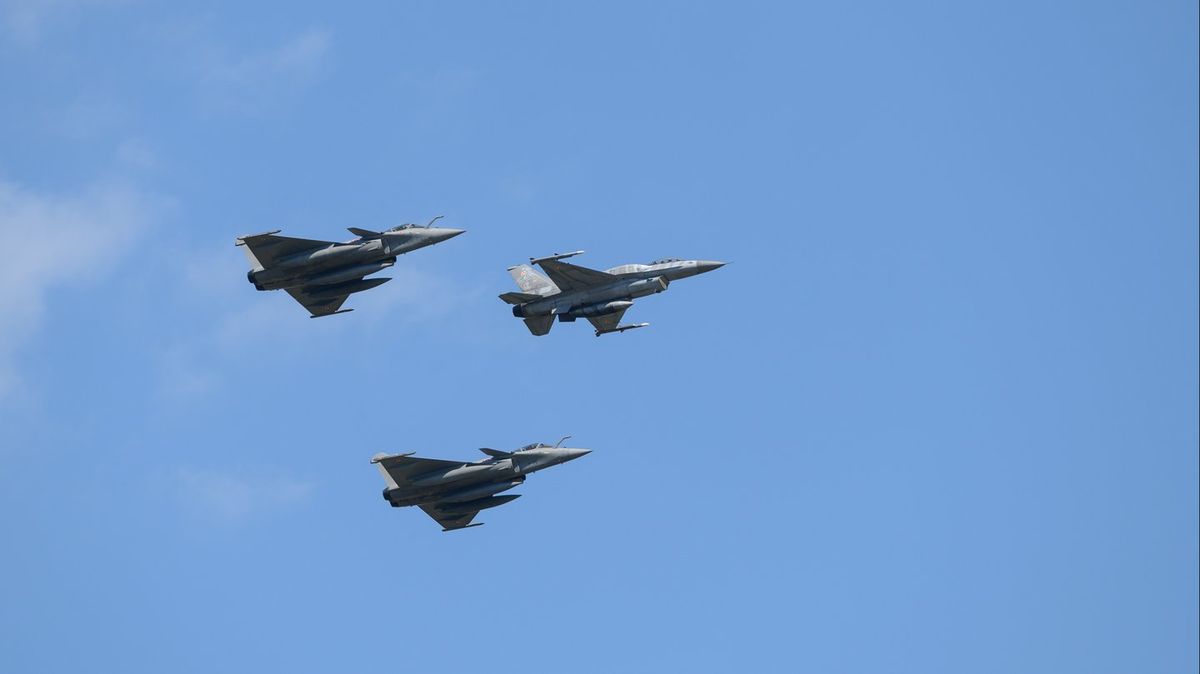
NATO launched fighter jets on Monday to identify and shadow Russian bombers operating close to allied airspace.
Aircraft were sent over the Baltic Sea earlier this week after a group of Russian planes was detected flying in international airspace but near NATO-managed skies, prompting an interception and tracking mission.
French Rafale fighters assigned to NATO’s Baltic Air Policing operation took part, alongside aircraft from Sweden, Finland, Poland, Denmark and Romania.
The Rafales flew from Lithuania, where they are based as part of NATO’s longstanding air-policing presence in the region.
Officials said the Russian formation included two supersonic Tu-22M3 bombers, supported by roughly 10 escort fighters, including Su-30s and Su-35s, which reportedly alternated their protective roles around the larger aircraft.

In a statement, Russia’s Defense Ministry said escort responsibilities were rotated among the accompanying aircraft while they supported the strategic bombers during the flight.
The ministry said the long-range mission had been scheduled in advance and was carried out over international waters in the Baltic Sea, adding on Telegram that the operation lasted more than four hours.
“At certain stages of the route, the long-range bombers were accompanied by fighters of foreign states,” the ministry said, per CBS News. “Crews of long-range aviation regularly conduct flights over the neutral waters of the Arctic, the North Atlantic, the Pacific Ocean, as well as the Baltic and Black Seas. All flights of Russian Aerospace Forces aircraft are carried out in strict compliance with international rules for the use of airspace.”
The ministry has previously announced similar bomber flights over the Baltic, including an operation in January that also drew a NATO response, along with multiple reported flights last year.

NATO frequently dispatches jets to intercept and identify Russian military aircraft when they approach or operate near allied airspace. The alliance says these flights are often conducted without transponders active, without contact with air traffic control, or without filed flight plans, which can trigger NATO identification sorties.
A significant share of the flights monitored under NATO’s Baltic Air Policing mission—created in 2004 after Lithuania, Latvia and Estonia joined the alliance—are linked to routes to and from Russia’s Kaliningrad exclave. Prior to the war in Ukraine, NATO was conducting roughly 300 such intercepts annually, mostly over waters in northern Europe.
Monday’s activity comes amid a broader run of recent Russian military operations above and below the Baltic Sea. In recent years, the region has also seen repeated reports of suspected Russian sabotage targeting undersea cables.