

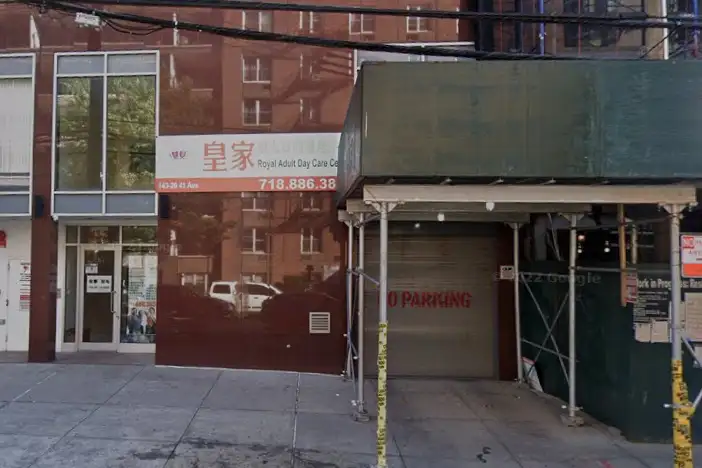
In the heart of Flushing, Queens, an intricate web of deceit targeting elderly Medicare and Medicaid recipients has cost the government roughly $120 million over a decade, federal prosecutors say. The scheme centered on social adult day care centers and pharmacies that exploited vulnerable seniors with cash bribes while billing the government for services that were never provided or billed for patients who never attended.
In February 2026, federal authorities unsealed charges against Inwoo Kim, 42, and Daniel Lee, 56, both of Flushing, accusing them of operating an elaborate fraud that ran from 2016 through 2026. Kim owned a pharmacy and two social adult day care centers operating as Royal Adult Daycare and Happy Life Inc., while Lee served as program director at Happy Life. The pair faces charges of conspiracy to commit health care fraud, each carrying a maximum 10-year prison sentence.
The mechanics of the scheme were brazenly simple. Kim and Lee allegedly paid illegal cash kickbacks and supermarket gift certificates to elderly Medicaid and Medicare recipients to lure them into enrolling at the day care centers and filling prescriptions at Kim’s pharmacy. Text message evidence reveals the coordinated nature of the crimes. Kim wrote to a co-conspirator, “Please give the $10,000 to the Korean members first.” Lee texted a co-conspirator, “I gave the payment,” and in another message, “I left the envelope [for a patient] with Tony [Kim].”
The pair then submitted fraudulent claims to the government for services that were never rendered. One particularly egregious example emerged during the investigation: on a single day in August 2022, Royal Adult Daycare billed Medicaid for services provided to approximately 1,041 people, despite having a certificate of occupancy allowing only 81 people in the facility. The submitted claims far exceeded what the buildings could physically accommodate, a mathematical impossibility that should have triggered immediate red flags.
Medicaid paid Kim’s day care businesses $62 million during the decade-long scheme, while Medicare paid his pharmacy $58 million for prescription drugs. The defendants withdrew significant cash from bank accounts they controlled to fund the ongoing bribery operation. When investigators examined sign-in sheets at the facilities, they discovered evidence of pre-filled dates and what appeared to be the same handwriting used for numerous patient names. Some sheets purportedly documented services provided on Sundays when Royal was closed.
The fraud unraveling began when some of the bribed seniors, upon reflection, reported the suspicious activity to authorities. Investigators initially received tips from New Yorkers who questioned the legitimacy of receiving cash in exchange for using the day care centers.
The Queens case represents just one prominent example of a much broader crisis in New York’s social adult day care industry. The program itself was added to Medicaid coverage in 2014 and expanded rapidly. Between January 2019 and October 2024, Medicaid made $2.4 billion in payments to social adult day care centers. The epicenter of this growth is Flushing, where 64 such facilities operate within a single mile, the densest concentration in the nation.
Federal authorities have grown alarmed by the speed and scale of expansion. Federal investigators are examining whether the rapid proliferation of centers across New York indicates systemic fraud. In a separate case from January 2026, two women pleaded guilty to roles in a $68 million fraud scheme involving kickbacks and bribes used to steer Medicaid recipients to Brooklyn-based social adult day care centers and home health care companies.
Dr. Mehmet Oz, administrator of the Centers for Medicare and Medicaid Services, has expressed serious concerns about the pattern. “It begs the question: How many social adult daycare centers do you need?” he told reporters when discussing the concentration of facilities in single neighborhoods. His office has begun investigating across New York whether the rapid spread of centers catering to seniors is indicative of fraud.
Recent investigations have revealed facilities billing Medicaid for thousands of patients they cannot possibly serve. In one case, a facility with a maximum capacity of 323 people allegedly served 530 members on a single day. Independent journalist investigations in July 2026 uncovered over $190 million in additional fraudulent Medicaid and Medicare billing from adult senior daycare centers in Flushing alone, examining public billing data combined with on-the-ground confrontations with facility operators.
A broader audit by the New York State Comptroller’s Office identified over $285 million in questionable payments made to social adult day care centers. Most troubling, the audit found that $28.6 million was paid to facilities that had already been terminated from care networks specifically because of fraud, waste, and abuse. In some cases, when one insurance plan terminated a facility for fraud, other plans simply continued to pay it.
The targeting of specific immigrant communities has also drawn attention. Prosecutors documented that fraudsters specifically target insular communities—Korean-Americans in Flushing, Bangladeshi-Americans in Brooklyn—where social pressure and cash payments can persuade seniors to participate in schemes they may not fully understand.
Experts have identified systemic vulnerabilities that enabled the fraud to flourish. As the number of social adult day care centers grew rapidly across New York City, regulatory capacity failed to keep pace. Centers opened and began billing before proper inspections were completed. Multiple agencies—Medicaid managed long-term care plans, the state Department of Health, and federal agencies—hold partial oversight responsibility, creating gaps that sophisticated fraudsters exploited.
The New York State Department of Health said it has taken action to root out abuses, including instituting new tracking processes and enhanced oversight. Since 2021, the agency has referred 387 centers for investigation, with one-third elevated to the Office of the Attorney General for law enforcement action. Still, the scale of fraud suggests enforcement efforts have struggled to keep pace with the problem.