

Dr. Bill Kimberlin, a clinical psychologist who has witnessed nearly 500 executions, is speaking out about the warning signs that precede botched lethal injections.
Kimberlin, who has spent decades observing death row procedures across the United States, says the failed execution of Christa Pike on September 30 displayed the same red flags he has catalogued throughout his career. Pike, who spent three decades on Tennessee’s death row for the 1995 murder of fellow student Colleen Slemmer, was administered two doses of pentobarbital but survived and was rushed to a hospital for what officials called “life-saving care.”

The psychologist said that uncertainty among execution staff is his primary indicator that a procedure may go wrong. “I will first look for the ‘un-certainty’ in the eyes of anyone involved in the actual process,” he says. “If you have ever seen emergency room physicians at work during a crisis along with the nursing staff and everyone involved, they move around with a purpose. They are precise with everything they say and do.”
Kimberlin draws a sharp contrast between competent medical crisis teams and execution personnel. “They may not feel as though they are in control, but an outside observer would see that they are,” he continues, describing how emergency room staff operate. During the first botched execution he ever witnessed, he noticed that guards and EMTs “were very uncertain in their body language and movements.” That procedure stretched to nearly two hours, with staff so unprepared that the condemned man had to get off the gurney to use the restroom before returning to be killed.
The psychologist’s most striking observation concerns what he calls the masking of violence. During the last execution he witnessed that went according to plan, Kimberlin said, “I did not see as much wavering among the staff.” Yet he immediately qualifies this: “This does not mean the execution was flawless by any means. It just means the state did their job by masking the effects of taking the life of a living human being to the point of where it appears to be peaceful and humane.”

Pike’s survival has drawn national attention partly because of the drug involved. While many states use a three-drug cocktail for lethal injections, Tennessee employed pentobarbital alone. According to the Death Penalty Information Centre, approximately 7.2 percent of lethal injection executions were botched between 1890 and 2010. Kimberlin argues the true risk is universal. “In my professional opinion, for what it’s worth, every single lethal injection scheduled to execute a human being has the potential of becoming botched and ending very badly for everyone involved,” he says. “This includes the family members of the victims who were never told that something like this would ever occur. Executions by lethal injections have the signs of becoming ‘botched’ before they begin.”
The fallout from Pike’s failed execution has hit victim’s family members particularly hard. Colleen Slemmer’s mother traveled to Tennessee expecting to witness what she believed would be justice for her daughter’s murder. Slemmer’s niece, Morgan Seeley, told WLTV: “She [Slemmer’s mother] went in there thinking that justice was going to get served, and then, of course, Christa didn’t die. You had 31 years to make sure you guys got everything in order for this day to happen. And for that to stop, it’s just a slap in the face, honestly.”
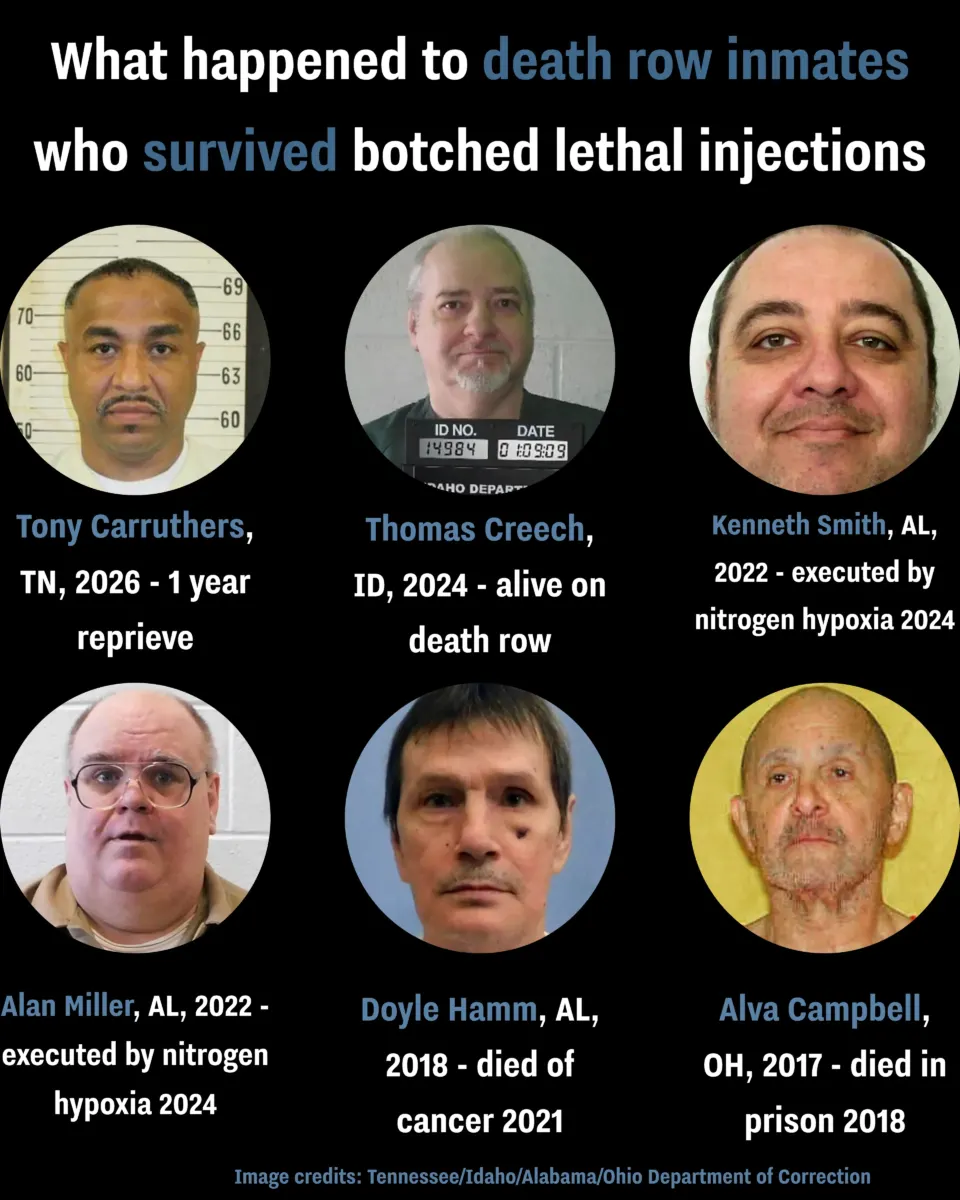
Pike has since regained consciousness and is able to speak, according to her lawyers, though she was described as “angry and confused about everything” in the immediate aftermath. The Tennessee Department of Correction has defended its handling of the procedure. “The Tennessee Department of Correction followed every step of the State’s lawful, established execution protocol approved by the Attorney General’s Office,” a spokesperson said shortly after the failed attempt. “The lethal injection chemical in the protocol has consistently been effective, and the protocol does not allow for additional procedures beyond what was carried out this evening. Christa Pike has been transported to an off-site medical facility.”
Kimberlin, who has now watched more executions than almost any private citizen in American history, maintains that each one haunts him equally. “Each execution is different and all are horrible to watch, in my opinion,” he says.
Pike was convicted of the 1995 torture and murder of 19-year-old Colleen Slemmer, a fellow Job Corps student in Knoxville. Prosecutors said Pike, then 18, and an accomplice lured Slemmer to a remote spot, where Pike attacked her with a box cutter and a piece of asphalt over the course of 30 minutes, partially because she believed Slemmer was trying to steal her boyfriend. Pike was sentenced to death in 1996 and has been Tennessee’s only female death row inmate for nearly three decades.
Tennessee officials have not announced whether they will attempt to reschedule Pike’s execution.