

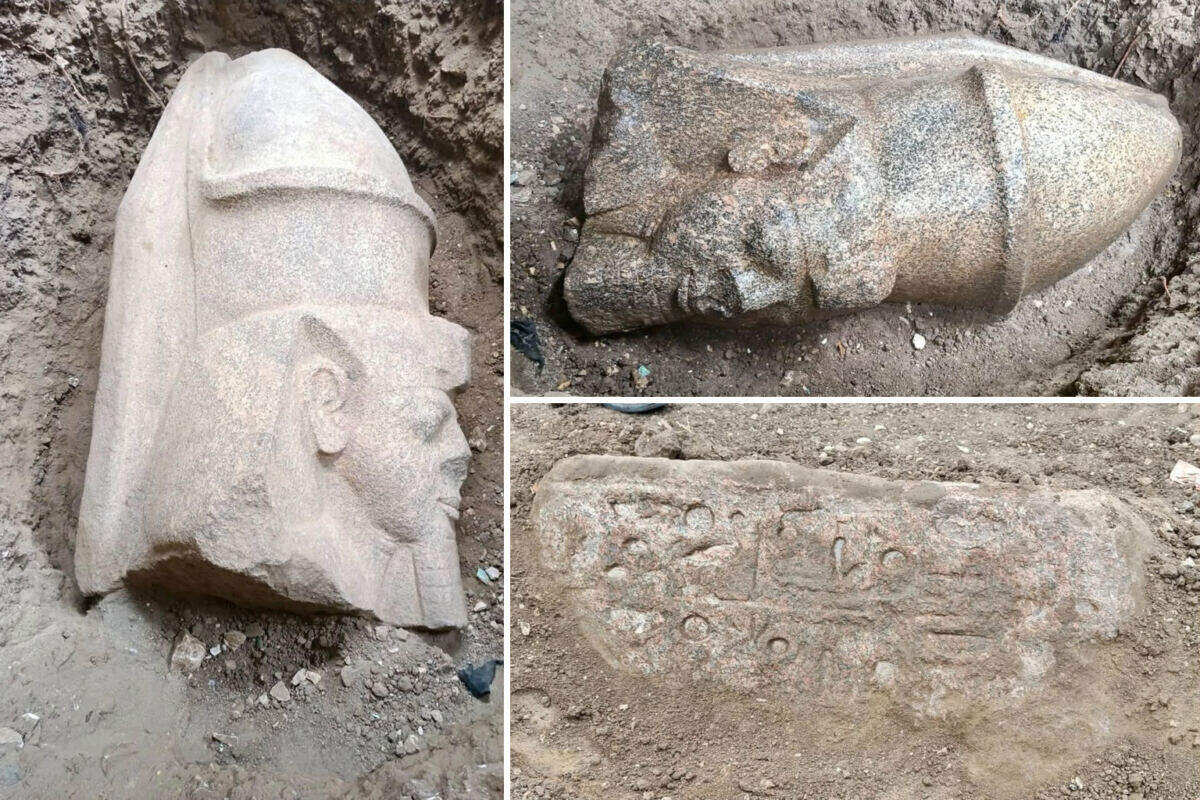
An Egyptian farmer accidentally uncovered a 28-foot statue of Ramses II while tilling his land, officials announced.
The discovery unfolded in Behbeit El Hagar, a village in Egypt’s Gharbia province, after the unnamed villager hit a carved stone block while working the soil in front of his home. He alerted local antiquities officials, prompting the Supreme Council of Antiquities to launch a formal excavation of the site.
Archaeologists unearthed an over 5-foot-tall head of the pharaoh wearing the double crown of Upper and Lower Egypt. Based on the head’s dimensions, they projected the complete statue once stood more than 27 feet tall including its base.
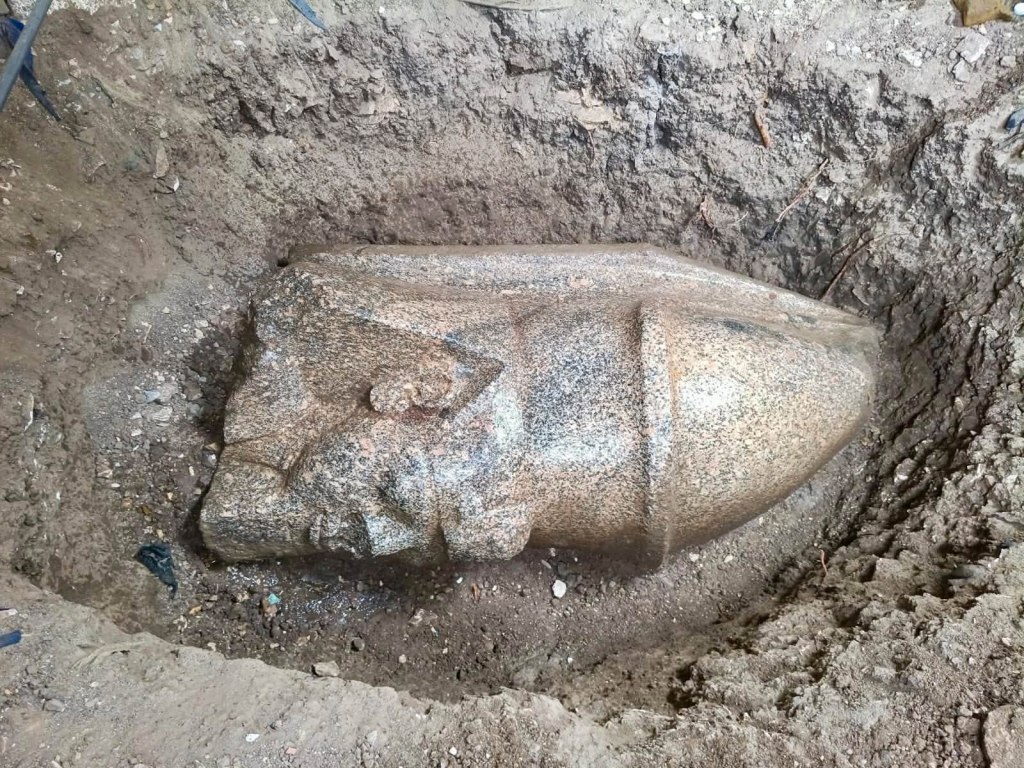
A second royal statue emerged during the dig, measuring just under eight feet tall. While its legs and base were missing, the face remained clearly visible, framed by the striped nemes headdress worn by ancient Egyptian rulers. The resemblance to the larger head and these distinctive markings led archaeologists to identify it as another depiction of Ramses II.
The excavation also yielded a 4-foot-high block of pink granite bearing fragments of hieroglyphic inscriptions. The text proclaims the pharaoh “Nesu Beti,” translated as King of Upper and Lower Egypt, and “Sa Ra,” meaning Son of Ra.
Born in 1303 BC, Ramses II reigned during Egypt’s New Kingdom era and is counted among its most powerful rulers. The pharaoh occupies a prominent place in biblical tradition as the tyrant who enslaved the Israelites and defied Moses in the Book of Exodus, though the scripture never names him directly. That popular association has made any new discovery connected to his reign immediately resonant beyond archaeological circles.
Sherif Fathy, Egypt’s Minister of Tourism and Antiquities, weighed in on the significance of the find. He said that the findings will hopefully contribute to a greater understanding of this region of the Nile Delta, which was a political, cultural and economic stronghold in ancient Egypt.
The minister added that officials hope further studies will help shed light on the statues and the architectural evolution of the repository during the epoch in question.
The Nile Delta region where the statues emerged served as a major center of power during ancient Egypt’s flourishing periods. Archaeological work there continues to reshape understanding of how pharaonic authority projected itself through monumental art and how religious and political institutions evolved over centuries of rule.
The accidental nature of this discovery echoes a familiar pattern in Egyptian archaeology, where routine construction or agricultural work periodically surfaces major finds that reshape historical understanding. The farmer’s decision to report the carved block rather than ignore or damage it allowed professional excavation to proceed.
Ramses II’s long reign and extensive building programs left numerous statues and monuments across Egypt, though specimens of this scale remain rare. The double crown depicted on the larger head symbolized the unification of Upper and Lower Egypt, a central ideological claim of pharaonic power that this massive sculpture would have broadcast to viewers.
The Supreme Council of Antiquities now faces the complex task of conserving the fragmented pieces and determining whether further excavation might recover additional elements of the original monument, including the missing legs and base of the smaller statue.