

Mysterious 1937 Painting Fuels Time Travel Theories After Viewers Claim They Spotted a Smartphone
An artwork completed in 1937 is puzzling viewers because one figure appears to be holding something that looks remarkably like a smartphone.
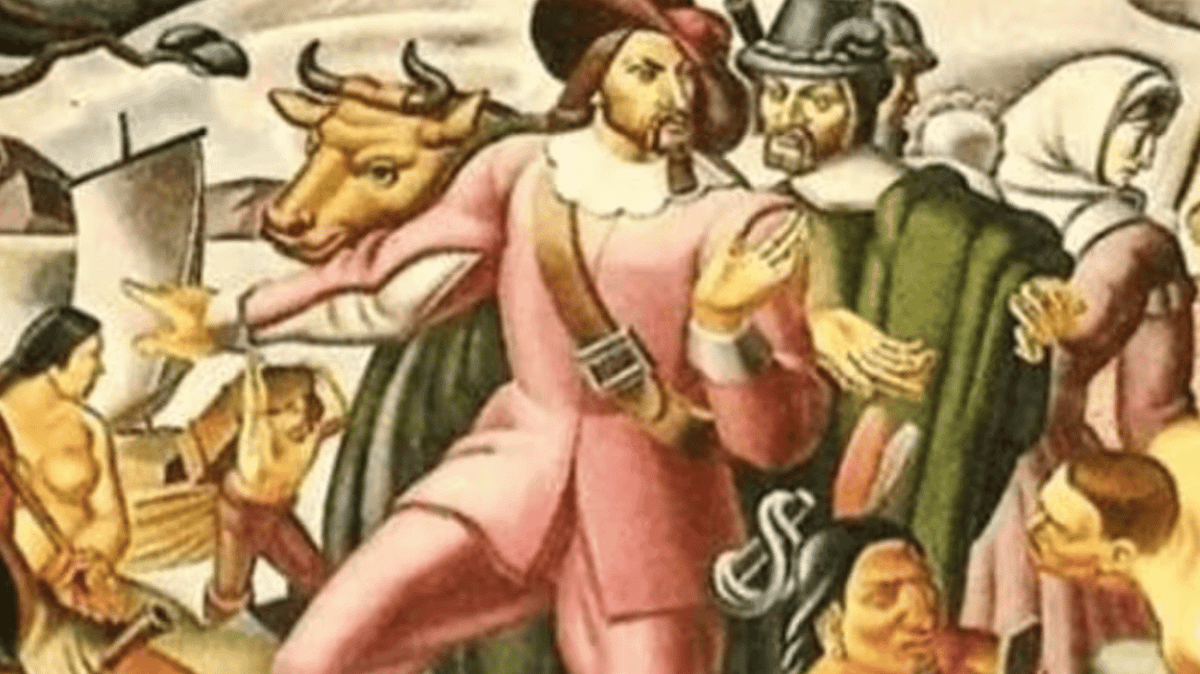
The piece is called ‘Mr Pynchon and the Settling of Springfield’ and was created by Italian-born artist Umberto Romano. Although it is often described online as a painting, it is more precisely a New Deal-era mural panel, installed in what was then the Springfield Main Post Office in Massachusetts.
The mural portrays English settlers and Native people in the area of Agawam, which became Springfield, during the 1630s. That makes the detail all the more striking to modern viewers, since the scene is set centuries before electricity, mobile phones or the internet.
According to the National Postal Museum, Romano was born in Italy before relocating to the US at nine years old, later growing up in Springfield, Massachusetts.
Romano completed the mural in 1937 with help from several students, as part of a series of six panels depicting the history of Springfield. The project was underwritten by the Federal Arts Project, the New Deal programme that helped fund public art during the Great Depression.
The murals remain in the same building today, though the former post office is now the Commonwealth of Massachusetts State Office Building.
The central figure in the work is William Pynchon, the English colonist and fur trader known as the founder of Springfield. Pynchon was born in Essex, England, in 1590 and travelled to North America in 1630. In 1636, he led a settlement expedition to the Connecticut River Valley and purchased land from local tribal leaders.
The National Postal Museum notes that the land sold to Pynchon was exchanged for items including hoes, wampum, coats, hatchets and knives, while Native people retained certain hunting, foraging and farming rights. That context is important, because the mysterious rectangular object may be connected to trade goods rather than anything futuristic.
The painting includes several white settlers, including William Pynchon, alongside a number of Native Americans. One person in particular has drawn a lot of attention because of the object in his hand.
Near the lower-right section of the painting, a Native American man can be seen seated and raising a small rectangular item toward his face, prompting some viewers to compare it to someone taking a selfie on a present-day phone.
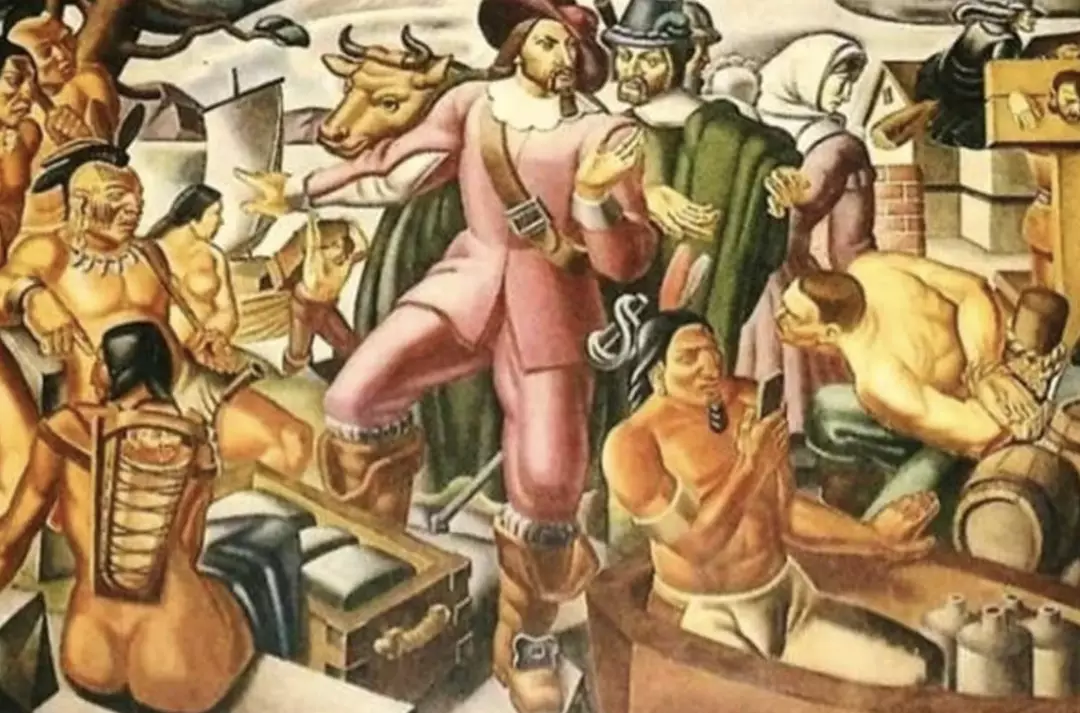
That unexpected detail has sparked confusion online, since smartphones did not exist either in the era shown in the painting or when Romano actually painted it in 1937.
For comparison, the first handheld mobile phone call is widely credited to Motorola engineer Martin Cooper in 1973, while Apple introduced the first iPhone in 2007 – 70 years after Romano completed the mural.
Many people have shared humorous theories on social media, with some imagining the man documenting the moment as it happened.
“Dude on 1937’s ‘Mr. Pynchon and the Settling of Springfield’ by Umberto Romano casually posting on his social media what’s happening around him,” they said.
Somebody else wrote: “Check out this painting from 1937! Spot anything weird? There’s a man using an iPhone. There’s also another guy tied up, like they’re goin thru his phone or somethin [sic].
“This picture depicts the founding of Springfield Massachusetts in 1636. Could it be a phone or something simpler?”
“The painting shows Pynchon in a pink suit and to his left, below him is a Native American looking as if he’s taking a selfie. Time travel?” said someone else on Twitter.
Not everyone was convinced by the more sci-fi interpretation, though.
But Brian Anderson thinks that time travel is unlikely.
'Mr. Pynchon and the Settling of Springfield' was completed by Italian Umberto Romano in 1937 and shows a scene from the 17th century
The painting shows Pynchon in a pink suit and to his left, below him is a Native American looking as if he's taking a selfie
Time travel?? pic.twitter.com/nAmv73ayS2
— Field Notes (@SocialLens360) November 19, 2017
Offering a more grounded interpretation, Anderson suggested the object may have been something introduced by Europeans rather than anything mysterious.
Giving a more realistic explanation, Anderson wrote on Motherboard: “There’s reason to believe, then, that what the man is examining is not an Indigenous object, but rather of European origin, like mirrors, which were presented often in such exchanges.”
He continued: “The way the man holds it up, if indeed he’s looking at his own face reflecting back at him, would certainly make sense.”
Others online have backed that theory, while some have proposed the figure could instead be looking at a small Bible or prayer book.
Another explanation has also been put forward. Dr Margaret Bruchac, an anthropologist and Native American and Indigenous studies scholar at the University of Pennsylvania, suggested in comments reported by Vice that the object could be an iron blade, with its edge resting against the man’s palm.
That theory would fit the wider colonial trade context, because knives, hatchets and other metal items were commonly exchanged in the 17th century. However, Bruchac also warned that the mural should not be treated as a historically accurate record of Native life, pointing out that many details in the image appear romanticised or inaccurate.
The National Postal Museum makes a similar point in its broader discussion of post office murals, noting that some historic depictions of Native people were based on stereotypes, legend or artistic invention rather than careful documentary accuracy.
In other words, the ‘smartphone’ effect may say as much about the way modern viewers interpret images as it does about Romano’s original intention. A small dark rectangle held near a face immediately reads as a phone to people today, even if the artist was more likely depicting a mirror, a book, a metal blade or another trade object.
Romano died in 1982, meaning he never lived to see the smartphone era and cannot explain exactly what he meant the object to be.
So what do you think the object really is?