

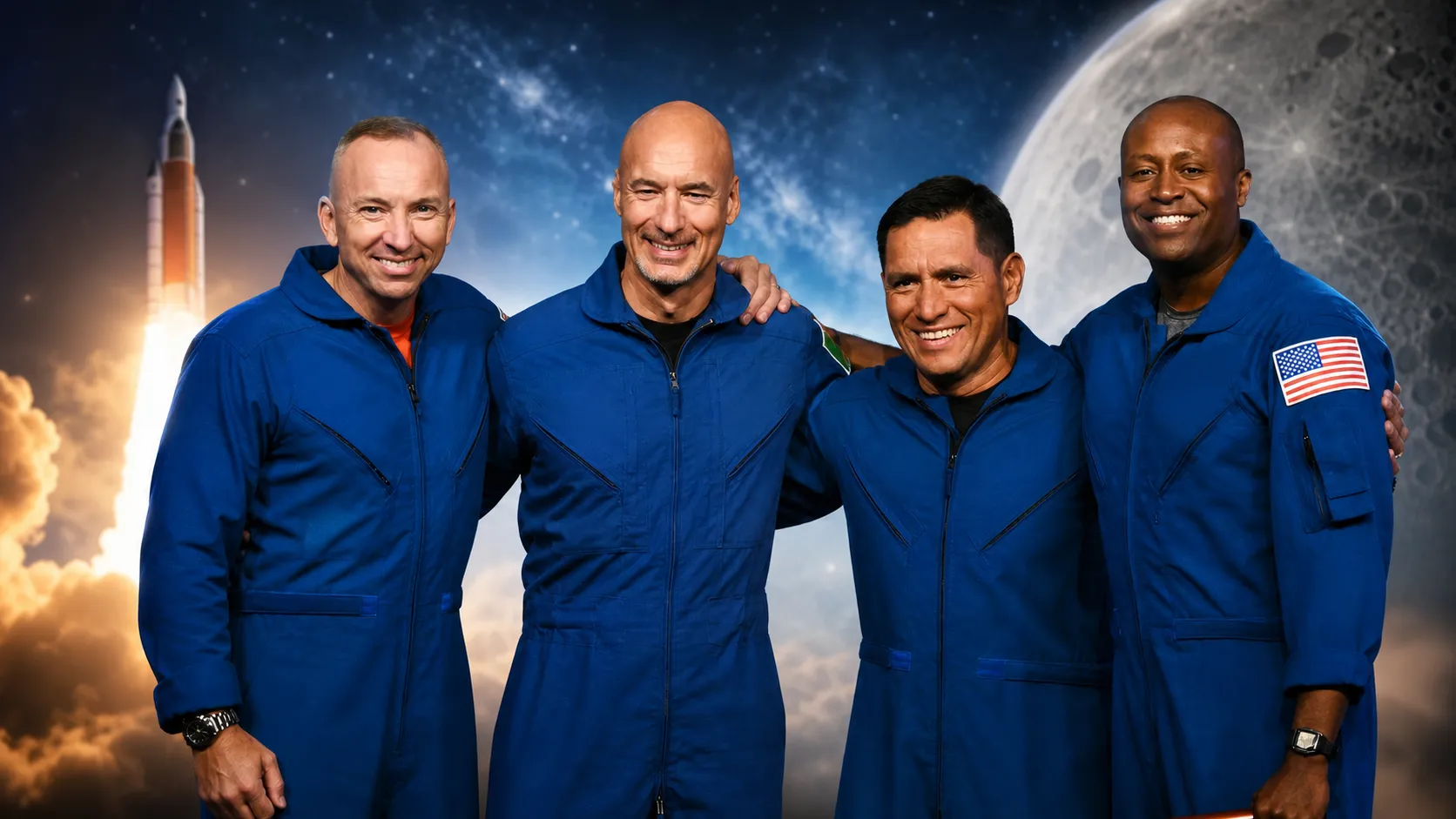
NASA has named the astronauts who will make up the Artemis III crew, as the agency continues preparations for the next major test flight in its program to return humans to the Moon.
The agency announced the crew on Tuesday, June 9, 2026, confirming that Artemis III is now planned as a 2027 crewed demonstration mission in low Earth orbit rather than a lunar landing. NASA said the flight will test critical systems needed before Artemis IV, which is currently targeted as the first Artemis crewed mission to the lunar South Pole in 2028.
When Artemis III launches, the crew will not include any women. The selected team is made up of NASA astronaut Randy Bresnik as commander, European Space Agency astronaut Luca Parmitano as pilot, and NASA astronauts Andre Douglas and Frank Rubio as mission specialists.
NASA also named astronaut Bob Hines as the backup crew member. Hines will train alongside the prime crew and would join the mission if one of the selected astronauts were unable to fly.
The assignment makes Parmitano the first ESA astronaut selected for an Artemis mission. ESA is also providing the European Service Module for NASA’s Orion spacecraft, which supplies propulsion, power, temperature control, air and water for the crew vehicle.
Following the crew reveal, Norman D Knight, NASA’s director of flight operations, addressed the astronauts.
“I am excited to welcome you as the next crew in the Artemis journey to successfully return to the Moon.
“This mission will be one of the most complex that Nasa has undertaken, and we are counting on your courage and your dedication in fulfilling this critical role.”
NASA said Artemis III will launch from Kennedy Space Center in Florida aboard the Space Launch System rocket, carrying the four astronauts inside Orion. After reaching low Earth orbit, Orion will conduct systems checks before attempting rendezvous and docking demonstrations with test versions of commercial human landing systems being developed by Blue Origin and SpaceX.
Under NASA’s current plan, a Blue Origin lander pathfinder would launch first and wait in orbit. Orion would then rendezvous and dock with it for about two days of tests, including crew entry into the lander. Orion would later undock and wait for a SpaceX Starship pathfinder, with the crew spending about a day connected to that vehicle for further checkouts.
The mission is expected to last about two weeks, although NASA said the exact duration will depend on launch timing, rendezvous operations and how the docked tests proceed. At the end of the flight, Orion is scheduled to return to Earth for splashdown in the Pacific Ocean, where NASA and the U.S. Navy will recover the astronauts.
Bresnik, a retired U.S. Marine Corps colonel and former test pilot, has flown to space twice before, including aboard space shuttle Atlantis in 2009 and later on a long-duration mission to the International Space Station, where he served as commander of Expedition 53.
Parmitano, an Italian Air Force colonel and test pilot, has also completed two spaceflights. He flew to the International Space Station in 2013 and again in 2019, when he became the first Italian to command the orbiting laboratory.
Rubio will be making his second trip to space. He launched to the International Space Station in September 2022 and returned in September 2023 after 371 days in orbit, setting the record for the longest single spaceflight by an American astronaut.
Douglas, selected by NASA as an astronaut candidate in 2021, will be making his first spaceflight. He previously served as a backup and closeout crew member for Artemis II and has a background in mechanical engineering, systems engineering, Coast Guard operations and autonomous vehicle development.
Artemis III follows Artemis II, the first crewed flight of the Artemis program, which NASA said was completed in April 2026. Artemis II sent astronauts around the Moon and tested Orion’s performance with people aboard, setting the stage for the more complex docking and lander demonstrations planned for Artemis III.
NASA said preparations for the mission are continuing, with work under way on Orion’s crew and service modules, the spacecraft’s docking system, SLS rocket processing and testing of the commercial lander hardware that will support later lunar surface missions.
The Artemis program is NASA’s long-term effort to establish a sustained human presence on and around the Moon, conduct scientific research, develop commercial and international partnerships, and build the experience needed for future crewed missions to Mars.