

NASA has unveiled its most extensive map of dark matter, providing an unprecedented view of this elusive substance.
Dark matter constitutes about 27 percent of the universe, yet our understanding of it remains limited.
However, NASA’s efforts are beginning to shed light on dark matter and its pivotal role in maintaining the structure of the universe.
Scientists at Durham University in the UK are optimistic that ongoing research might help astronomers understand the Milky Way’s formation.
In addition, the map and further studies could offer clues about the origins of planet Earth.

Professor Richard Massey, a study co-author published in Nature Astronomy, remarked, “Wherever you find normal matter in the Universe today, you also find dark matter. Billions of dark matter particles pass through your body every second. There’s no harm, they don’t notice us and just keep going.”
He further stated, “But the whole swirling cloud of dark matter around the Milky Way has enough gravity to hold our entire galaxy together. Without dark matter, the Milky Way would spin itself apart.”
Dark matter remains shrouded in mystery, yet its significance is evident. Some researchers suggest it plays a vital role in the formation of planets, paving the way for life as we know it.
To deepen their understanding, scientists utilized the James Webb Space Telescope, the world’s largest and most powerful telescope, to map the distribution of dark matter.
The team concluded that dark matter interacts with the universe primarily through gravitational forces.
Dr. Gavin Leroy, another study co-author, explained, “By revealing dark matter with unprecedented precision, our map shows how an invisible component of the Universe has structured visible matter to the point of enabling the emergence of galaxies, stars, and ultimately life itself.
“This map reveals the invisible but essential role of dark matter, the true architect of the Universe, which gradually organises the structures we observe through our telescopes.”
The James Webb telescope’s capabilities are highlighted by the fact that the new map includes 10 times more galaxies than previous ground-based observations.
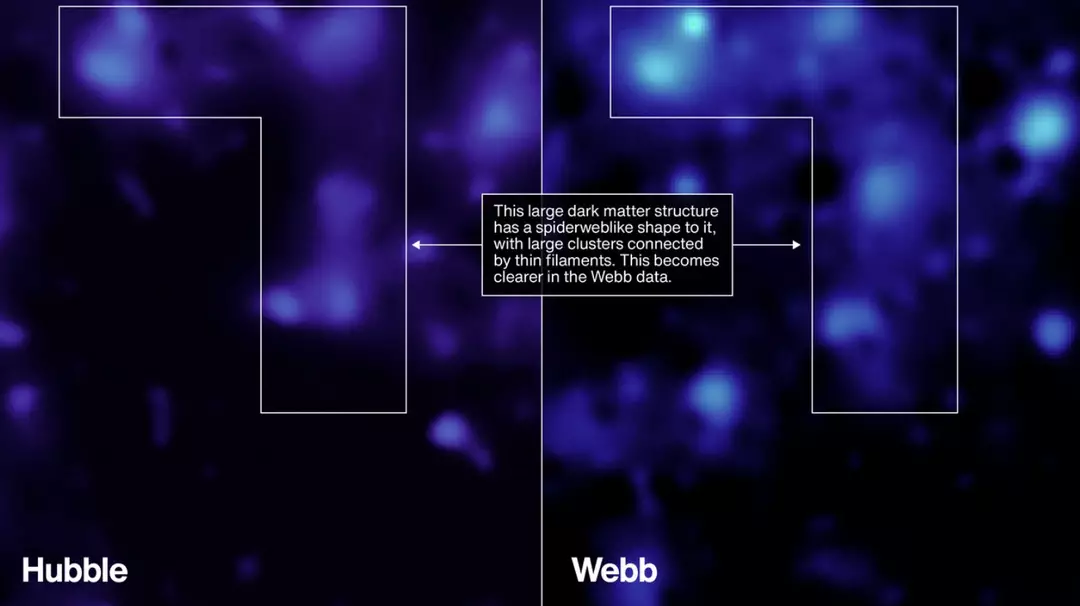
Diana Scognamiglio of NASA’s Jet Propulsion Laboratory and lead author of the study noted, “This is the largest dark matter map we’ve made with Webb, and it’s twice as sharp as any dark matter map made by other observatories. Previously, we were looking at a blurry picture of dark matter. Now we’re seeing the invisible scaffolding of the universe in stunning detail, thanks to Webb’s incredible resolution.”
In a remarkable achievement, researchers captured nearly 800,000 galaxies on the map, including some that were observed for the first time, after the telescope spent an impressive 255 hours exploring space.