


Two California bills targeting social media’s impact on children cleared a key legislative hurdle this week and could reach Gov. Gavin Newsom’s desk before the session ends.
The proposals, AB 1709 and AB 2, passed the State Senate Appropriations Committee and now head to the full Senate for a vote. Assemblyman Josh Lowenthal, the Long Beach Democrat who authored both measures, told California Politics 360 that the legislation reflects a dramatic shift in public attitudes toward tech regulation.
“There’s really been a sea change that’s taking place over the last couple of years. And parents up and down the state, across the aisle from every geography, every religion, every background that you can think of, all want the same thing. They want regulation. They want action. They’re worried about their kids. And I say that not just as a legislator but as a dad,” Lowenthal said.
“I’m worried about my kids, and we really need to do something.”


AB 1709 would prohibit social media platforms from offering addictive features to users under 16. The bill defines these features to include auto-scroll, infinite scroll, and notifications that Lowenthal argues are engineered to keep children hooked. Platforms could still allow minors to maintain accounts, but only if they strip away these design elements and offer alternatives like chronological timelines.
AB 2 would create a private right of action, allowing parents and children to sue platforms for civil penalties and damages if a minor is harmed.
Lowenthal emphasized that the measures are not a ban on social media use by young people. He compared AB 1709 to helmet laws for biking and skateboarding.
“We don’t say that we’re banning kids from riding bikes or skateboards when we say that you need to wear a helmet while you do so. And that’s effectively what 1709 does. We don’t ban children from using social media. What we’re saying is social media can’t access our children unless they don’t have these harmful features,” he said.
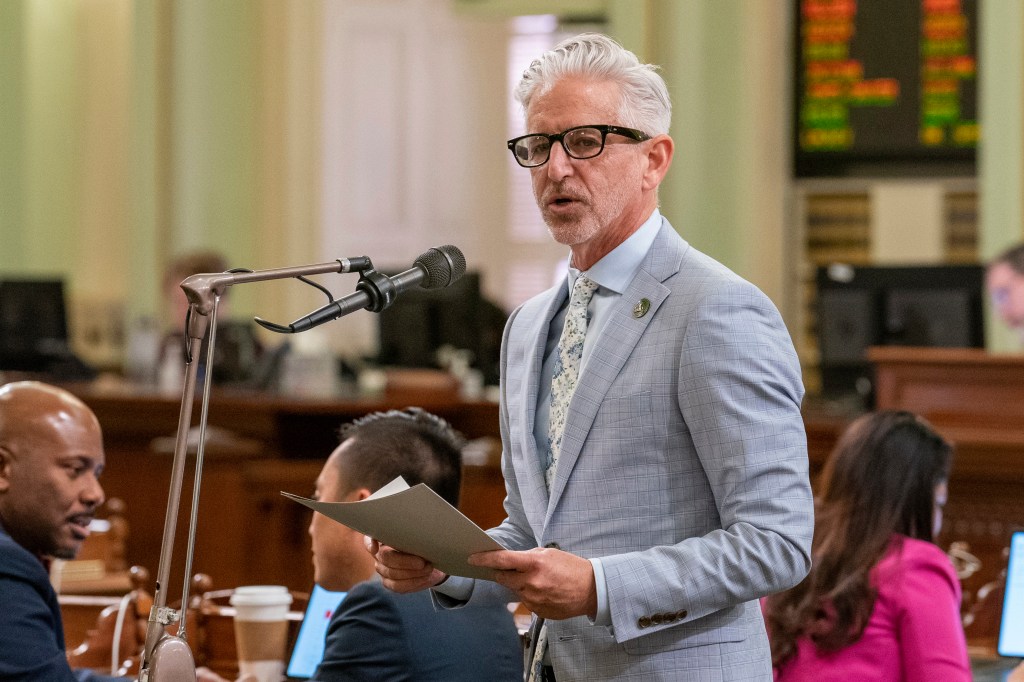
The assemblyman cited data showing children spend an average of five hours daily on social media, with totals exceeding school hours when weekends and holidays are factored in. He pointed to the developmental vulnerability of young users.
“They don’t have physiologically a prefrontal cortex yet. They can assess the consequences of their actions. Their brains at that age of development is really important that we hold sacred. And so this legislation takes care of that,” Lowenthal said.
He also addressed the lack of accountability from tech companies when problems arise.
“When you count weekends and holidays, that means they’re spending more time on social media than they are in school. And stop and think about the oversight that we have at school. We get to talk to our teachers, administrators, elected school board members. We’re involved on a day-to-day basis with the PTA and otherwise. We know who to go to when there’s a problem. And what do we have on social media? We have nobody to call. There is no customer service. There are no representatives in our communities from those outfits,” he said.
The bills have drawn opposition from tech industry groups and some civil liberties organizations. The Electronic Frontier Foundation has argued that AB 1709 amounts to a de facto ban on social media for minors because its definition of “addictive feeds” covers virtually all recommendation algorithms. The group also raised privacy concerns about age verification requirements.
Some youth advocacy groups, including LGBTQ and neurodivergent communities, have expressed worry that the legislation could limit access to supportive online communities.
Lowenthal acknowledged these concerns and said stakeholder input had shaped the legislation.
“The beautiful thing about our system is that we enable key stakeholders to voice their opinions along the way and really help shape legislation to make it stronger and stronger. And that is absolutely the case here,” he said.
He maintained that the California model creates a pathway for safe social media use without cutting off marginalized groups.
Newsom used his State of the State address to single out Australia’s approach to restricting children’s social media access and urged California to do more. Lowenthal said he traveled to Australia to study its implementation and kept Newsom informed during the trip.
“This is not controversial here. Whoever you talk to, whether they’re key stakeholders or people on the street, were overall supportive, happy that their government was taking action,” Lowenthal said of his Australia trip.
The tech industry has historically challenged similar state-level regulations on First Amendment grounds. Lowenthal said he crafted the bills to align with ongoing legal cases to improve their chances of surviving court review.
“The playbook of the platforms has been to sue against everything that we’re doing and trying to stop any progress in that regard,” he said.
Despite industry opposition, Lowenthal expressed optimism about eventual collaboration.
“I am not an enemy of the tech industry. I actually come from tech myself. I don’t see them as the problem. I actually see them as the solution,” he said. “These are some of the brightest, smartest innovators on the planet. And I think that we’re all going to turn the corner and together reach alignment.”
The full State Senate will vote within the next two weeks on whether to advance the bills to Newsom, with the legislative session set to conclude Aug. 31.