

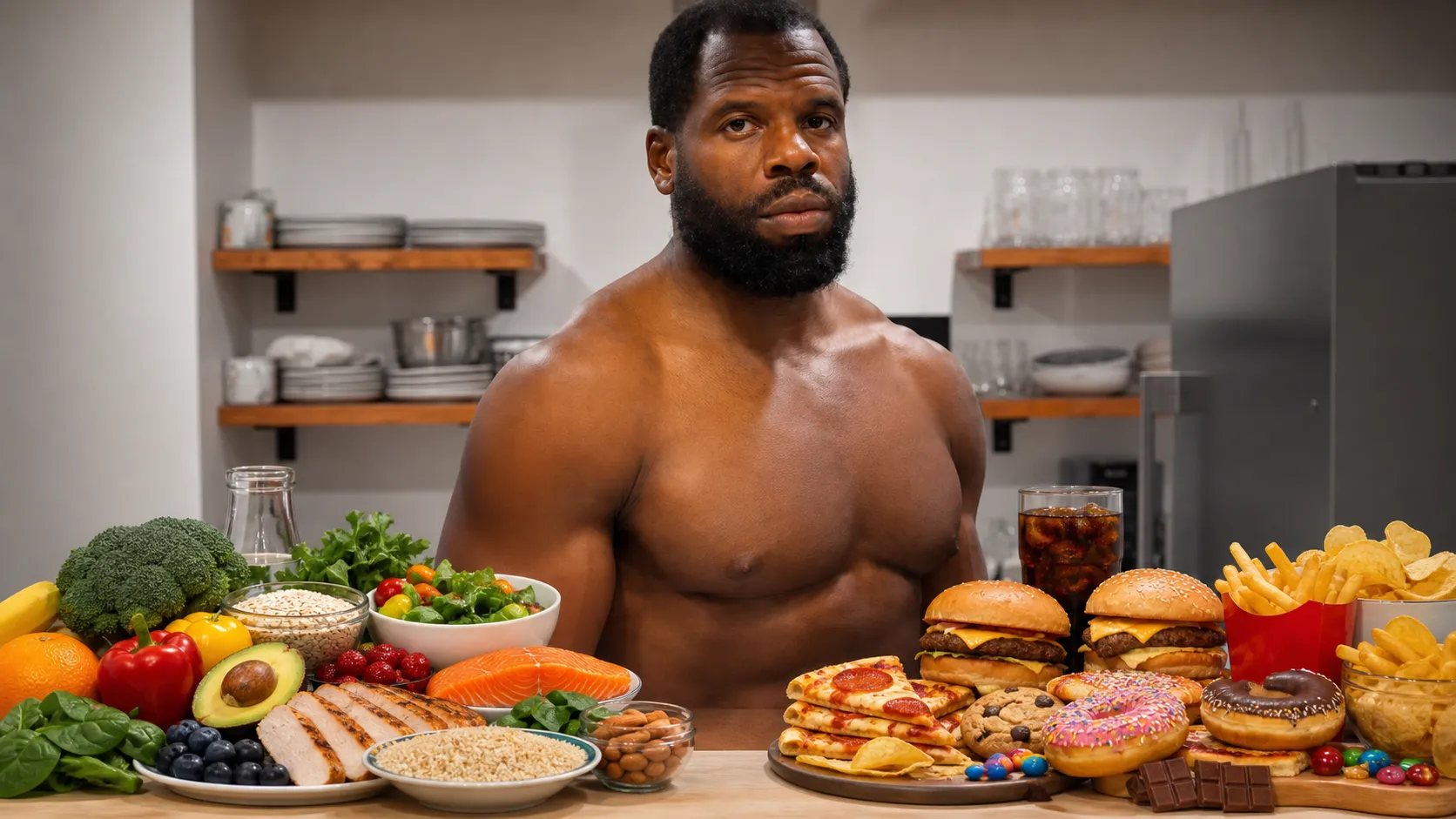
A fitness coach and online creator has attracted major attention after putting two very different 2,500-calorie meal plans side by side to show that the quality of what you eat can matter just as much as the total number of calories.
For years, many people have been told that eating less is the main route to getting healthier, losing weight or simply feeling better day to day. But that idea misses a lot of the wider picture.
In reality, nutrition is often less about cutting back at all costs and more about paying attention to the type of food on the plate. In some cases, eating more volume from better ingredients can leave you feeling more satisfied, more energised and better supported through exercise and recovery.
That is the point Leyon, a personal trainer, wanted to make in a clip that has been widely shared on social media.

In the video, he splits a table in half with tape and uses it to contrast two diets that both add up to the same calorie amount, while showing how differently they can affect hunger, energy and body composition goals.
“Yes… a caloric deficit helps you lose weight. And that’s great. But what about the muscle you’re trying to keep… or even build?”
He also made clear that he was not trying to ban people from enjoying the foods they like.
‘not demonizing food’
His point was that the same calorie target can look very different depending on how the meals are made and what ingredients go into them.
That distinction matters because calories are only one part of the picture. Protein, fibre, volume, micronutrients and the degree of processing can all affect how full a meal feels, how easy it is to stick to over time and how well it supports training or recovery.
‘make them homemade with real ingredients’
To explain that, he compared simple whole-food choices with more heavily processed alternatives.
‘potato with salt and spices instead of the factory-made, chemically processed potato chip’
‘homemade burger instead of an ultra-processed one’
According to Leyon, those swaps can better
‘fuel’
The body, while also giving meals that are
‘high volume’
With
‘better macros’
And
‘higher protein’
Plus
‘carbs that actually fuel you’
He said that kind of eating can help people stay fuller for longer and avoid the rapid ups and downs that often come from more processed options.
‘steady energy,’
‘perform’
‘recover’
On the other side of the table, he described the processed meal setup as
‘low volume,’
‘easy to eat,’
‘calorie-dense’
And built around
‘poor macros’
Which can leave someone feeling
‘sluggish,’
‘bloated’
With
‘energy crashes’
And then
‘right back looking for more’
The broader message was that two people can consume the same number of calories and still end up with very different outcomes depending on protein, processing, portion size and overall nutrition.
‘overall macros matter’
“That’s how people stay stuck eating 2,500 but getting completely different results.”
“Eat more food. Just make it real food.”
There is also a growing body of research suggesting that heavily processed foods can make it easier to overeat, even when calorie and nutrient targets look similar on paper. At the same time, nutrition experts still stress that sustainable eating patterns have to work in real life, which means budget, access and convenience all matter too.
Leyon is not the only one making that argument. The latest federal nutrition guidance also emphasizes whole, healthy and nutritious foods, with an increased focus on limiting ultra-processed foods and added sugars.
“Eat real food.”
Those guidelines encourage people to prioritize nutrient-dense foods such as protein, dairy, vegetables, fruits, healthy fats and whole grains, while staying mindful of foods that are high in added sugars, saturated fat and sodium.
“To Make America Healthy Again, we must return to the basics. American households must prioritize diets built on whole, nutrient-dense foods—protein, dairy, vegetables, fruits, healthy fats, and whole grains.
“[…] The United States is amid a health emergency. Nearly 90 percent of health care spending goes to treating people who have chronic diseases.1 Many of these illnesses are not genetic destiny; they are the predictable result of the Standard American Diet—a diet which, over time, has become reliant on highly processed foods and coupled with a sedentary lifestyle.”
“We are putting real food back at the center of the American diet. Real food that nourishes the body. Real food that restores health. Real food that fuels energy and encourages movement and exercise. Real food that builds strength.”
Even so, some viewers backing Leyon’s message have pointed out that the whole-food side of the comparison can cost more than the processed side, which is a real obstacle for many households.
His answer was simple:
‘meal prep’
It may not solve every budget problem, but for many people it is one practical way to make healthier choices more manageable.