

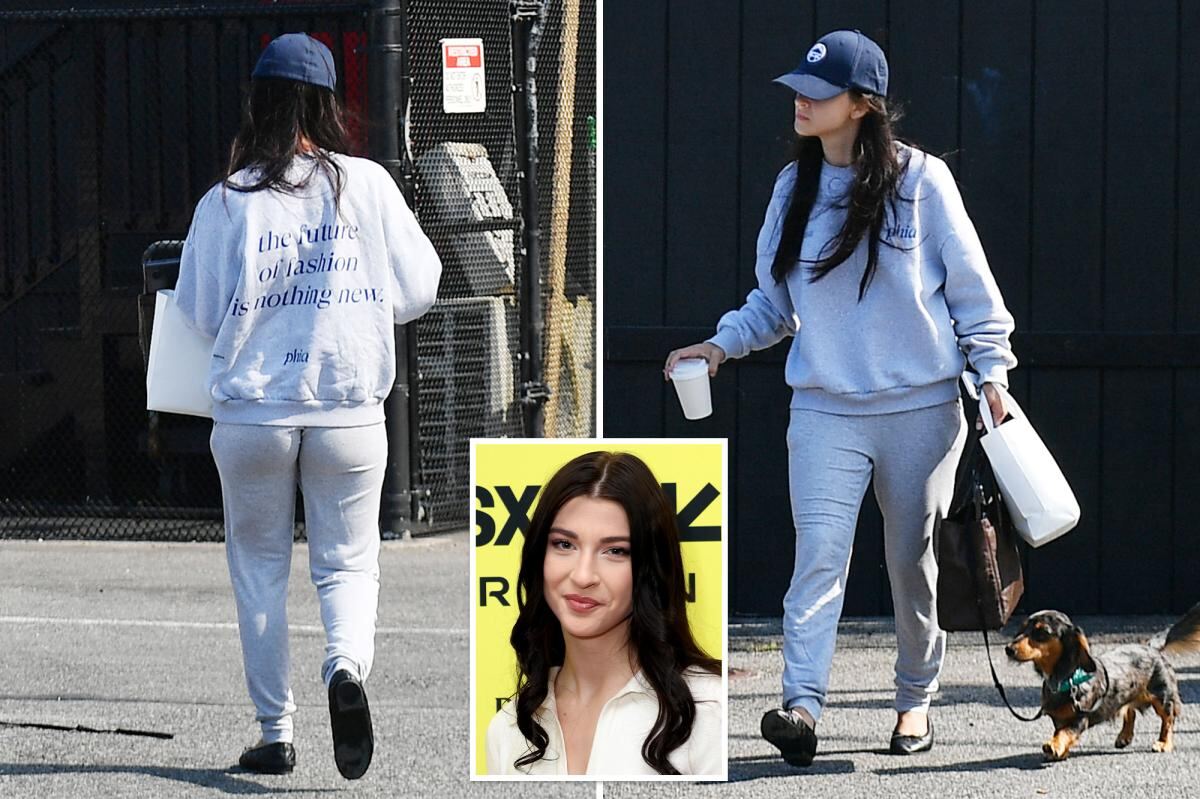
Phoebe Gates was spotted stepping off a helicopter in New York City wearing Phia-branded merch just days after explosive new reporting alleged she had known about her startup’s “cookie stuffing” scheme for months.
The 23-year-old Stanford alum, youngest daughter of Microsoft co-founder Bill Gates, was photographed Sunday in a Phia sweatshirt bearing the slogan “the future of fashion is nothing new,” paired with gray sweatpants, a blue baseball cap and black ballet flats. She carried a brown purse and walked a small Dachshund on a leash as bodyguards escorted her to a chauffeured limousine, joined by a friend. The photo agency that captured the images suspected Gates was returning from Westchester County, where her sister Jennifer Gates, 29, owns a 124-acre, $16 million North Salem horse farm — a graduation gift from their parents.


Gates reportedly lives in a loftlike two-bedroom Manhattan apartment with pink walls and 20-foot ceilings. She has publicly insisted she wanted to build something without her billionaire parents’ help. “Honestly, for me, my primary motivation is, right, I have a chip on my shoulder to build something generational that has no ties to, you know, me, my privilege, or my last name,” she said on Yahoo Finance’s “Opening Bid Unfiltered” podcast earlier this year.
That ambition now faces serious questions. A Bloomberg investigation published this month revealed internal Slack messages showing Gates and co-founder Sophia Kianni, also a Stanford alum, knew about Phia’s cookie-stuffing practices since at least December — seven months before the company publicly claimed it had only discovered the issue “within the last 24 hours.”
“can u confirm auto pop for cookie drop is live on ALL sites w a coupon to confirm we are monetizing on all gmv,” Gates wrote in a December 18 Slack message obtained by Bloomberg. In a separate exchange, Kianni urged employees to “keep these cookies dropping” after an engineer warned that auto-dropping cookies could be “against compliance,” according to the reporting.
The practice allowed Phia’s browser extension to place affiliate tracking cookies during online checkout even when customers had not used Phia’s coupon codes, effectively claiming commissions for sales the startup did not drive. Cookie stuffing traced back to at least December across retailers including Nike, Gap and Nordstrom, and accounted for roughly 51 percent of merchandise value Phia claimed credit for in June, Bloomberg reported. Average daily revenue plummeted from about $80,000 to between $10,000 and $28,000 after the features were disabled on July 7 — the same day Bloomberg first contacted Phia for comment.

Legal experts have noted that cookie stuffing can be prosecuted as federal wire fraud, which carries a maximum penalty of 20 years in prison. “There’s a possibility of a max penalty of up to 20 years prison + fines/restitution,” corporate attorney Ariel Givner wrote on X in response to Bloomberg’s reporting. However, experts told The Post that Gates is more likely to face financial penalties than jail time if authorities pursue action. No criminal charges have been filed against Gates, Kianni or Phia as of this week.
Phia has disputed some of Bloomberg’s claims while maintaining it is correcting course. “Any features causing misattributions were immediately removed over a month ago on July 7,” a Phia spokesperson said in a statement. “We are reviewing every transaction, we are fully committed to and have already begun issuing all transaction reversals to brand partners as a result of any misattribution, and we are hiring a head of compliance to make sure something like this never happens again.”
The spokesperson added: “We are now continuing to connect our users with items and offers from thousands of brand partners. We will learn from this and want to ensure our users have the best possible shopping experience, with features like our new digital closet and more to come.”
Bloomberg first reported on July 9 that Phia was receiving credit for sales it had not helped generate. The company initially blamed “technical anomalies” and said it had worked “overnight” to resolve the issue. But the subsequent revelation of internal Slack messages contradicted that narrative, showing founders who actively pushed for the cookie-dropping features rather than discovering them by accident. The scandal has drawn particular attention given Phia’s high-profile backing — the startup raised $30 million in 2025 from investors including Hailey Bieber, Kris Jenner and Spanx founder Sara Blakely, with additional reports of funding from Khosla Ventures, Kleiner Perkins and Notable Capital. Impact.com, the affiliate platform Phia used, suspended the startup following the initial reporting.
The controversy has also put a spotlight on Gates’ Stanford education, including her participation in a secretive, invite-only course called “So You Think You Can Rule the World?” The unofficial 10-week class, which had no enrollment code and was not publicized, brought together 12 hand-picked students to study power structures and how to “hack” them, according to The Stanford Daily. “It’s more about identifying the vulnerabilities or loopholes,” one former student told the paper. “I think [the instructor is] less concerned with the ethics of it all.”
Gates has previously been open about the pressures of her family name. “I was like, I have so much privilege. I’m a nepo baby,” she said on “The Burnouts,” her podcast with Kianni. “I had so much insecurity around that.”
Phia has lost nearly half its full-time employees since the beginning of the year, Puck reported after the initial cookie-stuffing investigation.
Phia’s spokesperson did not directly address the allegation that founders knew about the disputed practices months earlier in the company’s latest statement to Bloomberg.