

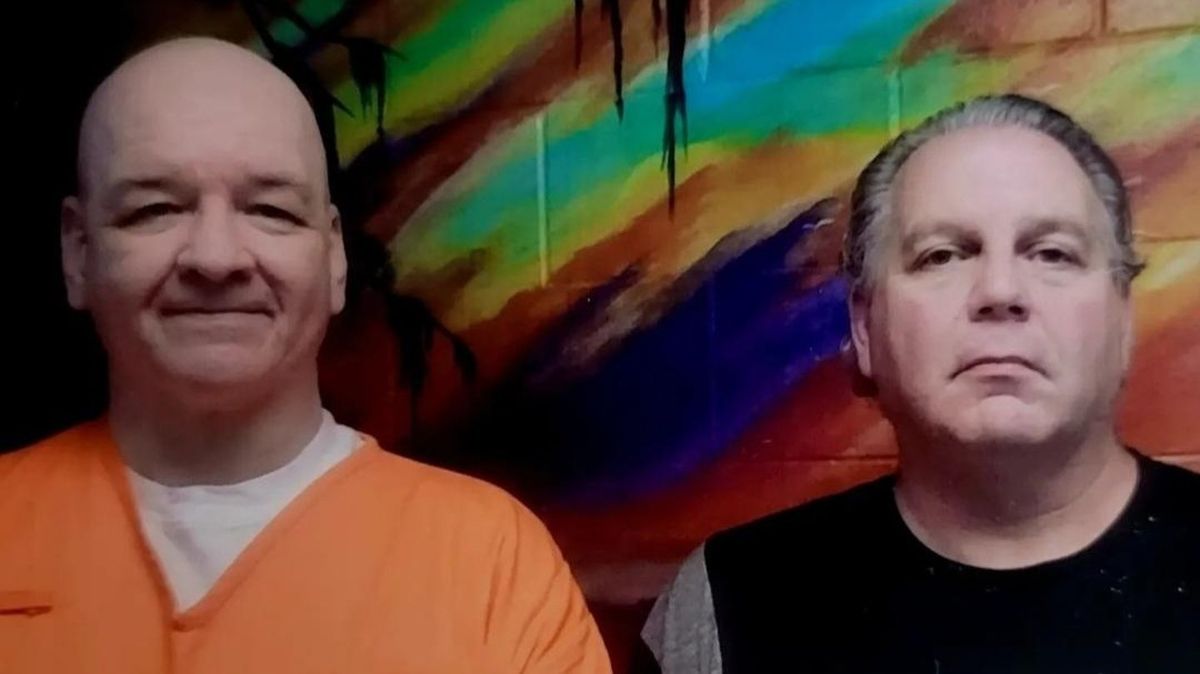
A psychologist who has spent years meeting death row prisoners says the inmates he has come to know have sent him some deeply unsettling gifts, including artwork made with bodily fluids.
Dr. Bill Kimberlin, a clinical psychologist and professor of psychology, has interviewed hundreds of people on death row and says the bond he develops with many of them is unlike anything most people would experience. Some have even asked him to be present when they are executed.
For prisoners still awaiting execution, that connection often continues through the mail. According to the U.S. Department of Justice Bureau of Justice Statistics, inmates spend an average of approximately 19 years on death row before they are put to death, and during that time Kimberlin says many of them send him personal items.
These are not exactly typical keepsakes.
Kimberlin says: “They send me everything from their artwork to their prison uniforms, you name it. I have thousands of pieces of art stored because I’ve never sold a single piece of anything that I’ve received. So I still have the very first letter I’ve received over 20 years ago.”
Not all of the pieces he receives are conventional paintings or drawings, however.
Kimberlin reveals: “I have a lot of paintings made from human blood and semen. Yeah, it’s just… You never know what to expect when you get packages from death row.”
And the unusual deliveries go well beyond that.
“Oh boy. You know, they send me their shoes, their socks, their uniforms. A little shrunken head made from dried fruit,” he adds.
Kimberlin says some of the most frightening moments have not involved the packages at all, but the conversations he has had while sitting face-to-face with condemned inmates.
He recalled sharing a meal with one prisoner whose execution date was close, when the inmate made a comment that left him rattled.
Kimberlin recalls him saying: “I’ve been thinking that if I killed one more person, if I killed somebody like today right now, then they can’t execute me, right?”
“Because they have to take me to trial,” the inmate added, which he said was going to ‘take years’.
At that point, Kimberlin realised how vulnerable the situation was. Although a guard was nearby, he says the officer was not within view while the two were talking.
“I’m sweating bullets thinking ‘Oh I my god. Don’t know what I’m going to do’,” he says.
He responded by trying to talk the inmate down, telling him: “They’re still going to put you to death, they’re going to try and abstentiate you out of here and bring more embarrassment to your family, so that’s definitely not something you want to entertain.”
Kimberlin says the exchange has stayed with him ever since.
“That one will always be on my mind.”
Alongside the strange gifts sent to him by inmates, last meal requests from death row prisoners have also produced some especially unusual cases over the years. Kimberlin’s work, which he has documented in his book “Watch Me Die: Last Words from Death Row,” has included attending executions and interviewing inmates shortly before their deaths.
Victor Feguer abducted and murdered Dr Edward Bartels in July 1960. Bartels’ body was later discovered in an Illinois cornfield with a gunshot wound to the head.
After being convicted of federal kidnapping and murder, Feguer was hanged at the Iowa State Penitentiary on 15 March, 1963.
His final request was a single olive, pit included. He reportedly said he hoped an olive tree would grow from his grave, “as a sign of peace”.
John Wayne Gacy, one of the most infamous serial killers in US history, was convicted in 1980 of murdering at least 33 boys and young men during the 1970s.
He was executed by lethal injection at the Stateville Correctional Center in Illinois on 10 May, 1994, at the age of 52.
For his last meal, Gacy chose a bucket of KFC original recipe chicken, French fries, 12 deep-fried shrimp and a pound of strawberries. The choice carried an eerie connection, as he had once managed several KFC restaurants owned by his father-in-law.
Ronnie Joe Smith was convicted of killing Larry Don Rohus while robbing an office building in Houston, Texas, in 1983.
He was executed by lethal injection at the Huntsville Unit on 26 June, 1990.
Smith asked for a lump of rhaeakunda dirt as his last meal, saying it was part of a voodoo ritual he practised and believed would help him on his journey into reincarnation.
The request was refused, and he was instead given plain yoghurt.
Timothy McVeigh was found guilty of conspiracy, using a weapon of mass destruction and destruction by explosives resulting in death for the 1995 Oklahoma City bombing, which killed 168 people.
He was executed by lethal injection at the Federal Correctional Complex in Indiana on 11 June, 2001.
For his final meal, McVeigh requested two pints of mint chocolate chip ice cream.
Lawrence Russell Brewer, a white supremacist, was convicted alongside two other men for the 1998 murder of James Byrd Jr. In Jasper, Texas. Byrd, an African American man, was chained to a pickup truck and dragged for three miles, a racially motivated crime that drew national attention.
He was executed by lethal injection at the Huntsville Unit in Texas on 21 September, 2011, aged 44.
Brewer’s last meal request became notorious for its size. He asked for: two chicken fried steaks smothered in gravy with sliced onions; a triple bacon cheeseburger with fixings on the side; a cheese omelette with ground beef, tomatoes, onions, peppers and jalapeños; a large bowl of fried okra with ketchup; one pound of barbecue meat with half a loaf of white bread; three fajitas with all the trimmings; a Meat Lovers pizza; one pint of vanilla ice cream; a slab of peanut butter fudge; and three root beers.
When the food arrived, he refused to eat any of it. The refusal sparked outrage from Texas state senator John Whitmire, who called the practice of allowing special last meals “extremely inappropriate.” His intervention led to the state ending the tradition in 2011, which had been in place since 1924. Texas now serves death row inmates the same meal as other prisoners on the day of execution.