

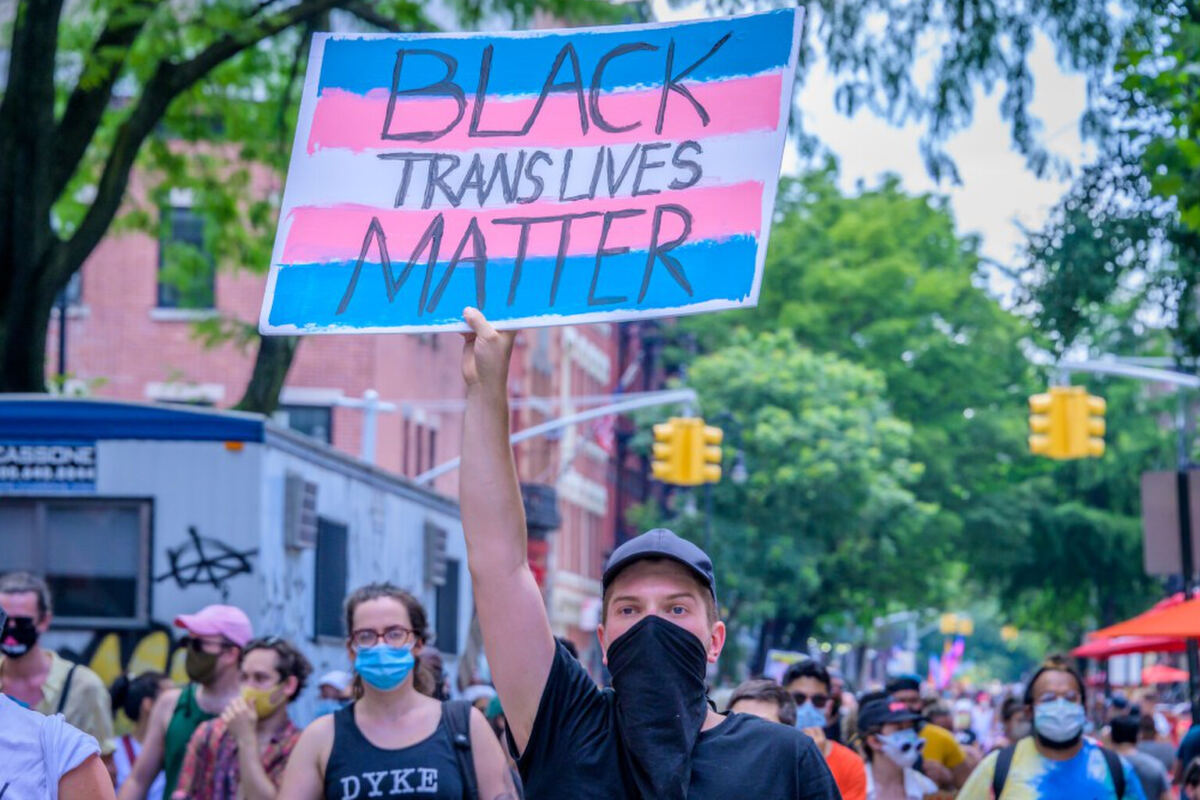
A new research paper challenges the prevailing narrative that transgender Americans face a uniquely deadly wave of hate-driven violence.
The study, published earlier this year by Manhattan Institute researchers Vincent Lundgren and Colin Wright, examined more than 300 murder cases dating back to 2015 in which the victim was transgender. Their findings paint a picture sharply at odds with claims by major advocacy organizations.
Lundgren and Wright found that transgender people are actually less likely to be murdered than the general U.S. Population. Between 2010 and 2014, the transgender murder rate stood at roughly 3.66 per 100,000 — about one-seventh the 25.8 per 100,000 rate among the general population during that same five-year stretch.
The researchers also examined the racial dynamics of these killings. In cases where suspects were identified, black suspects accounted for 65% of perpetrators, while white suspects made up just 18%. The researchers emphasized that this pattern held steady across their dataset. “This finding is not the result of one bad year or a handful of outlier cases,” they stated.
The year 2020 proved particularly significant in their analysis. That year, the Human Rights Campaign attributed the deaths of “our Black trans siblings” to “an epidemic of violence” fueled by “systems of white supremacy.” Yet Lundgren and Wright reported that in the cases they verified for 2020, not a single white suspect was identified.
Confirmed hate crimes were scarce in the data. The researchers found such motivation in only 3.3% of the cases they studied.
Instead, a different pattern dominated. “The leading identified circumstance of the murders was instead intimate partner violence,” Lundgren and Wright wrote. They noted that other common circumstances included sex-work encounters, disputes, robbery, and other forms of interpersonal conflict.
The researchers drew a sharp conclusion about what this means for understanding these deaths. “In other words, the dominant pattern is not hateful white men hunting down black transgender victims because of racism and transphobia,” they continued. “It is violence between people who know each other, sleep with each other, live around each other, or encounter each other in high-risk contexts.”
Demographically, young black transgender women constituted 69% of all victims in the dataset. The researchers found their homicide rate to be “approximately one quarter that of young Black non-transgender men.” They argued that comparisons have often been misleading. “Misleadingly, these male victims are usually compared with black non-transgender women (females), which makes their homicide rate look unusually high for ‘women,'” they noted.
The Manhattan Institute paper directly confronts messaging from prominent organizations. The findings, according to the researchers, “seemingly debunk claims by the Human Rights Campaign (HRC) and other nonprofit organizations that there is an ‘epidemic’ of deadly violence against the trangender community driven by ‘transphobia’ and even ‘white supremacy.'”
The HRC has previously characterized violence against transgender people, particularly black transgender women, as an epidemic rooted in systemic hatred. The Manhattan Institute researchers offer a counter-narrative centered on interpersonal dynamics rather than societal bias.
HRC did not immediately respond to The Post’s request for comment.
The researchers summarized their core argument this way: “Transgender people are less likely to be murdered than the rest of the population, most transgender people are murdered by members of their own race, and intimate partner violence — not hate — is the leading identified motive for most such murders.”