

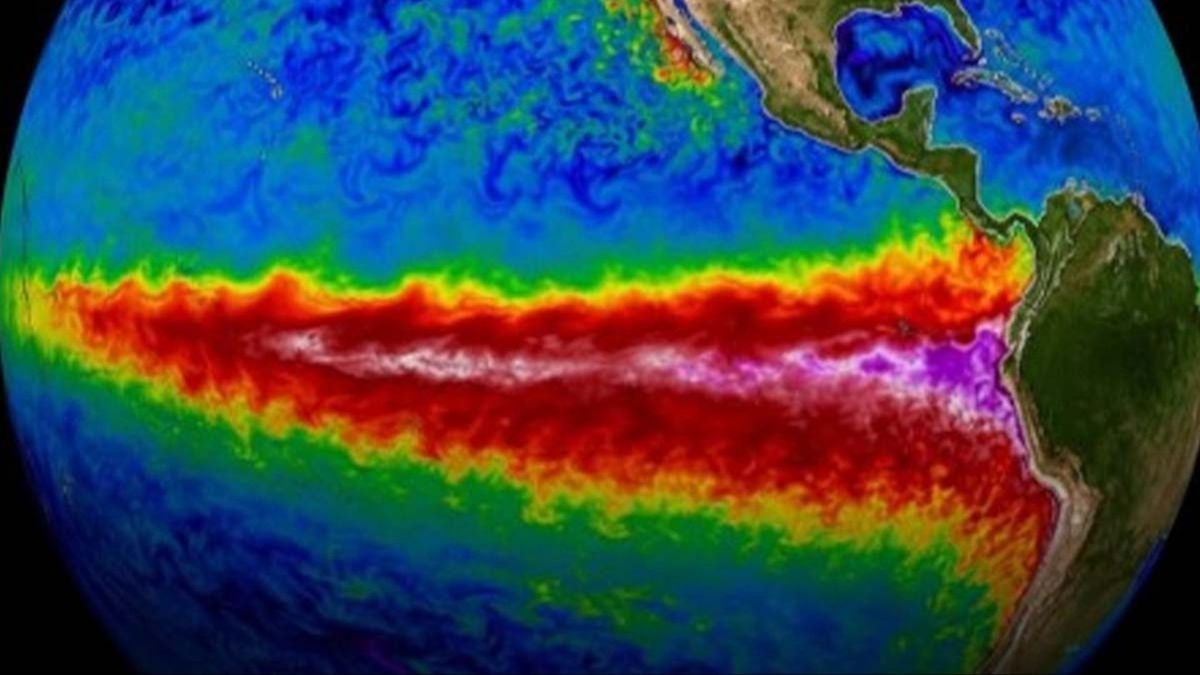
Researchers say a newly identified feature forming deep in the Pacific Ocean may be helping drive this year’s El Niño conditions.
Scientists report they’ve tracked an unusually warm subsurface formation—called a Kelvin wave—that’s strengthening quickly beneath the Pacific.
This vast body of heated water is registering as much as 13.5 degrees Fahrenheit above normal in some areas, a level of warmth that could contribute to extreme heat at the surface and beyond.
A “super El Niño” is typically defined as a period when Pacific sea-surface temperatures climb at least 3.6 degrees Fahrenheit above the long-term norm.
When that happens, global weather patterns can be disrupted, increasing the odds of unusually hot, potentially record-setting summers in some regions and colder, stormier winters in others.
Michelle L’Heureux, a researcher with the National Oceanic and Atmospheric Administration’s Climate Prediction Center, told the Wall Street Journal: “The current Kelvin wave is impressive and, by some measures we look at, it is rivaling the one we saw in 1997.”
The size and intensity of a Kelvin wave in the lead-up to El Niño can offer clues about how strong the warming phase may become.
Historically, the first widely recognized super El Niño occurred in 1877, triggering catastrophic drought and famine that are estimated to have caused around 50 million deaths worldwide.
More recently, the 2015–2016 super El Niño was linked to major public-health impacts, including increased outbreaks of Zika virus, cholera, hantavirus, chikungunya, and other illnesses.
The US National Oceanic and Atmospheric Administration (NOAA) currently estimates there is an 80 percent chance of El Nino developing by July 2026.
Speaking to AFP, Adam Scaife, head of long-range prediction at the UK Met Office, said the developing event could be among the most powerful in decades, or “even be of record strength”.
He added: “There’s definitely something coming. We’re very confident about that, and it looks like it will be a big event.”
Still, forecasters stress that the risks may not end with the event itself.
“The impacts of this El Nino – on things like rainfall and of course temperature – are riding on top of climate change, and could well be larger than anything we’ve seen in the past,” Scaife further noted.
Because the planet is warmer overall, an El Niño occurring in 2026 may not resemble similar events from a couple of decades ago, even if the underlying ocean pattern looks comparable.
L’Heureux added: “Ultimately the strength of this event will be likely influenced by details, like the low-level winds, which we cannot predict many months in advance.”