

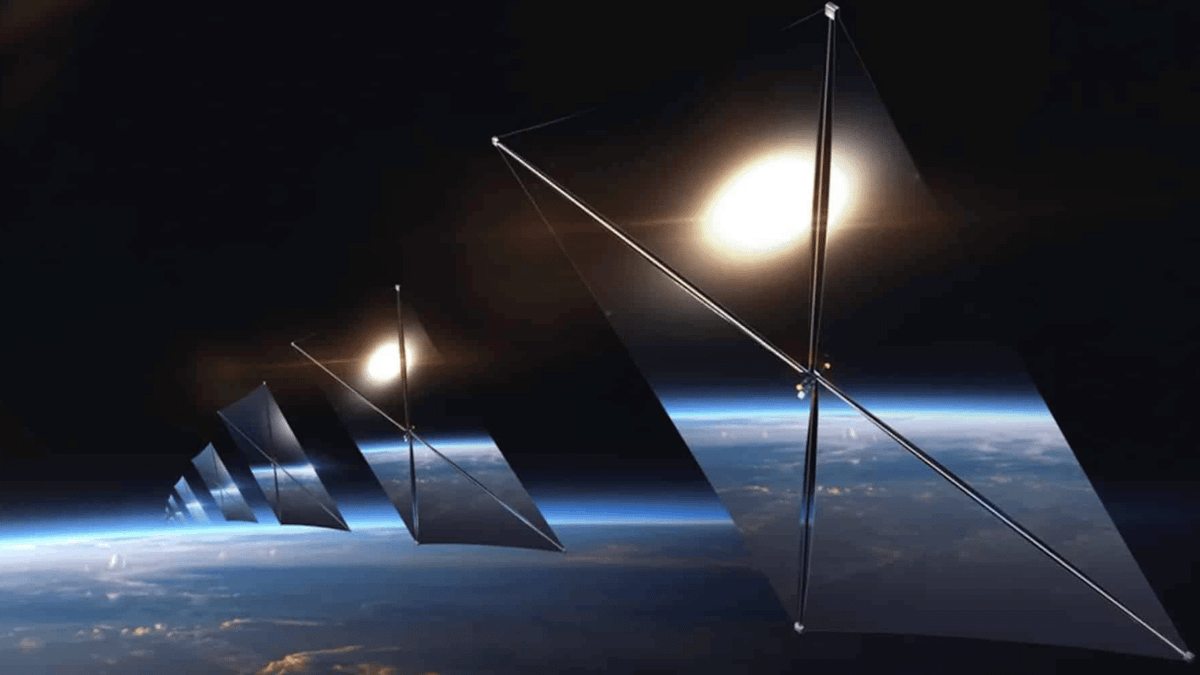
Scientists are warning about a proposed venture that could involve sending tens of thousands of mirrors into orbit.
The concept would use satellites to deploy around 50,000 reflective panels in space — a scale that has prompted concern among researchers.
The goal isn’t to create a spectacle for astronauts, but to make sunlight available “on demand” by redirecting it back to Earth during hours when it wouldn’t normally reach certain locations.
The proposal comes from Reflect Orbital, a California-based space technology company aiming to position mirrors in orbit so they can bounce sunlight to targeted areas below.
According to the company, the reflected light could help some solar power facilities operate around the clock, provide illumination for disaster-hit regions, and potentially reduce the need for street lighting.

The company also suggests the extra light could lengthen workable hours and create distinctive evening conditions for events and public spaces.
However, researchers say the idea could carry serious consequences, and some have written to the US Federal Communications Commission (FCC) urging caution before any approval moves forward.
“The proposed scale of orbital deployment would represent a significant alteration of the natural night-time light environment at a planetary scale.”
Experts argue that changing exposure to natural darkness could disrupt biological clocks in humans and wildlife, influencing sleep cycles and hormone regulation. For nocturnal animals, altered night conditions could also interfere with behaviors such as foraging and migration in species including hedgehogs, owls, racoons, and fireflies.
Prof Charalambos Kyriacou, a geneticist at the University of Leicester and president of the EBRS, has called on the FCC to pause and consider the wider ripple effects.
“We’re saying, please think before you go through with this, because this could have global implications for things like food security. Plants need the night. You can’t just get rid of it.”
The Royal Astronomical Society (RAS) has also criticized the potential impact of large-scale orbital projects, including Reflect Orbital’s mirrors and SpaceX’s stated ambitions to launch up to 1,000,000 satellites as part of efforts tied to powering artificial intelligence.
“These proposals would not only have a disastrous impact on the science of astronomy, they would also hinder the right of everybody on Earth to enjoy the night sky. That is unacceptable.
“The stars above us are a valued part of human heritage – deploying more than one million exceptionally bright satellites would utterly destroy this and permanently scar the natural landscape.
“We hope the FCC wholeheartedly rejects the plans.”
The FCC has been contacted for comment.