

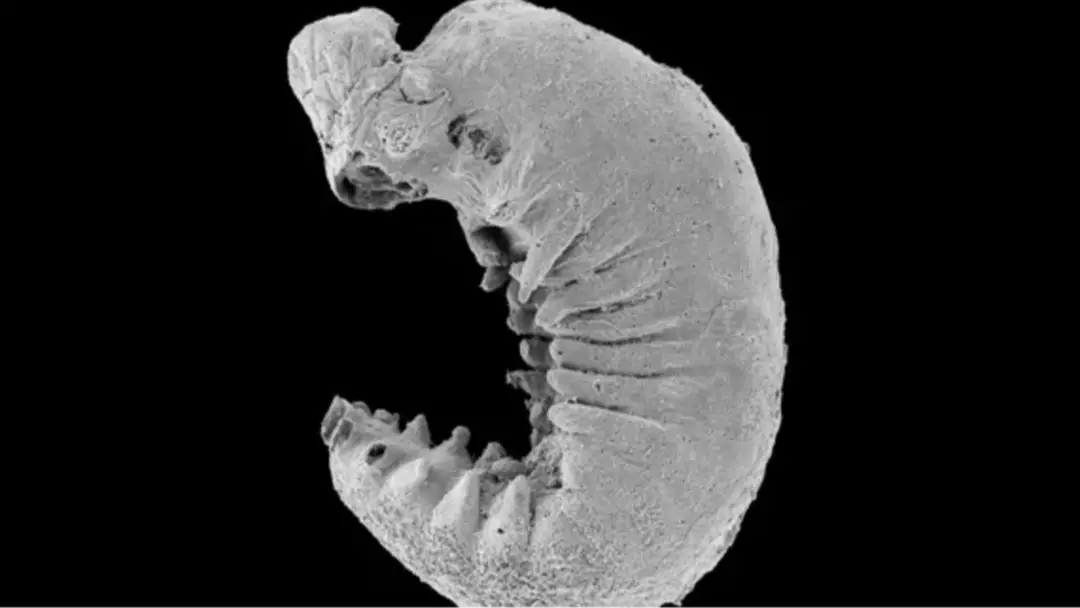
Researchers were astounded upon unearthing a fossil that dates back hundreds of millions of years, preceding the era of the dinosaurs.
Dinosaurs began their existence approximately 243 million years ago during the Triassic period. They eventually dominated Earth’s ecosystems until a catastrophic extinction event 66 million years ago.
The context is significant, as this particular fossil has been dated to a remarkable 520 million years ago.
This places it about 130 million years before the emergence of trees and 70 million years before the evolution of sharks.
In other words, there is a greater time gap between this fossil and the first dinosaurs than between the first dinosaurs and the present day.
So, in a world devoid of dinosaurs, trees, and sharks, what exactly was inhabiting the Earth 520 million years ago?
This time frame is known as the Cambrian Period, characterized by the ‘Cambrian Explosion,’ a significant surge in the diversity of complex life forms in the fossil record.
The majority of these life forms were arthropods, precursors to modern-day crabs, insects, and spiders.
The recent fossil find is indeed an arthropod, named Youti yuanshi.
What makes this fossil unique?
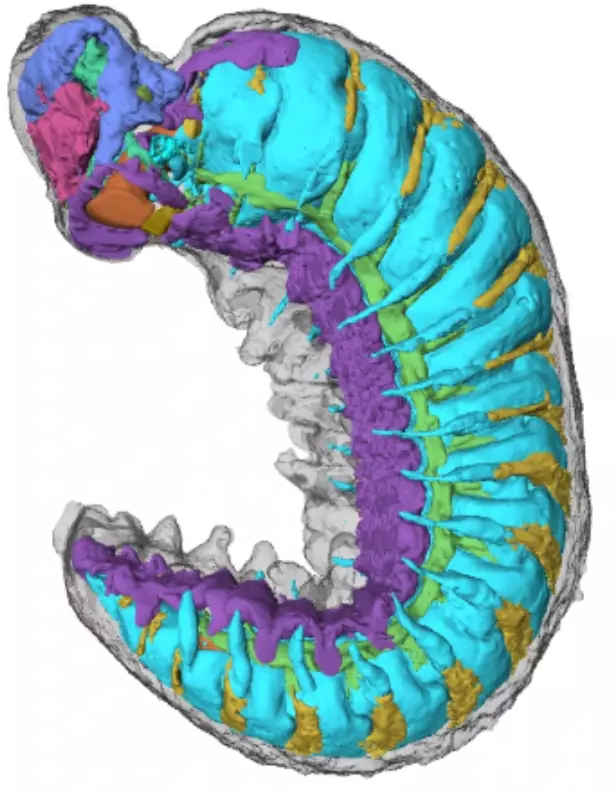
Not only is it a larval fossil, offering insights into the life cycles of early arthropods, but it also remarkably retains its internal organs from this ancient period.
Finding a dinosaur fossil with intact internal organs, skin, or feathers is uncommon, and discovering one that is significantly older is truly rare.
Dr. Martin Smith from Durham University, a principal author of the study, explained to Live Science that the creature’s soft tissues were replaced by phosphate and preserved in rock, likely due to high phosphorous levels in the water.
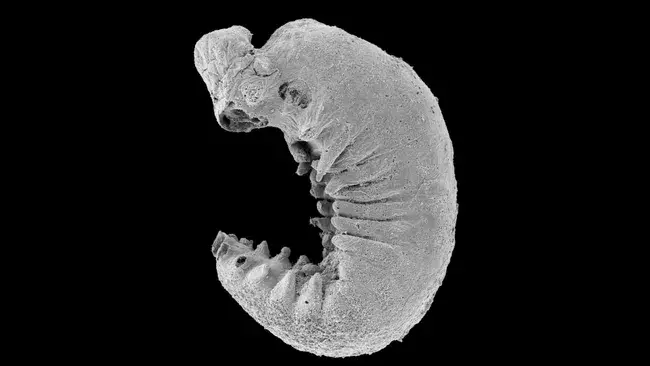
Researchers at the site noted they could discern ‘the miniature brain regions, digestive glands, a primitive circulatory system, and even traces of the nerves supplying the larva’s simple legs and eyes.’
Dr. Smith stated, “When I used to daydream about the one fossil I’d most like to discover, I’d always be thinking of an arthropod larva, because developmental data are just so central to understanding their evolution.”
He further noted: “But larvae are so tiny and fragile, the chances of finding one fossilized are practically zero – or so I thought!
“I already knew that this simple worm-like fossil was something special, but when I saw the amazing structures preserved under its skin, my jaw just dropped – how could these intricate features have avoided decay and still be here to see half a billion years later?”