

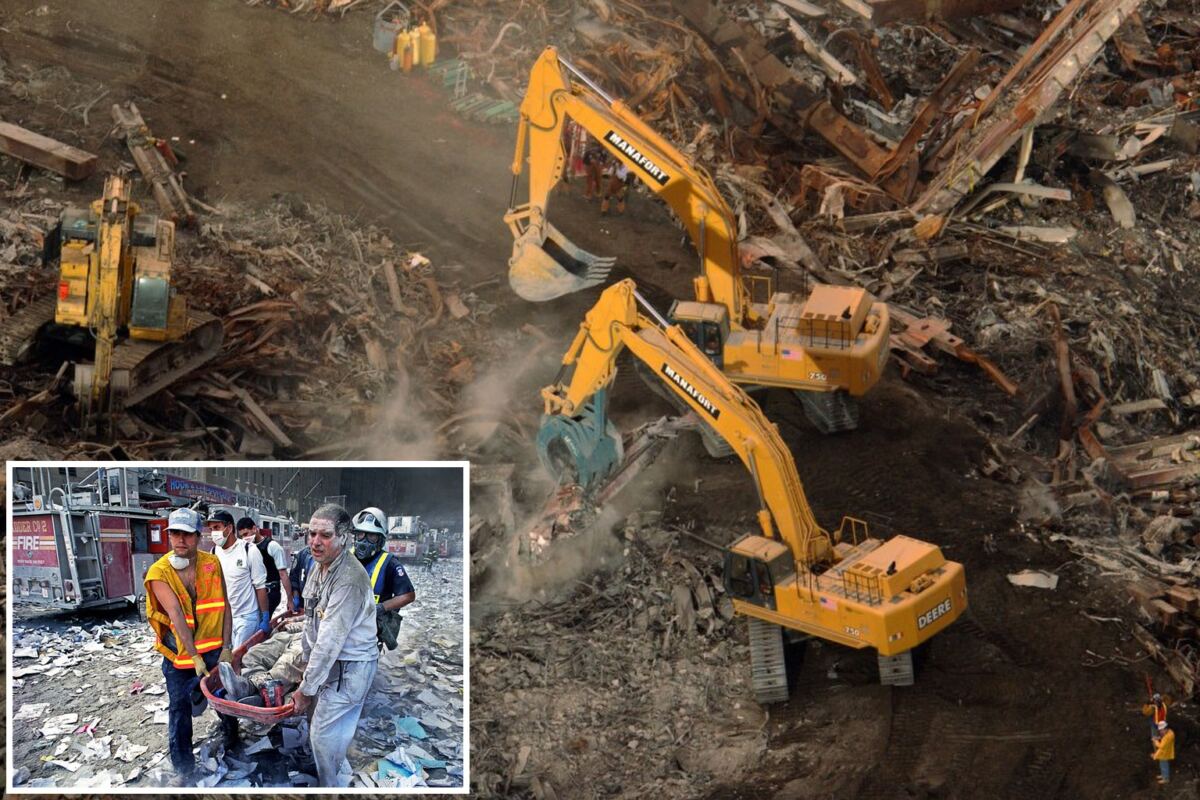
A second victim of the September 11 attacks has been identified through advanced investigative genetic genealogy, New York City officials announced Wednesday.
The woman, who perished when the Twin Towers collapsed on Sept. 11, 2001, will not be publicly named at her family’s request, the city medical examiner’s office told Newsday. Her identification marks the second successful use of the emerging technique by the ME’s office, coming just months after an initial breakthrough in August.
The cutting-edge technology, known as IGG, compares a victim’s genetic profile with publicly available ancestry databases. The NYPD conducts this research through its specialized genetic genealogy squad, which analyzes the data to reconstruct family lineages and establish identifications that had previously eluded investigators.
Harsh conditions at Ground Zero have made extracting viable DNA notoriously difficult over the past nearly 25 years. The terror attacks claimed 2,753 lives, and 1,098 victims still remain unidentified. Fire, collapse damage, and prolonged environmental exposure degraded biological material in ways that challenged conventional forensic methods.
The ME’s office has now collected 47 new genetic samples capable of undergoing genealogical review. That collection offers renewed hope to families still waiting for closure a quarter-century after the attacks.
The first IGG identification of a 9/11 victim came in August, establishing proof of concept for a technique more commonly associated with solving cold-case homicides and identifying unknown deceased individuals. Both successes represent a significant expansion of the technology’s application into one of the most complex mass-casualty events in American history.
Investigative genetic genealogy has transformed forensic science in recent years, most prominently through its use in cracking the Golden State Killer case and dozens of subsequent investigations nationwide. The method relies on distant relatives who have voluntarily uploaded their own genetic information to public databases, allowing investigators to build out family trees and narrow down identities.
The NYPD’s dedicated genetic genealogy squad represents one of the few municipal police units specifically structured around this capability. Their work on the 9/11 identifications demonstrates how the approach can succeed even with severely compromised samples from historical disasters.
The medical examiner’s office continues its sustained effort to identify all victims of the World Trade Center attack, maintaining what has become the largest and most complex forensic identification project in U.S. History. The 47 new samples now queued for review suggest additional announcements may follow in coming months.
Family members of the unidentified have long pressed for continued advancement of forensic techniques, arguing that technological progress should be applied to the still-open wound of 9/11. The two recent identifications validate that advocacy and provide tangible evidence that even decades-old cases remain viable.
The woman’s family now has the option of receiving her remains for burial, a resolution denied to hundreds of other families whose loved ones were never identified or whose remains were never recovered separately from the commingled material at the World Trade Center site.