

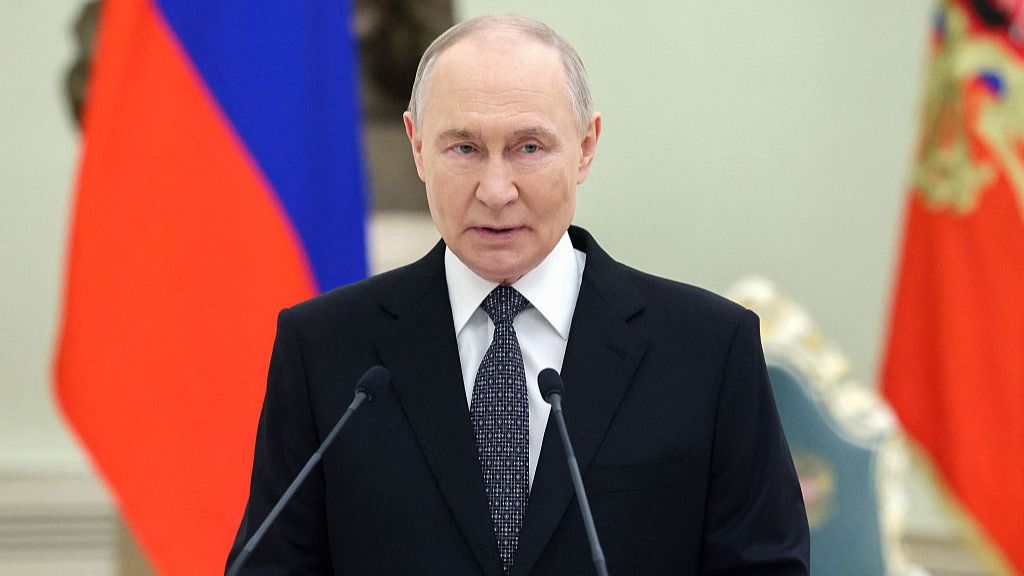
For military planners watching Russia’s brutal invasion of Ukraine, the specter of another world-shattering conflict on the scale of World War II has rarely felt distant.
Along the war’s roughly 745-mile eastern front, vast numbers of young Ukrainian and Russian men have been funneled into relentless fighting. The BBC has estimated that as many as 400,000 of President Vladimir Putin’s troops have been killed for territorial gains sometimes measured in mere meters.
Ukraine, too, has paid a staggering price. The BBC has also reported that around 200,000 soldiers, volunteers and conscripts have died since the full-scale invasion began in February 2022, leaving entire communities scarred by loss.
Yet anxiety is no longer confined to a distant battlefield at Europe’s edge. Analysts warn that the risk of the conflict widening could drag major powers into direct confrontation — and, in the worst case, place the continental United States in the crosshairs, with seven American locations previously highlighted by Russian state media as potential nuclear targets.
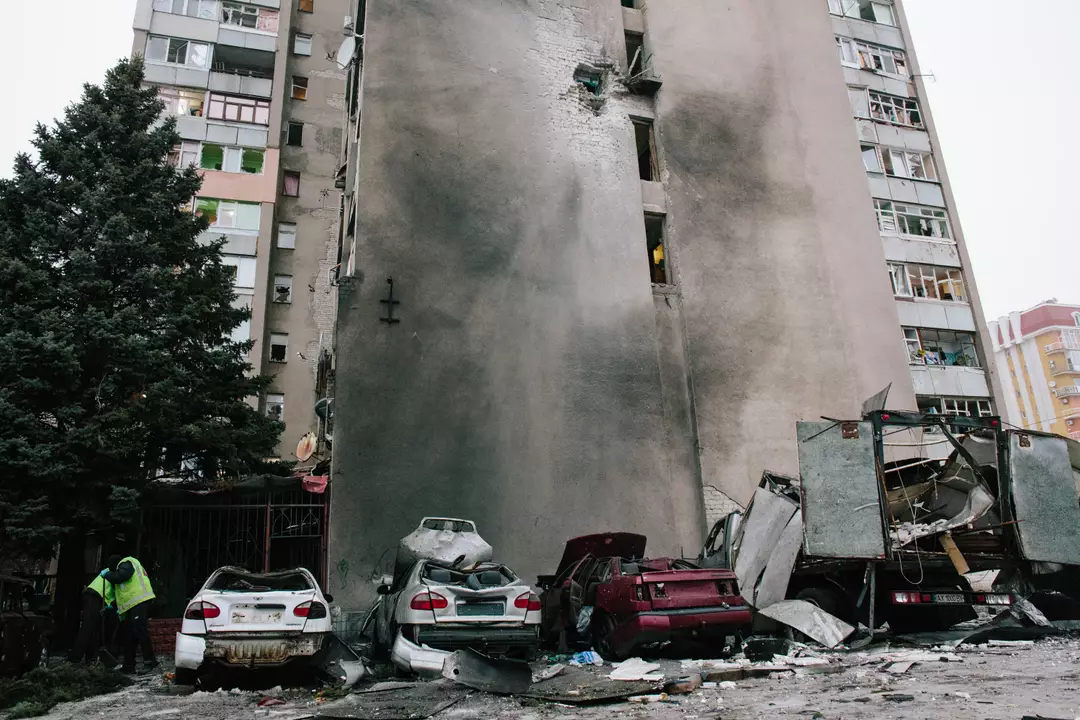
Fears of spillover beyond Ukraine’s borders appear to intensify week by week as both sides deploy more advanced capabilities.
For months, Russia has struck targets across Ukraine — including civilian areas and critical energy infrastructure — from hundreds of miles away using an array of modern ballistic and hypersonic missiles, some reportedly capable of exceeding 15,000 miles per hour.
Ukraine has increasingly answered with long-range systems of its own. This week, it reportedly hit a ballistic-missile manufacturing site more than 870 miles inside Russian territory using the domestically produced FP-5 Flamingo cruise missile.
Those responses have come despite repeated cautions from partners that deep strikes could increase the risk of retaliation against Ukraine’s principal backers — especially the United States, which has provided more than $127 billion in military and financial support.
Pressed on whether intensifying Ukraine’s retaliation could invite a wider war, President Volodymyr Zelensky told the BBC: “I believe that Putin has already started it.
“The question is how much territory he will be able to seize and how to stop him… Russia wants to impose on the world a different way of life and change the lives people have chosen for themselves.”
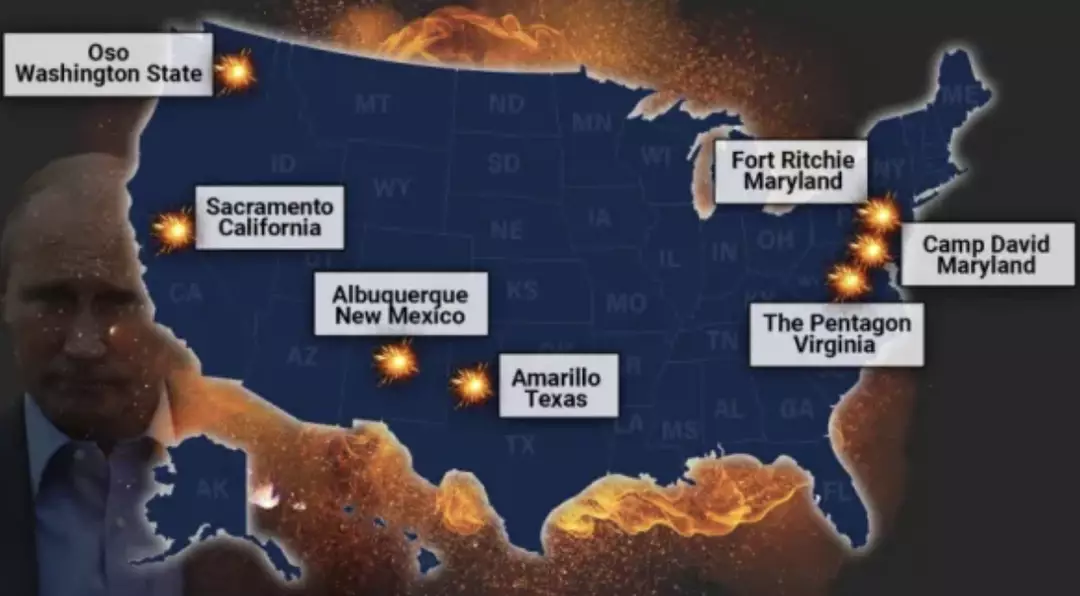
Details of Moscow’s nuclear decision-making in a crisis are tightly guarded. Still, earlier in the war, Russia’s state television aired a segment naming several U.S. sites it claimed would be among the first struck in the event of escalation.
Each of the listed locations carries clear strategic significance — and a nuclear detonation at any one of them would cause mass casualties and widespread disruption.
For example, modeling cited from the open-source tool Nuke Map suggests that a “standard-sized” Russian nuclear weapon detonating over Sacramento could kill roughly 100,000 people almost instantly.
Even so, it is uncertain whether the broadcast reflected real targeting priorities or was primarily meant as intimidation. Some sites, such as Fort Ritchie and Sacramento, appear to echo Cold War-era thinking, with their direct military value having shifted substantially over time.
Another interpretation is that the selection hints at how Russia might approach a strike: Fort Ritchie, once an intelligence-focused installation, has been decommissioned, but it sits near the Raven Rock Mountain Complex — often described as a fallback “underground Pentagon” designed to support continuity of government during a national emergency.
From that perspective, a strike on key West Coast targets could be intended not only to inflict damage, but also to degrade America’s ability to organize and coordinate a response in a nuclear scenario.