

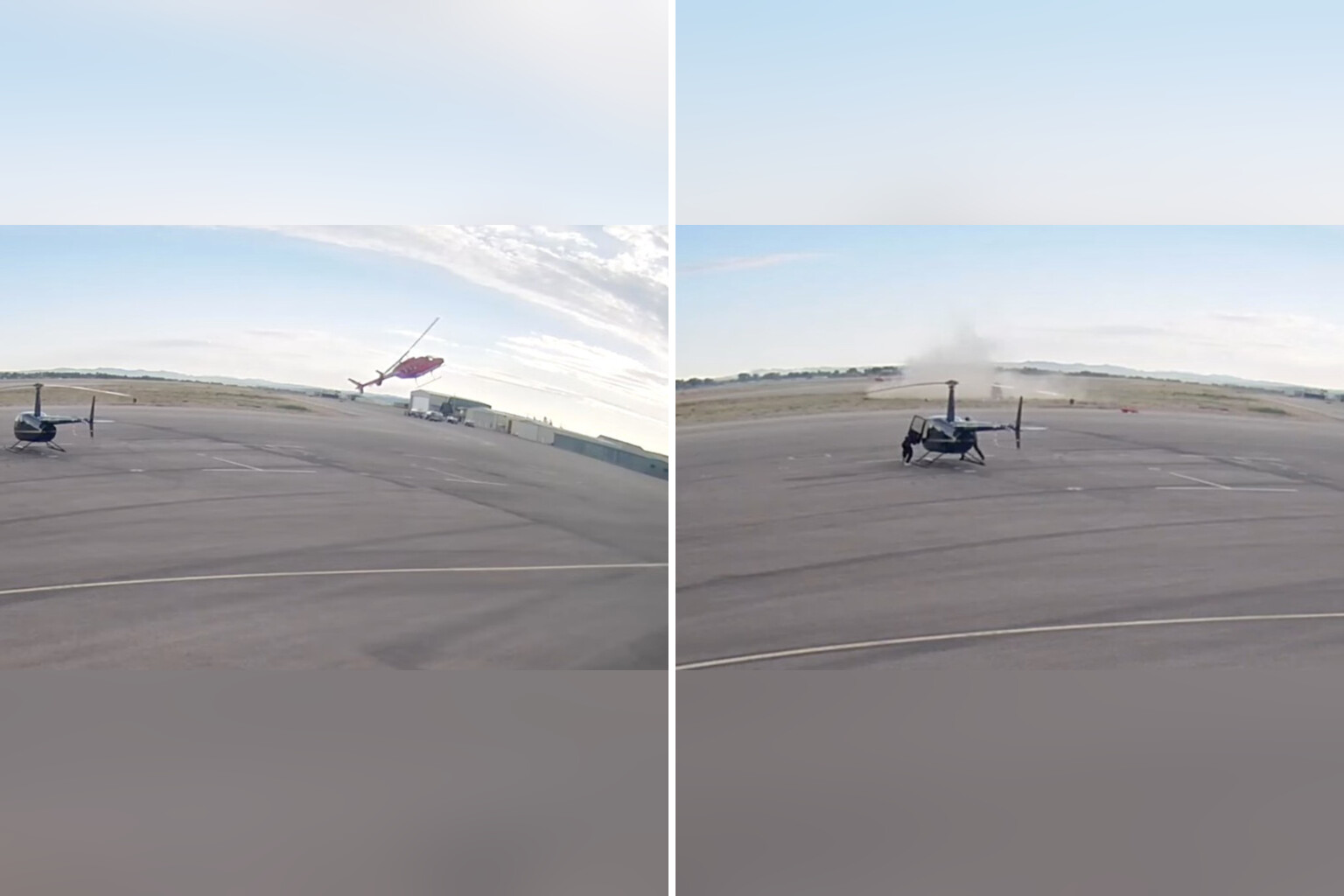
The National Transportation Safety Board has released dramatic surveillance footage of a helicopter training flight that ended in a violent series of crashes on a Utah airport taxiway, with both occupants somehow walking away with only minor injuries.
The 32-year-old flight instructor lost control of the red Bell 206 during a lesson at Cedar City Regional Airport on May 23, the NTSB determined, ruling out mechanical failure as the cause. His student, a 25-year-old man, was in the aircraft with him when the routine training exercise turned catastrophic.
The CCTV footage shows the helicopter lifting off before it bounced on impact and began careening helplessly across the taxiway. The chopper’s tail section was sheared off after it hit the ground nearly vertically, yet the aircraft continued to spin and crash until it finally came to a standstill in a pile of dust and debris.
Despite the dramatic destruction visible in the video, both men escaped with what the NTSB report characterized as “minor” injuries. The agency did not publicly identify either the instructor or the student in its release.
The Bell 206, a model widely used for training and utility operations, was left in pieces across the taxiway. The tail section separation and the helicopter’s repeated impacts with the ground made the survivability of the incident particularly striking to aviation safety observers.
Cedar City Regional Airport, located in southwestern Utah, serves as a regional hub for general aviation and flight training operations. The May 23 crash drew immediate local emergency response before the NTSB began its formal investigation into the sequence of events.
The instructor’s loss of control during what should have been a standard training maneuver raised immediate questions about the conditions and decisions that led to the initial bounce and subsequent uncontrolled ground contact. The NTSB’s quick determination that mechanical failure was not a factor pointed the investigation toward operational and human factors.
Flight training accidents involving loss of control during hover or low-altitude maneuvers remain a persistent concern in general aviation safety. The Bell 206’s behavior in the footage—lifting off, bouncing, and then entering an uncontrolled sequence of impacts—suggested a possible dynamic rollover or settling-with-power scenario, though the NTSB has not publicly detailed its specific findings on the mechanism of the initial upset.
The release of the surveillance video by the federal safety board provided the first public visual account of an incident that had previously been known only through preliminary local reports. The footage’s circulation quickly drew attention to the remarkable outcome for two men who survived an aircraft destruction sequence that appeared, from the video, to have been potentially fatal.
The NTSB continues its investigation into the Cedar City crash as part of its broader mandate to investigate civil aviation accidents and issue safety recommendations. The agency typically produces a final report months after an incident, incorporating pilot interviews, weather data, aircraft records, and analysis of the accident sequence.
Both the instructor and the student have not been identified publicly, and it remains unclear whether the instructor continues to hold flight instructor certification or whether any enforcement action has been taken by the Federal Aviation Administration in connection with the May 23 crash.
The NTSB’s next scheduled public meeting on general aviation safety issues has not been announced.