

When a person suddenly has a serious medical emergency and becomes unconscious or unresponsive, CPR can be the key action that keeps them alive until professional help arrives.
Getting down beside them and delivering steady chest compressions helps maintain breathing-like circulation, keeping oxygen-rich blood moving from the heart to critical organs.
However, CPR has to be done correctly. Effective compressions can mean cracked ribs but a preserved life; poorly performed CPR may fail to circulate blood adequately, increasing the risk of severe oxygen deprivation and brain injury.
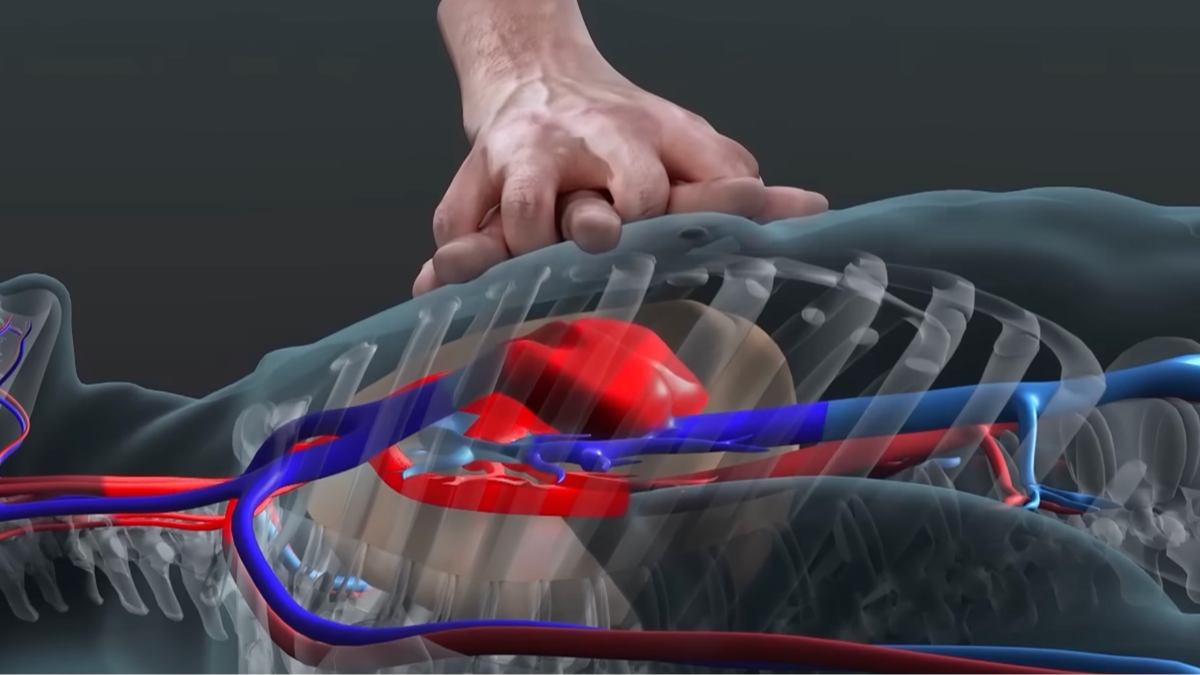
A detailed simulation from Action First Aid illustrates what the body goes through during CPR, and why compressions that are too fast or too slow may not deliver enough blood flow to protect the brain during a major emergency.

Even if incorrect CPR may do little to help, it is still the primary way to support someone’s chances of survival until medical staff—or a defibrillator—can restart or stabilize heart and breathing function.
If someone stays unresponsive for around four minutes, brain injury can begin, and after roughly 10 minutes without sufficient blood flow or breathing, that damage can become permanent.
That urgency is why CPR training matters, despite research indicating that even in hospitals—when performed by medical professionals—CPR succeeds in only about 20 to 40 percent of cases.
Action First Aid says that CPR puts ‘the power to save a life in your hands’ because it performs two ‘critical’ roles.
“One, compressions move oxygenated blood to the brain to keep [it] alive, and two, compressions keep blood and oxygen moving to the heart muscle itself so that it has the best chance of resuming a normal electrical rhythm,” the experts stated.
According to the explanation, every firm downward press acts like an artificial pump, forcing oxygenated blood out from the heart toward organs such as the brain, while the release phase helps draw deoxygenated blood back.
Compressing to a depth of about two inches helps ensure blood is pushed effectively through the body, and maintaining a consistent cadence gives circulation time to move between compressions. The simulation suggests that failing to keep proper depth and rhythm can quickly lead to dangerous oxygen loss.
To keep blood oxygenation and brain delivery as high as possible, the recommended pace is 100 to 120 compressions per minute—an exhausting effort for the rescuer and a forceful process for the patient’s body.
At the right pace, compressions keep blood ‘moving within the heart and up to the brain’, and proper chest recoil is essential so the next compression can push blood outward again toward the body’s most vital control center.
It can be intimidating—especially because ribs may fracture—but Action First Aid says” “If ribs break, that’s ok. What’s not OK is allowing the brain to die from lack of oxygen.”
Staying consistent, often by matching compressions to the beat of Stayin’ Alive by the Bee Gees, can help keep the person stable until paramedics arrive—and can be the deciding factor between survival and death.