

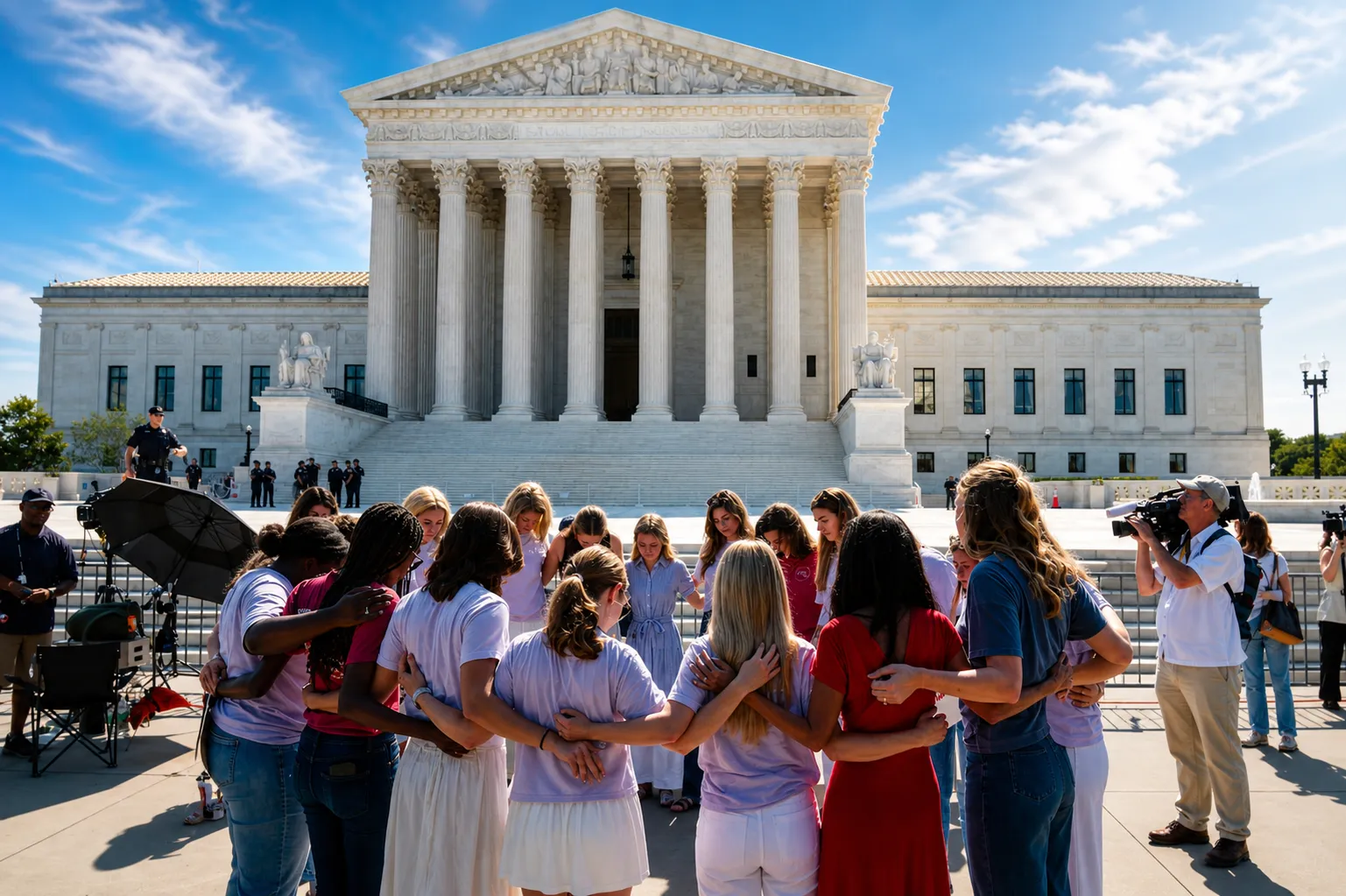
The United States Supreme Court on Tuesday upheld state laws banning transgender girls and women from participating in girls’ and women’s school sports teams, marking the first time the high court has weighed in on the contentious national debate over transgender athletes.
In a 6-3 decision, the court ruled that neither Title IX, the landmark federal civil rights law prohibiting sex discrimination in education, nor the Constitution’s Equal Protection Clause prevent states from enforcing these bans. Justice Brett Kavanaugh authored the majority opinion in the cases known as West Virginia v. B.P.J. And Little v. Hecox.
“The Constitution and Title IX do not require an overhaul of women’s and girls’ sports throughout America,” Kavanaugh wrote, while adding that transgender girls and women who want to play sports deserve “respect” and should not be “ostracized or vilified.”
The ruling effectively validates athletic participation restrictions in at least 29 states. The two cases specifically challenged laws enacted by West Virginia and Idaho. Idaho adopted its law in 2020, becoming the first state to forbid transgender athletes from participating in girls’ and women’s sports. West Virginia followed with the “Save Women’s Sports Act” in 2021.
The West Virginia case involved B.P.J., a teenager who publicly identified as a girl since third grade and has taken puberty blockers to prevent male puberty. B.P.J. Competed on her school’s track and cross-country teams during the litigation and recently won the state championship in girls’ shot put while finishing fourth in girls’ discus. The Idaho case involved Lindsey Hecox, a college student who sought to try out for Boise State University’s women’s track and cross-country teams.
Lower courts in both cases had blocked the state bans, concluding they violated Title IX and the Equal Protection Clause. The Ninth Circuit Court of Appeals ruled that Idaho’s law violated the 14th Amendment’s Equal Protection Clause, while the Fourth Circuit found West Virginia’s law violated Title IX.
The majority held that Title IX explicitly allows sex-segregated athletic teams and that states are free to limit participation to biological sex. Kavanaugh emphasized that the interests in safety and competitive fairness are sufficiently important to justify sex-based classifications in sports. The court rejected arguments that biological males who have undergone gender-affirming medical treatment lack athletic advantages.
The opinion also distinguished this case from the Supreme Court’s landmark 2020 Bostock v. Clayton County decision, in which the court held that federal employment law prohibits discrimination on the basis of gender identity. Challengers had argued that reasoning should apply to Title IX and school sports. However, Kavanaugh wrote that the civil rights law and its application “are not relevant in this very different statutory and factual context,” noting that Title VII concerns employment while Title IX in this context focuses on sports.
The court’s three liberal justices dissented. In a blistering partial dissent, Justice Sonia Sotomayor, joined by Justices Elena Kagan and Ketanji Brown Jackson, argued that the majority cut off constitutional claims before lower courts could resolve key factual disputes. Sotomayor contended that students like B.P.J. Should have had the opportunity to demonstrate that states’ safety and fairness interests did not apply to transgender girls who had not experienced male puberty and received gender-affirming treatment.
“Because of the Court’s decision today, West Virginia, and any other state actor, can deny B.P.J. And others like her these experiences simply because it thinks they have an inherent athletic advantage, even if the facts show that they do not,” Sotomayor wrote.
Justice Ketanji Brown Jackson filed a separate partial dissent arguing that transgender girls and women can experience sex-based discrimination under Title IX just as cisgender women do when institutions impose gender-based expectations upon them.
The Williams Institute at UCLA estimates that approximately 122,000 transgender American teenagers participate in high school sports. The ruling represents a major setback for LGBTQ+ advocates, coming just over a year after the court’s 6-3 decision upholding a Tennessee law banning gender-affirming medical treatments for transgender minors.
Despite the ruling’s breadth, the majority opinion left some questions unresolved. Kavanaugh noted that the decision does not address whether schools that choose to allow transgender athletes to compete on teams matching their gender identity may do so, nor does it decide whether such inclusionary policies would violate the Constitution. He also noted that the decision does not resolve broader questions about whether classifications targeting transgender people merit heightened constitutional scrutiny.
The case has become politically significant in recent years. The 2024 Trump presidential campaign aired attack ads on transgender athletes more than 15,000 times, making the issue a prominent feature of national politics. President Donald Trump praised Tuesday’s ruling, calling it a “BIG WIN.”
State officials argued the bans protect fairness and safety in women’s sports, citing research showing that testosterone produced during male puberty leads to greater muscle mass, larger hearts and lungs, greater height, and longer limbs. Many transgender advocates counter that transgender girls who receive medical treatment early in development do not have physiological advantages over competitors.
Twenty-one states currently allow transgender girls to compete on girls’ sports teams, including California and New York, which have laws explicitly protecting that right. The Supreme Court’s ruling does not require these states to change their policies, but it removes constitutional obstacles that had previously blocked other states from enforcing bans.