

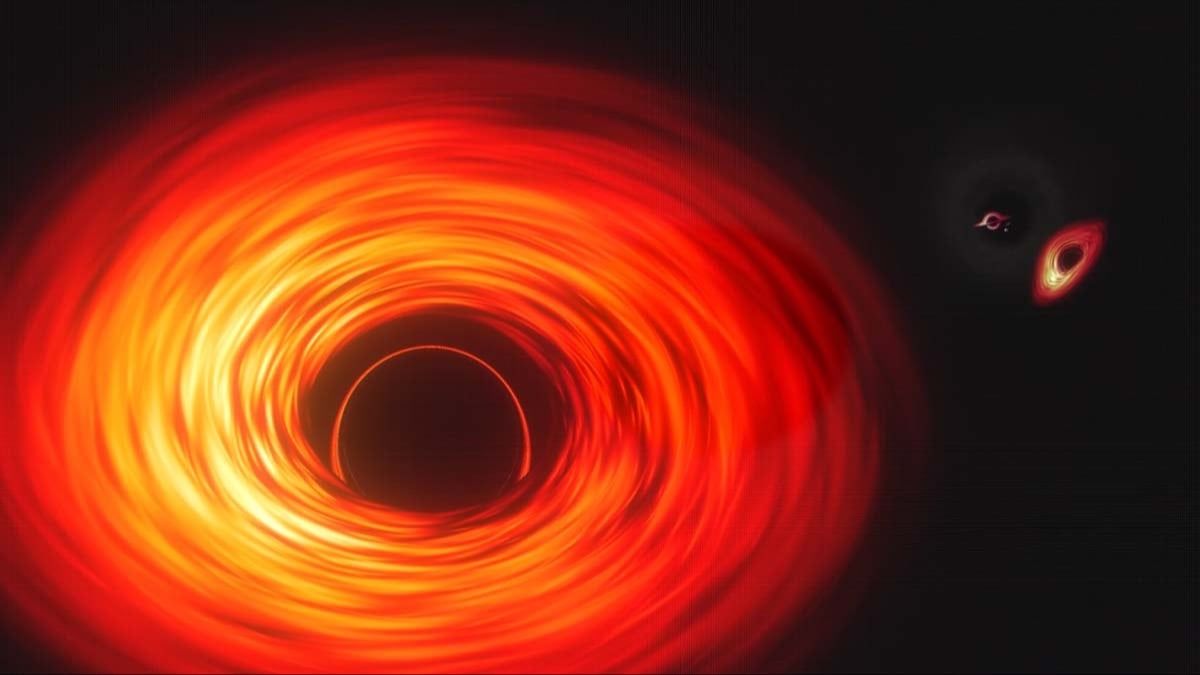
A NASA animation has sized the biggest black holes known to scientists, revealing the ‘super’ scale of supermassive black holes, including one that has the mass of 66 billion Suns.
First shared in 2023, the short animation is meant to help put black hole “sizes” into perspective. It focuses on the enormous black holes that sit in the cores of many large galaxies — including the Milky Way — with masses ranging from around 100,000 Suns to many tens of billions of Suns.
In the clip, NASA highlights 10 of these outsized objects and compares them by scaling the diameter of each black hole’s shadow. The viewpoint starts close to the Sun and then zooms farther out, lining each shadow up against familiar landmarks across our solar system as the black holes grow larger and larger.
The scaling is informed by observations from the Event Horizon Telescope, a worldwide network of radio dishes that worked to image the supermassive black holes in M87 and the Milky Way in 2019 and 2022. Those efforts produced the now-famous view of a glowing ring of superheated gas surrounding a dark central region.
That dark area corresponds to the black hole’s influence on nearby light: anything that passes the event horizon — the point of no return — can’t escape, and light that passes close by is strongly bent by gravity. Together these effects create a ‘shadow’ that’s roughly twice the diameter of the actual event horizon, providing a key measurement for comparisons like the ones in the video.
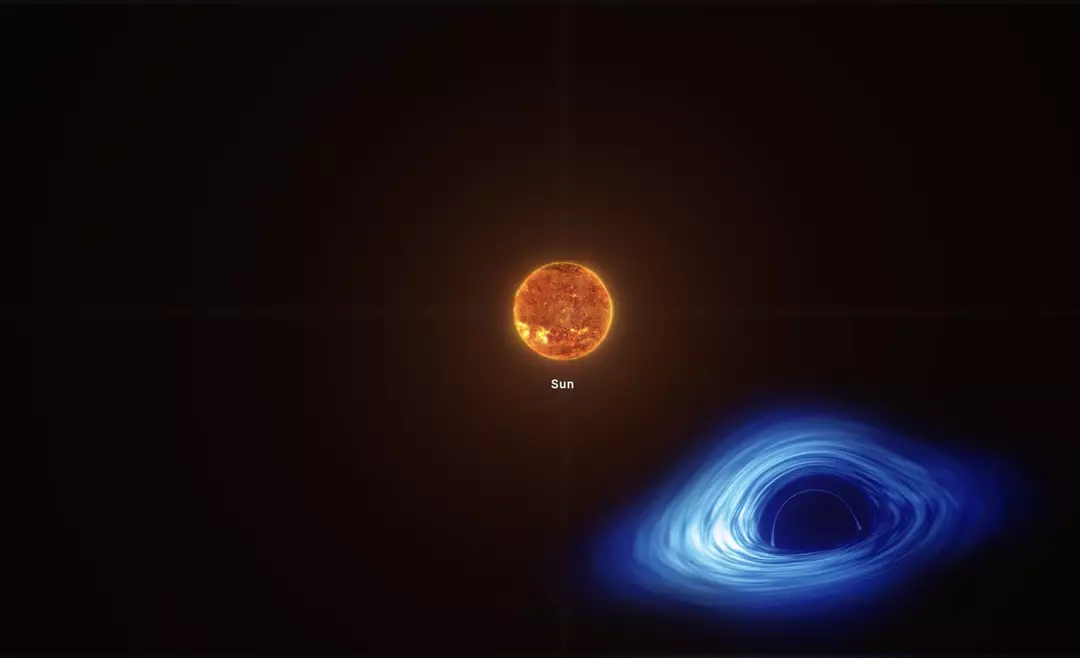
The sequence begins with 1601+3113, a dwarf galaxy whose central black hole is about 100,000 times the Sun’s mass. Even at that scale, the object is so compact that its shadow would still appear smaller than the Sun.
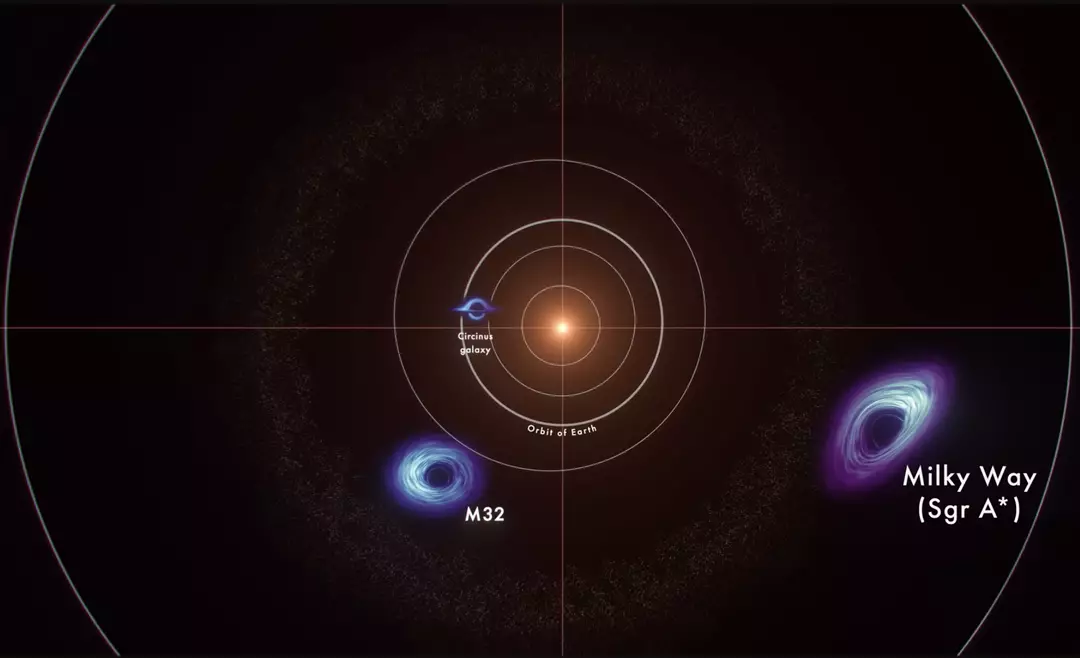
Next is the Milky Way’s own central black hole, Sagittarius A* (pronounced ay-star). Based on years of following the orbits of nearby stars, its mass is estimated at about 4.3 million Suns, and its shadow would span roughly half the diameter of Mercury’s orbit.
The animation also features the unusual case of NGC 7727, a galaxy with two supermassive black holes about 1,600 light-years apart. One is around 6 million solar masses, while the other exceeds 150 million, and researchers expect the pair to eventually collide and combine within about 250 million years.
“Since 2015, gravitational wave observatories on Earth have detected the mergers of black holes with a few dozen solar masses thanks to the tiny ripples in space-time these events produce,” said Goddard astrophysicist Ira Thorpe (via NASA). “Mergers of supermassive black holes will produce waves of much lower frequencies which can be detected using a space-based observatory millions of times larger than its Earth-based counterparts.”
From there, the video moves on to the famous black hole in M87, estimated at about 5.4 billion solar masses. Its shadow is so vast that a light beam moving at 670 million mph (1 billion kph) would need roughly two and a half days to cross from one side to the other.
The final object shown is TON 618, among the most massive black holes with direct measurements. With more than 60 billion solar masses, its shadow is so enormous that light would take weeks to travel across it.
Speaking on the behemoth black holes, Jeremy Schnittman, a theorist at NASA’s Goddard Space Flight Center in Greenbelt, Maryland, said that ‘when galaxies collide, their central black holes eventually may merge together too’.
As for whether Sagittarius A* could ever consume Earth, there’s little reason for concern. Despite their reputation as cosmic vacuum cleaners, black holes don’t exert some special “sucking” force from afar; at large distances their gravity behaves like any other object of the same mass, and they only pull in material that gets extremely close and crosses the event horizon (via BBC Sky at Night Magazine).