

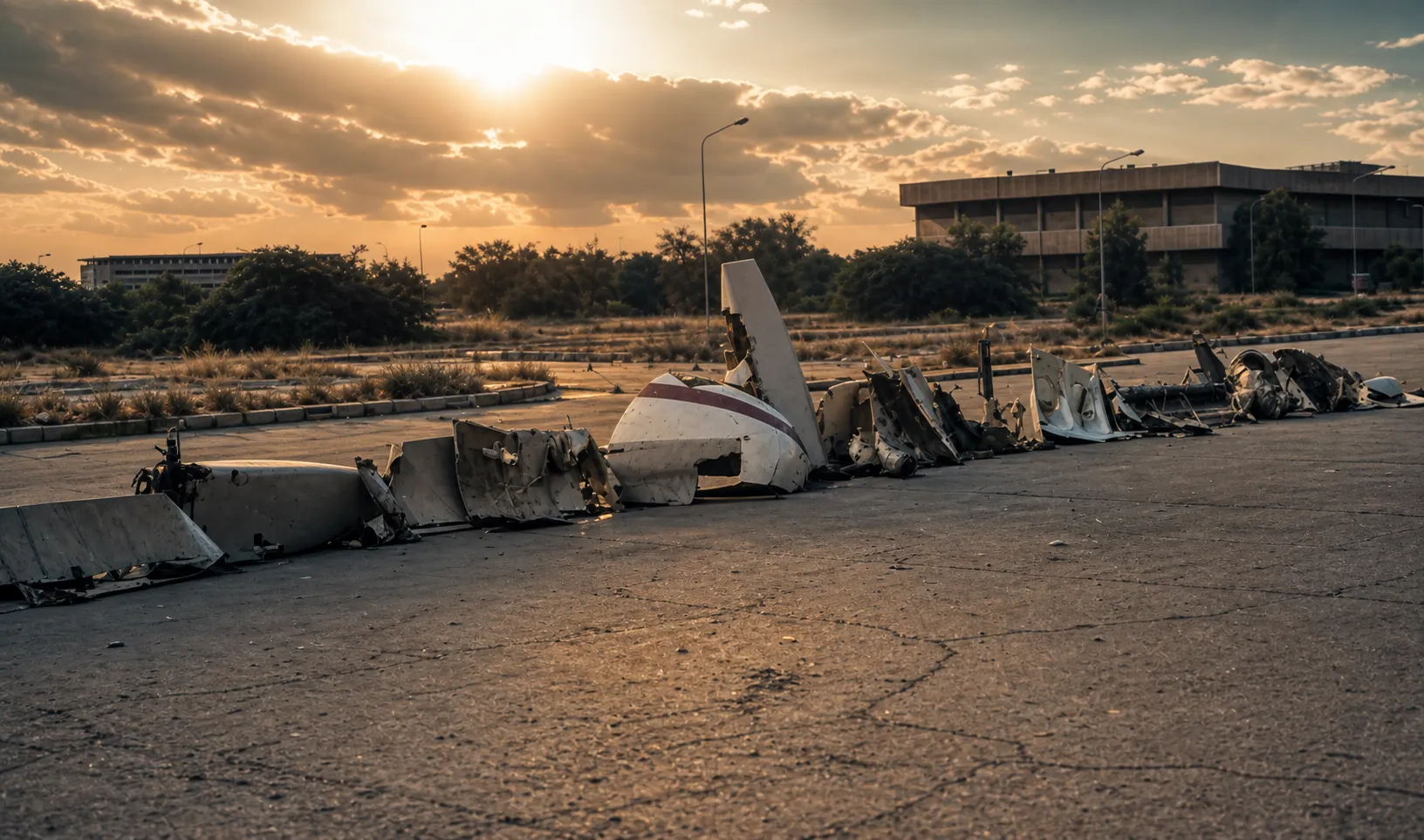
On July 3, 1988, during the closing moments of the Iran-Iraq War, a routine commercial flight became one of aviation’s deadliest catastrophes when the USS Vincennes, a U.S. Navy guided-missile cruiser equipped with state-of-the-art technology, mistakenly fired two surface-to-air missiles at Iran Air Flight 655 over the Strait of Hormuz. All 290 people aboard the Airbus A300 were killed, including 66 children, making the incident one of the deadliest airliner shootdowns in history and a tragedy that would reshape U.S.-Iran relations for decades.
Flight 655, a scheduled commercial service, departed from Bandar Abbas airport in southern Iran at 10:17 a.m. Local time, 27 minutes behind schedule due to an immigration issue. The aircraft, captained by experienced pilot Mohsen Rezaian, was bound for Dubai in the United Arab Emirates on what should have been a brief 28-minute flight across the Persian Gulf. The airplane was transmitting the correct civilian transponder code and maintained radio contact with air traffic control facilities in English throughout its ascent.
The Vincennes, a Ticonderoga-class cruiser commissioned just three years earlier and fitted with the sophisticated Aegis combat system, was patrolling the Strait of Hormuz as part of Operation Earnest Will, a U.S. Initiative to protect oil tankers during the Iran-Iraq War. Commanded by Captain William C. Rogers III, the cruiser had earned a reputation within the Navy as an aggressive vessel. That morning, the Vincennes was engaged in a firefight with Iranian Revolutionary Guard speedboats in Iranian territorial waters after a helicopter deployed from the ship came under small arms fire.
As the surface action continued, Flight 655 appeared on the Vincennes’s radar. The military aircraft was identified at 10:47 a.m., just minutes after takeoff. In the chaos of the ongoing battle with Iranian gunboats, a cascade of errors began. The radar operator initially identified Flight 655 as a commercial airliner based on its transponder code, but amid the darkness of the combat information center and confusion over time zones—the commercial flight schedule used Bandar Abbas time while the ship operated on Bahrain time—this identification was lost. The flight appeared 27 minutes later than scheduled, making it harder to locate on the published aircraft schedules being searched.
More critically, the Aegis system’s computer reassigned tracking numbers in ways that created fatal confusion. The aircraft was briefly assigned one tracking number, then switched to another, while the original number was recycled and assigned to a U.S. Navy fighter jet hundreds of miles away that was descending toward a carrier. Some crew members in the combat information center became convinced they were tracking an attacking Iranian F-14 fighter jet descending toward their vessel, despite their own instruments showing the aircraft was actually ascending.
Over the next seven minutes, the Vincennes issued multiple warnings on military and civilian emergency frequencies, but Flight 655 did not respond. The aircraft, operating on a published commercial flight corridor and in contact with civilian air traffic control, had no reason to monitor military distress channels. The warnings were also vague, addressed to an “unidentified aircraft,” and pilots on a commercial flight would naturally assume they were already identified.
The key decision came at 10:24 a.m., when an agitated crew member informed Rogers that the aircraft was descending and heading directly toward the Vincennes. This report, it later emerged, was wrong. The ship’s own Aegis tapes confirmed the aircraft was ascending through 12,000 feet at a speed of approximately 380 knots—slower than initially reported. Rogers, in the midst of a combat situation and under extreme stress, ordered the firing of two SM-2 surface-to-air missiles at a range of approximately ten nautical miles.
Twenty-one seconds later, the missiles struck the Airbus at 13,500 feet and eight nautical miles from the ship. The aircraft, still well within its assigned commercial air corridor, disintegrated. All 290 people aboard were killed—254 Iranians, 13 Emiratis, 10 Indians, six Pakistanis, six Yugoslavs, and one Italian. Among the dead were families with children who had been traveling to Dubai for leisure.

In the immediate aftermath, U.S. Military officials provided explanations that later proved false. Admiral William Crowe, chairman of the Joint Chiefs of Staff, announced that the Iranian airliner had been flying at 9,000 feet, descending rapidly at a “high speed” of 450 knots, and “headed directly” for the Vincennes. These claims contradicted the data from the ship’s own computers.
The Pentagon released an investigation led by Rear Admiral William Fogarty on August 19, 1988. The report’s findings were more damning than officials had publicly acknowledged. It concluded that Flight 655 had been transmitting the correct civilian identification code and “was on a normal commercial air flight plan profile, in the assigned airway, squawking Mode III 6760, on a continuous ascent in altitude from takeoff at Bandar Abbas to shoot-down.” U.S. Officials attributed the misidentification to “stress” and “unconscious distortion of data” among the crew. Psychological evaluations indicated that combat stress and the crew’s inexperience in actual warfare had led to misjudgment and the unconscious warping of information.
The investigation revealed that the Vincennes had been inside Iranian territorial waters at the time of the shooting—approximately 2.5 miles inside—contrary to initial Navy statements. Three years after the incident, Admiral Crowe publicly admitted on television that the ship had been operating in Iranian territorial waters, finally contradicting the Navy’s earlier claims.
The incident strained U.S.-Iran relations severely. In Iran, many believed the attack was deliberate, fearing it signaled American intention to join Iraq in the war. This perception may have influenced Iran’s decision to accept a ceasefire with Iraq in August 1988, effectively ending the eight-year conflict. Iran filed a lawsuit against the United States at the International Court of Justice in May 1989.
The response to the incident in the United States added to Iranian anger. In October 1988, the crew of the Vincennes received a rapturous heroes’ welcome in San Diego. More controversially, in 1990, Captain Rogers was awarded the Legion of Merit “for exceptionally meritorious conduct in the performance of outstanding service as commanding officer” from April 1987 to May 1989. The citation made no mention of the downing of Flight 655, but Iranians viewed the award as tacit approval of his actions. Other crew members received Navy Commendation Medals and Combat Action Ribbons.
In 1996, after years of legal proceedings, the United States and Iran reached a settlement at the International Court of Justice. The U.S. Agreed to pay $131.8 million in total compensation, with $61.8 million going to the families of the 248 Iranian victims at rates of $300,000 per wage-earning victim and $150,000 per non-wage-earner. However, the United States never formally apologized or admitted legal liability, characterizing the payment as being made on an “ex gratia” or humanitarian basis. President Ronald Reagan issued a written diplomatic note expressing “deep regret” over the loss of life.
The downing of Iran Air Flight 655 remains a pivotal moment in the long history of U.S.-Iranian animosity. In Iran, the incident is commemorated annually, with mourners tossing flowers into the Persian Gulf at the site where the aircraft went down. Iranian officials continue to invoke the tragedy as evidence of American hostility, ranking it alongside the 1953 CIA-backed coup that toppled Iran’s elected prime minister. The incident underscores the catastrophic consequences that can result from a combination of military aggression, technological complexity, human error, and the fog of war—a lesson that resonates three decades later.