

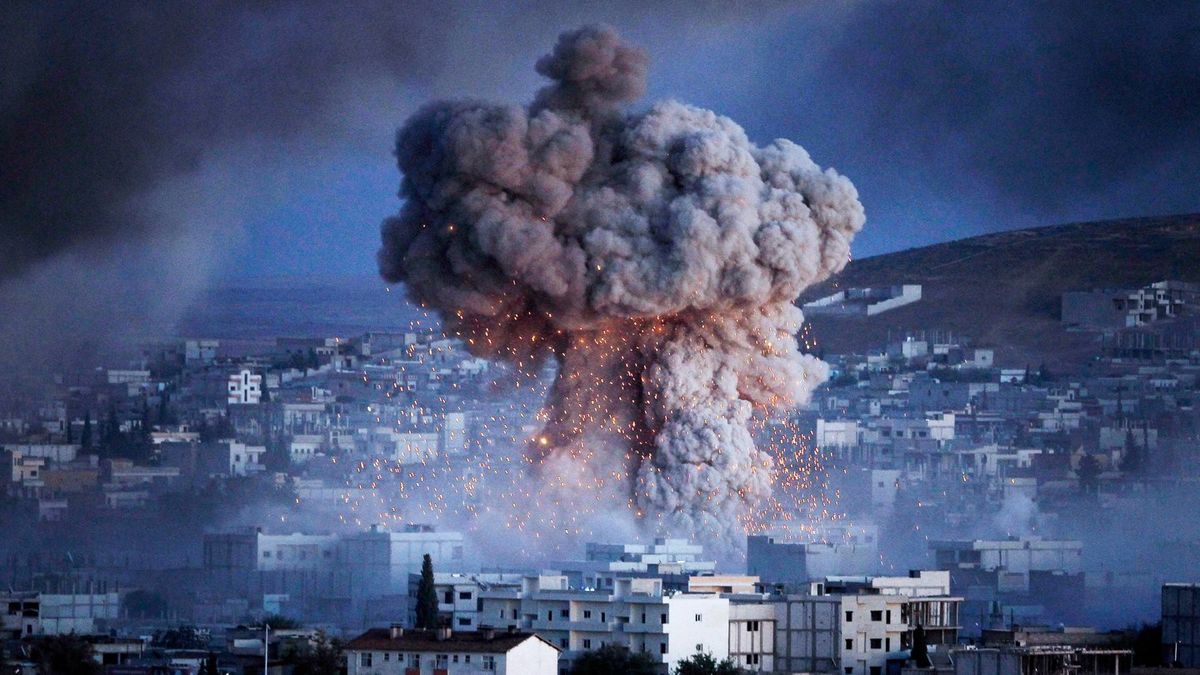
New clashes involving some of the world’s nuclear-armed nations have revived fears that a wider global conflict could erupt — and with it, catastrophic consequences for humanity.
In the last week, the US and Israel — both nuclear powers — have entered direct conflict with Iran. At the same time, as strikes were exchanged with Tehran, Afghanistan’s Taliban launched a separate and violent confrontation with Pakistan, another nuclear-armed state.
For people across the Middle East, the immediate reality of bombardment is already horrifying. But the larger concern is that as more nuclear states become tied to fast-moving wars, escalation risks begin to extend far beyond any one region.
Peer-reviewed research published in Nature suggests a large-scale nuclear exchange could kill around five billion people, driven by extreme blast heat and a “nuclear winter” that could plunge much of the planet into prolonged darkness — with only two countries potentially spared the worst of the fallout.
Annie Jacobson, an author and investigative journalist who wrote Nuclear War: A Scenario, drew on scientific studies and conversations with defense specialists to map out what could happen if major powers unleashed the roughly 12,000 nuclear weapons believed to exist in global stockpiles.
“Hundreds of millions of people die in the fireballs, no question,” the investigative journalist explained on Steven Bartlett’s The Diary Of A CEO podcast.
But Jacobson argued that the most far-reaching damage would come after the initial detonations — affecting those who survive the blasts and the radioactive fallout that follows. In her account, billions could remain alive at first, but society and daily life would be transformed into something almost impossible to recognize.
“Places like Iowa and Ukraine would be just snow for 10 years, and so agriculture would fail. When agriculture fails, people just die.” she said, before Bartlett raised the question of where could even be safe in such a scenario.
According to Jacobson, the Nature research indicates New Zealand and Australia may be among the only places capable of sustaining food production during a nuclear winter — and possibly the only regions where conditions might still allow people to spend time outdoors.
Detonating thousands of modern warheads — many far more powerful than the bombs dropped on Hiroshima and Nagasaki — could also severely damage the atmosphere’s protective ozone layer, increasing exposure to harmful solar radiation.
Jacobson described: “On top of [a nuclear winter], you have the radiation poisoning, because the ozone layer would be so damaged and destroyed that you can’t be outside in the sunlight.”
If sunlight became dangerous across much of the world, Jacobson suggested survivors outside Australasia could be forced into harsher living conditions, with scarce resources and widespread instability.
“People will be forced to live underground,” she added. “So you have to imagine people living underground, fighting for food, everywhere except for in New Zealand and Australia.”
Even with comparisons often made to mass-extinction events like the asteroid impact believed to have killed the dinosaurs, Jacobson emphasized that nuclear catastrophe would be fundamentally different — because it would be the result of human decisions, not an unavoidable natural event.
And unlike an asteroid, she noted, there are steps governments can take to reduce nuclear risk, limit proliferation, and prevent wars from spiraling. The challenge is whether the global community will act decisively before escalation makes the worst-case scenario more than just a warning.