


A viral World Cup claim from a supposed ‘time traveler’ may yet prove accurate, even after England’s run ended at the semi-final stage.
England are out of the tournament after the Three Lions were beaten 2-1 by Argentina in a dramatic World Cup semi-final in Atlanta yesterday.
That result sends Argentina into Sunday’s showpiece, where they will meet Spain as they aim to secure a fourth World Cup crown.
The 2026 FIFA World Cup final is scheduled to be played on Sunday, July 19, at MetLife Stadium in East Rutherford, New Jersey, giving the old prediction just one more hurdle to clear before it can be called truly uncanny.
The unexpected twist is that this exact final pairing appears to have been called years in advance.
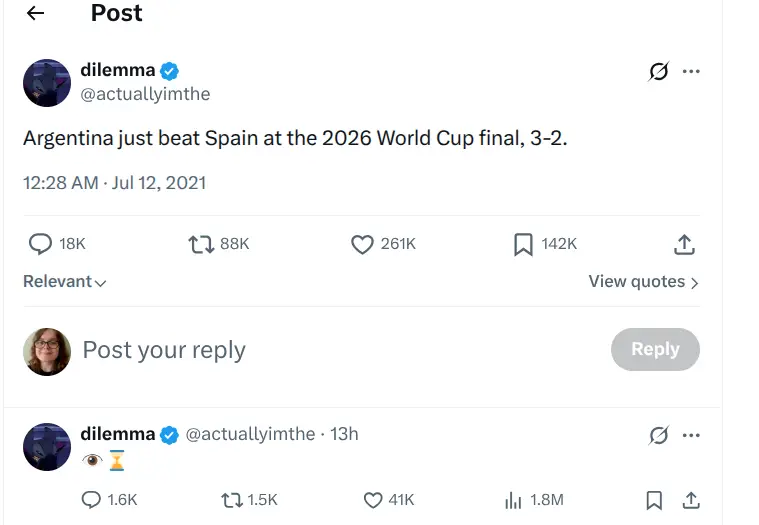
Back in 2021, an anonymous X account using the handle @actuallyimthe posted a prediction that read: “Argentina just beat Spain at the 2026 World Cup final, 3-2.”
When it was first shared, the post seemed like the kind of bold forecast that could easily be forgotten. Now, five years on, it has exploded online because it correctly identified both teams who have reached the final.
After Argentina overcame England and Spain got past France in the other semi-final, users on social media quickly began digging up the old message again.
One user wrote: “How is this even possible to predict? WOW!” while another simply dubbed the mysterious poster a ‘timetraveler’.
Another user commented: “You tweeted this before world cup 2022, who’s your source please?”
The post’s replies have since filled up with reaction GIFs, including the White Rabbit from Alice in Wonderland and Dexter character Sgt James Doakes giving his trademark suspicious stare.
The person behind the account has only fuelled speculation further, replying after Argentina’s win over England this week with an eye symbol and an hourglass.
Although this prediction has taken off online, a number of other notable attempts to call the tournament have already fallen apart.
German mathematician Joachim Klement, who previously forecast three World Cup winners using an economics-driven model, had predicted that the Netherlands would finally win the trophy this year.
Klement has said his system takes into account factors including population size, climate, national wealth, football infrastructure and current FIFA rankings.
This time, though, the model did not deliver the right answer.
Elsewhere, another widely shared forecast came from a TikTok user who argued that the World Cup “script” had essentially been exposed through the competition’s visual branding.
Her theory was that while the tournament logo remains black and white, each edition’s official colour scheme supposedly hints at the eventual champions.
She claimed this year’s colours — green, red, blue and grey — suggested Portugal would go on to win it all.
That theory did not last long, however, as Portugal were eliminated by Spain after a 1-0 loss on July 6.
Now that only Argentina and Spain are left, the five-year-old X post suddenly looks far less far-fetched than it once did.
If Argentina do go on to beat Spain by a 3-2 scoreline in Sunday’s final, the old post will go from internet curiosity to one of the most improbable sports predictions ever shared online.
All that remains is to see whether Sunday’s final score also matches the prediction exactly.