

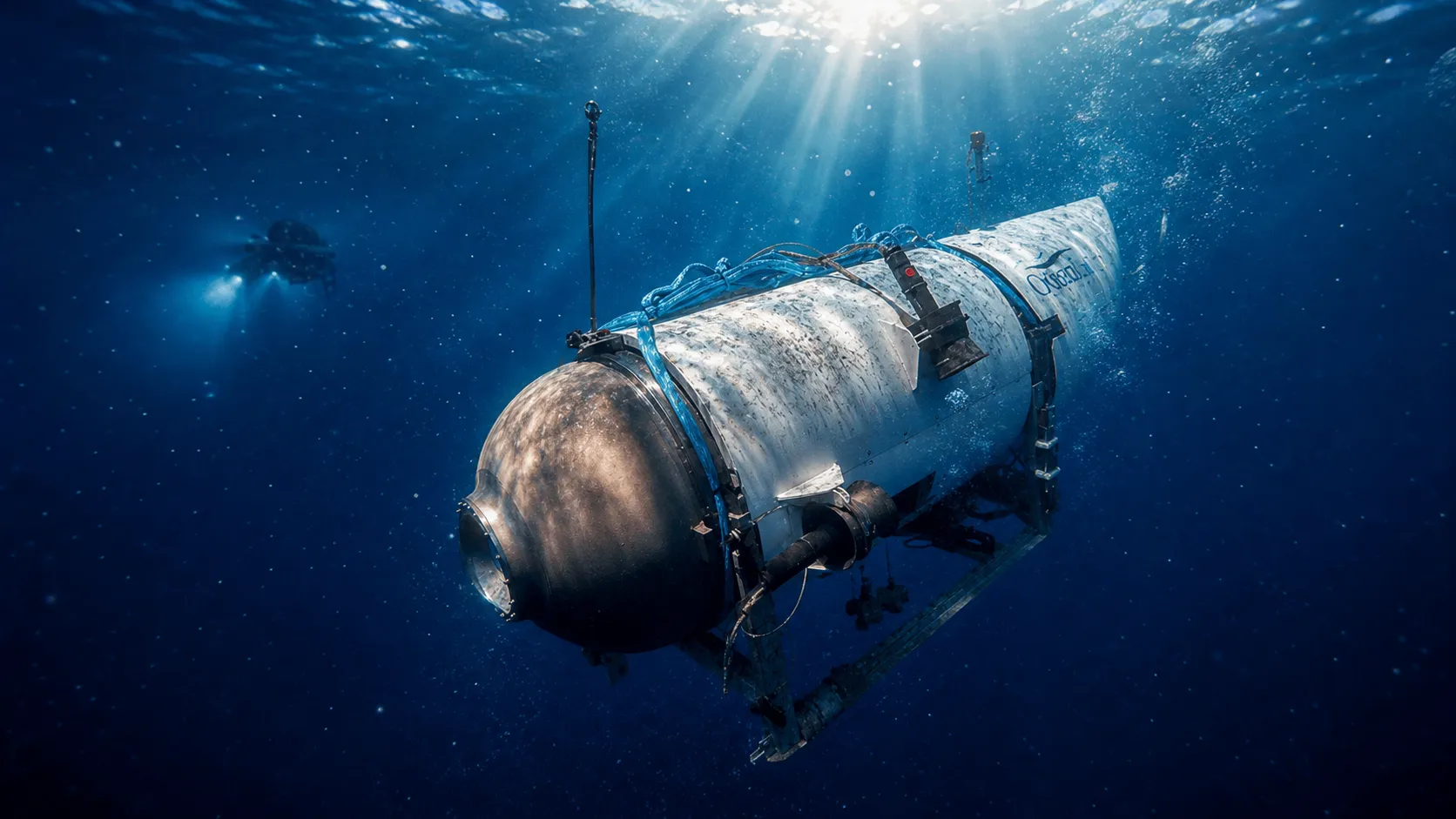
A new marine safety investigation from the Transportation Safety Board of Canada has delivered a severe assessment of the Titan disaster, pointing to major engineering shortcomings, weak oversight and a company mindset that investigators say contributed to the fatal loss of the submersible.
The TSB released its report, M23A0169, on June 17, 2026, almost exactly three years after Titan began the dive that ended in disaster. On June 18, 2023, Titan set out on a commercial descent to the Titanic wreck in the North Atlantic, about 372 nautical miles south-southeast of Cape Race, Newfoundland and Labrador. Around one hour and 45 minutes into the descent, the submersible imploded.
All five people aboard were killed: pilot Stockton Rush, OceanGate’s founder; explorer Hamish Harding, 58; businessman Shahzada Dawood, 48; his 19-year-old son Suleman; and Titanic expert Paul-Henri Nargeolet.
The US Coast Guard had already published its final findings in 2025, and Canada’s Transportation Safety Board has now followed with report M23A0169, which examines both the design of Titan and the safety culture behind its operation.
The Canadian report says company decision-making was influenced by ‘confirmation bias’.

A key focus of the investigation was Titan’s pressure hull, especially its carbon fibre cylinder. The report notes that submersibles more commonly use steel or titanium in these structures, making Titan’s configuration unusual.
Investigators also explained that a pressure hull is ‘typically spherical’, because that is considered ‘the best shape for resisting external pressures and allowing even distribution of stresses,’ but Titan instead used a cylindrical form.
The board further concluded that ‘the as-built properties of the Titan’s carbon fibre cylinder were never validated to ensure they met the theoretical values used in the design process’.
It also found that ‘standard engineering practices’ were not followed during construction and testing.
Because of that, investigators said there was uncertainty over how long the hull would ‘remain structurally intact’ when subjected to repeated deep dives to the Titanic site.
OceanGate created two one-third-scale Titan models and pressure-tested them six times. Both failed, and those failures happened at depths shallower than the Titanic wreck itself.
Although OceanGate altered the design and manufacturing approach afterward, the investigation said testing of the finished submersible remained limited.
According to the report, each of the 13 tests on the final Titan produced ‘stressed, small damages’.
“Normal engineering practice would be to expose full-scale models to a very significant number (hundreds, possibly thousands) of test cycles.”
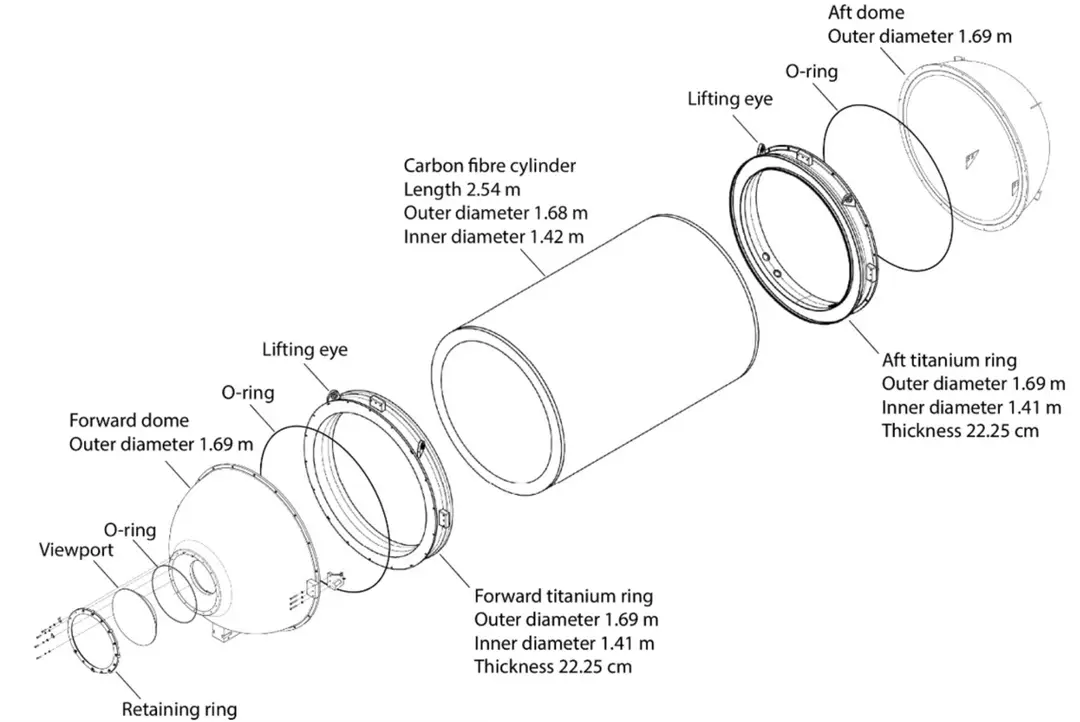
The report says OceanGate ‘developed two systems to monitor the integrity of the pressure hull’.
One was a ‘strain monitoring system’ that ‘provided data for post-dive analysis to identify potential problems with the pressure hull that could lead to failure on a subsequent dive’.
The other was ‘an acoustic monitoring system,’ intended to warn of an ‘impending hull failure’ early enough for Titan to return to the surface.
But investigators said the strain data gathered by OceanGate was ‘inconsistent’ and ‘did not result in the pressure hull being removed from service before its failure’.
The acoustic system was criticized as well. The report said it was not proven to ‘consistently provide enough advance warning’ and ‘did not function as intended during the occurrence’.
Investigators found that the cylinder failed ‘progressively’ because of the ‘reduced compressive strength of the Titan’s carbon fibre cylinder’, with damage ‘accumulating during each dive cycle,’ along with ‘defects that were potentially introduced during manufacturing, operations, storage, and transport’ of the submersible.
The report also raises concerns about management culture, saying OceanGate showed signs of ‘closed-mindedness, pressures toward uniformity and overestimation of the group’s power’, which may have increased the danger surrounding the dive.
“Over the course of OceanGate’s operating history… Employees with expertise in specific areas left the company or were dismissed after raising safety-related concerns or expressing differing perspectives from the CEO.”
In the report’s final assessment, OceanGate ‘did not identify and mitigate key risks associated with the structural integrity of the Titan’.
The Canadian report also makes clear that Titan operated in a wider regulatory gap. Although Transport Canada knew the submersible was operating from St. John’s with support from Canadian vessels, the investigation found Titan received no oversight. The TSB said the absence of effective regulatory oversight increased risk to everyone involved and exposed broader weaknesses in how submersibles are supervised internationally.
The board issued six recommendations aimed at tightening risk-based oversight of commercial vessels and submersibles, improving information-sharing between Transport Canada and other government departments, and pushing for stronger international standards through the International Maritime Organization.
In the United States, the Coast Guard’s 2025 report likewise concluded that OceanGate’s inadequate design, certification, maintenance and inspection process was a primary contributing factor, and said the disaster was preventable. The U.S. Investigation also pointed to a toxic workplace culture, ineffective whistleblower protections and gaps in regulation for novel vessel designs.
Together, the two investigations paint a stark picture: Titan was not simply the victim of a single catastrophic event, but of a chain of unresolved engineering problems, inadequate testing, poor risk management and weak oversight that allowed the submersible to keep operating until it failed.