


In March 2014, a flight bound for Beijing took off from Kuala Lumpur International Airport with 227 passengers and 12 crew members. However, the aircraft deviated from its planned route shortly thereafter.
Malaysia Airlines flight MH370 was detected on military radar making a sharp westward turn over the Andaman Sea, before it eventually went off radar and vanished.
Eleven years have passed since the incident, widely regarded as a significant mystery in aviation history, yet the whereabouts of the Boeing 777-200ER aircraft remain unknown.
On December 3, the Malaysian government announced a renewed search for the missing plane and its 239 occupants. Ocean Infinity, a US-based robotics company, has been contracted for the advanced search efforts.
This announcement has revived interest in three potential explanations for this unprecedented aviation disappearance.
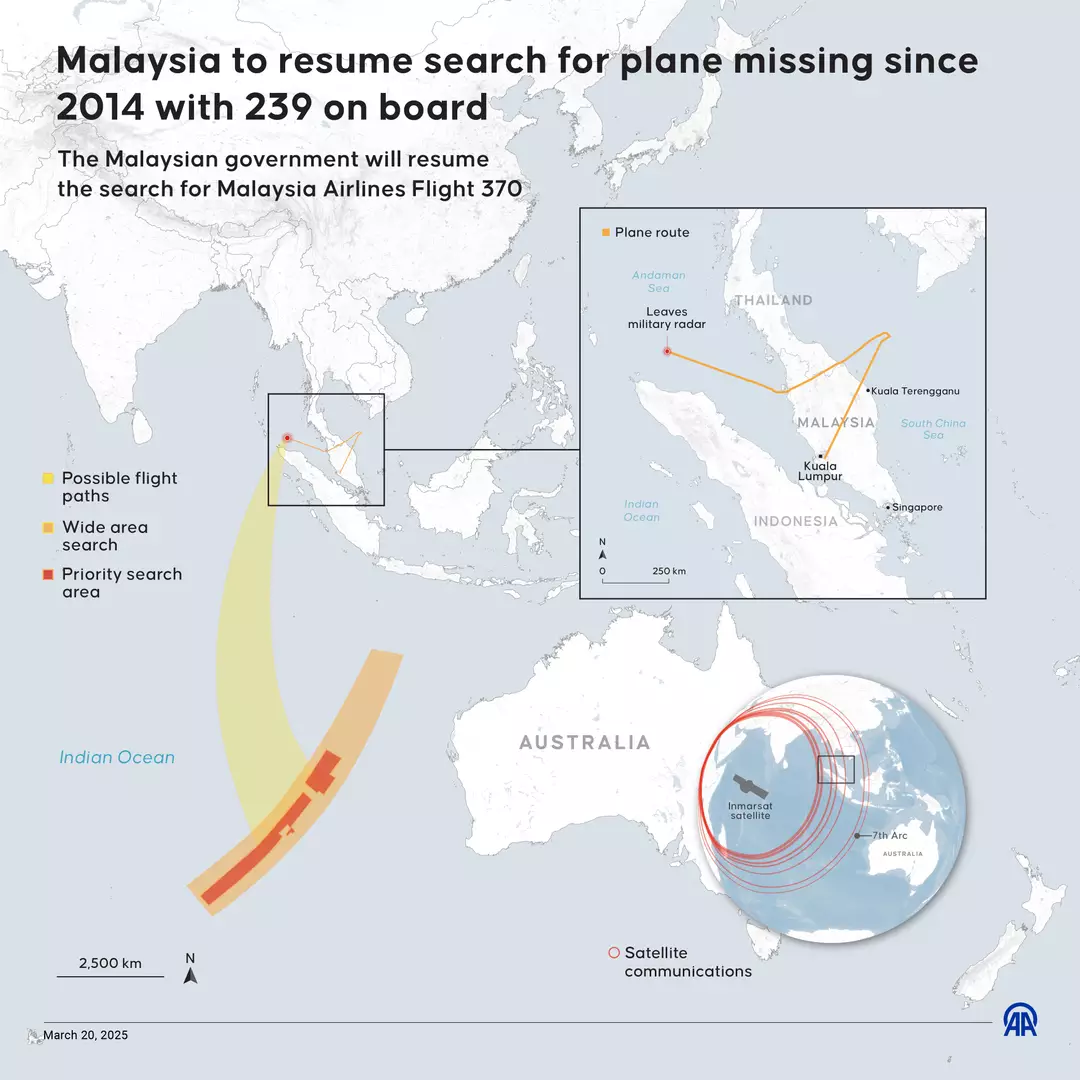
The new search effort will differ from those undertaken in 2014 and 2018, as it will utilize advanced modeling and technology, such as underwater naval drones, to focus on specific areas of the Indian Ocean.
Ocean Infinity has indicated that improved analytical models have refined their search area, deploying autonomous underwater vehicles (AUV) to explore a remote section of the southern Indian Ocean.
According to a statement from the company, they have been authorized to ‘recommence seabed search operations for a total of 55 days’, conducting intermittent explorations of the ocean floor.
Investigators and aviation enthusiasts have narrowed the potential causes of MH370’s disappearance to three ‘plausible’ scenarios, which could be verified if additional wreckage is discovered.
The ‘ghost flight’ hypothesis, involving an unresponsive crew and autopilot navigation over the Indian Ocean, remains a primary consideration due to the absence of communications as the flight altered its course.
The final communication from the cockpit occurred 38 minutes after takeoff, when co-pilot Fariq Abdul Hamid radioed: “All right, good night.”

Some suggest a sudden and catastrophic event, such as cabin depressurization, rendered the crew unresponsive, allowing the flight to continue on autopilot over the ocean.
This concept is supported by satellite ‘handshakes’ that continued for several hours post-radar disappearance, suggesting the aircraft maintained a straight path until fuel depletion led to a crash.
Another theory involves deliberate cockpit control, suggesting a pilot or passenger redirected the flight after the abrupt change in trajectory, indicative of human intervention rather than mechanical error.
Evidence from Captain Zaharie Ahmad Shah’s computer, showing a simulation of a flight into the Indian Ocean, adds to this theory, although it is not considered definitive proof of intent.

A third theory posits that a developing catastrophe, such as an electronic malfunction, may have prompted the crew to attempt a return, leading to the initial sharp turn westward.
While this aligns with emergency protocols from Kuala Lumpur International Airport, it does not explain the subsequent prolonged, unaltered flight path across the ocean.
Some propose that a series of escalating malfunctions could have incapacitated the crew, leaving the aircraft to drift until it exhausted its fuel supply.