

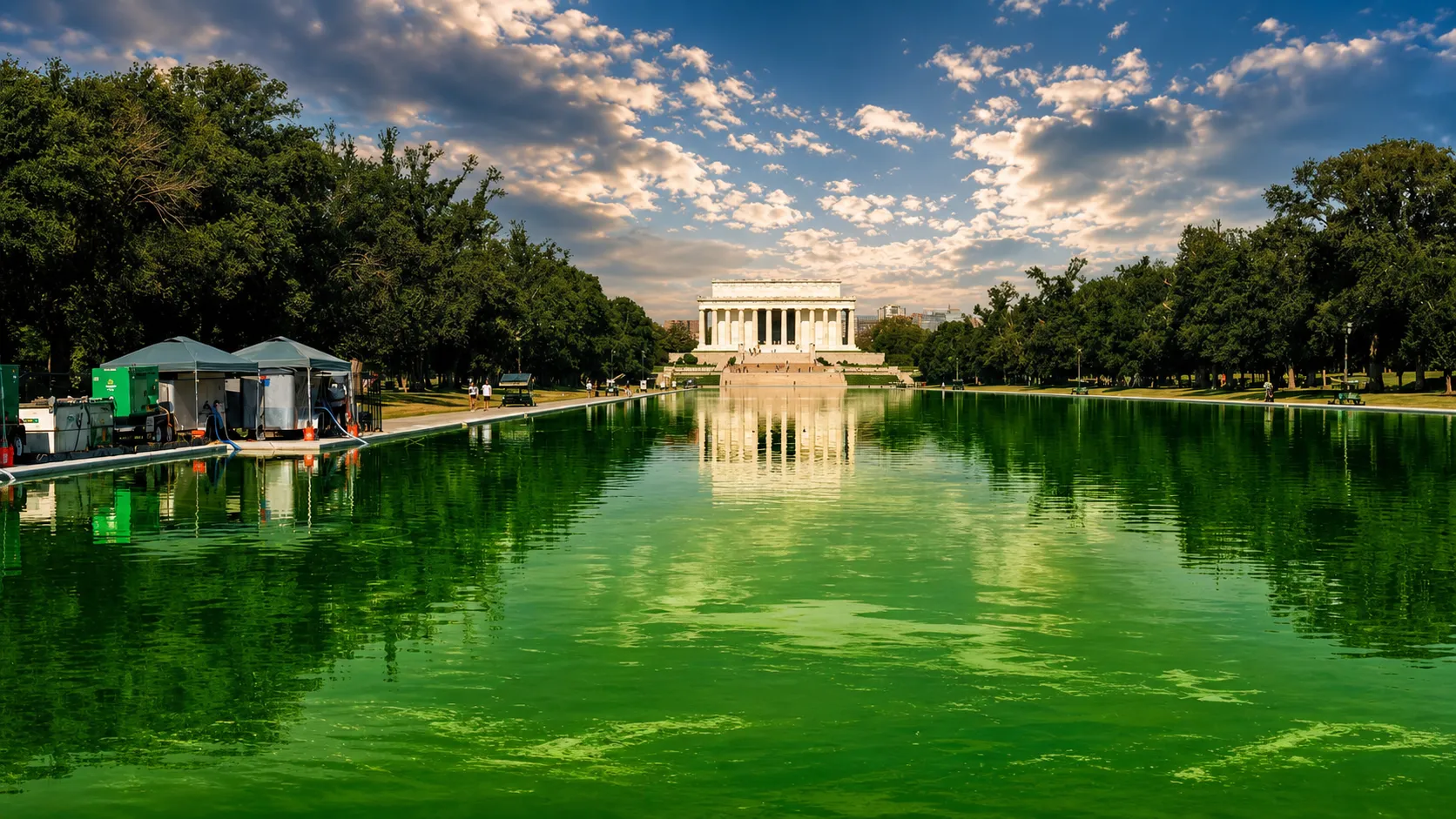
A newly completed project on Washington, DC’s National Mall is already prompting speculation, with many wondering what might have caused an unexpected problem.
No, this isn’t about Donald Trump’s disputed idea of hosting a UFC title fight on the South Lawn as part of celebrations for his 80th birthday and America’s 200th anniversary.
It’s also not related to plans for a massive new ballroom that would require altering sections of the historic site.
Instead, attention has turned to the recently renovated reflecting pool at the Lincoln Memorial, a project that reportedly came with a $14.2 million price tag and was completed in early June after weeks of lining, repair and repainting work.
The issue catching people’s eyes is the pool’s appearance, as the water has taken on a striking green color.
The direct explanation is relatively straightforward: an algal bloom. Tiny plant-like organisms have multiplied in the water, and the chlorophyll they contain is what gives the pool its green hue.
That said, the bigger question is what triggered the bloom in the first place. Christopher Lowe, a senior lecturer in marine biology at Swansea University in the UK, shared several possible explanations with the outlet.
One possibility involves the pool’s updated finish, which has been changed to what has been described as ‘American flag blue’. Lowe suggested that the color itself may play a role because different surfaces absorb heat differently.
Darker shades tend to take in more heat and light, and over time that can raise the water temperature.
Warmer water can encourage algae growth, potentially creating what Lowe described as “perfect conditions for algae to bloom”.
Another possible factor is circulation. In a man-made body of water as large as the reflecting pool, a substantial treatment system is needed to prevent the water from sitting still — essentially a much larger version of the filter system used in a pond or aquarium.
If that setup is not operating as intended, water movement can be disrupted, making an algal bloom more likely.
Should that be the cause, the solution would likely involve additional adjustments and technical work to make sure the system is functioning properly.
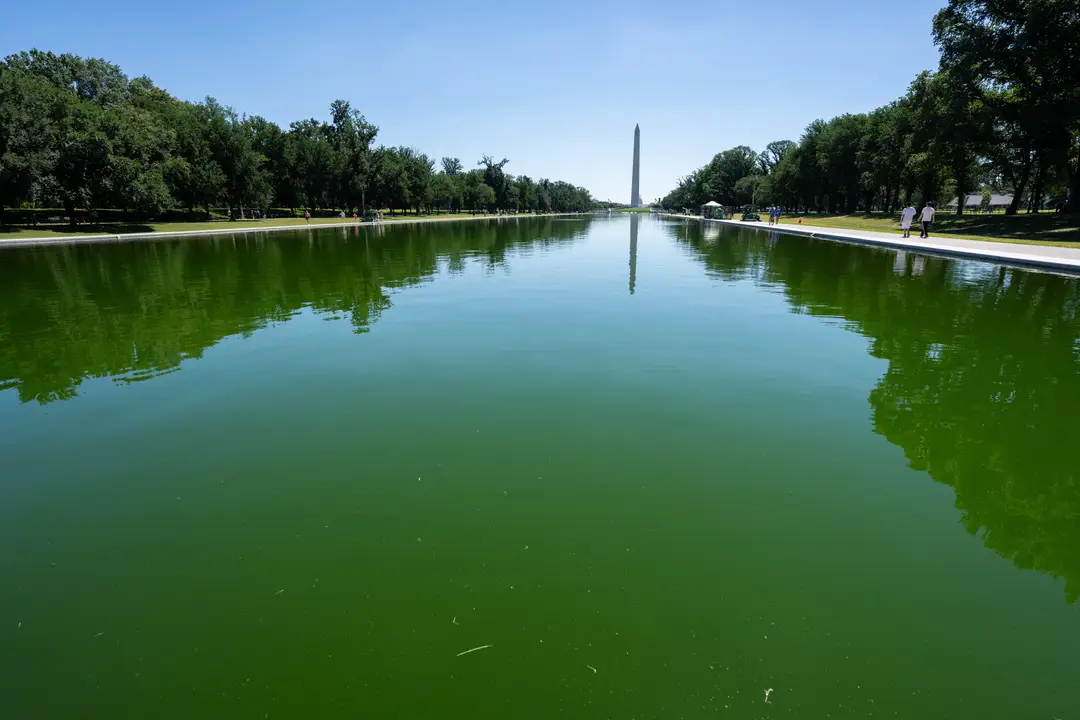
Weather conditions in Washington, DC may also be contributing. The city is well known for hot temperatures and heavy humidity, both of which can help algae thrive.
With those elements in place, Lowe explained how quickly the problem can escalate.
“When nutrients, light and temperature are all high, algae can reproduce extremely quickly.”
A spokesperson for the Interior Department gave a different explanation, saying the algae is ‘residual’.
According to that account, algae had remained in the pipes for eight weeks while construction was underway. Once the pool was put back into operation, that leftover material is said to have led to the bloom now visible in the water.
The reflecting pool’s history also makes the situation less surprising than it first appears. The shallow basin has long had recurring issues with leaks, water quality and algae growth, and previous renovation efforts have also run into similar problems.
The latest repair work began in April and was scheduled to end in June, with the pool refilled only after the basin was lined, joints were repaired and the surface was repainted. That means the green tint may be less a sign of a catastrophic failure than a familiar maintenance issue showing up again in hot weather.
For now, officials appear to be treating the bloom as a temporary startup problem rather than a sign that the entire renovation has gone wrong. But given the pool’s visibility — and the political attention surrounding it — even a patch of algae is enough to spark a fresh round of commentary.