

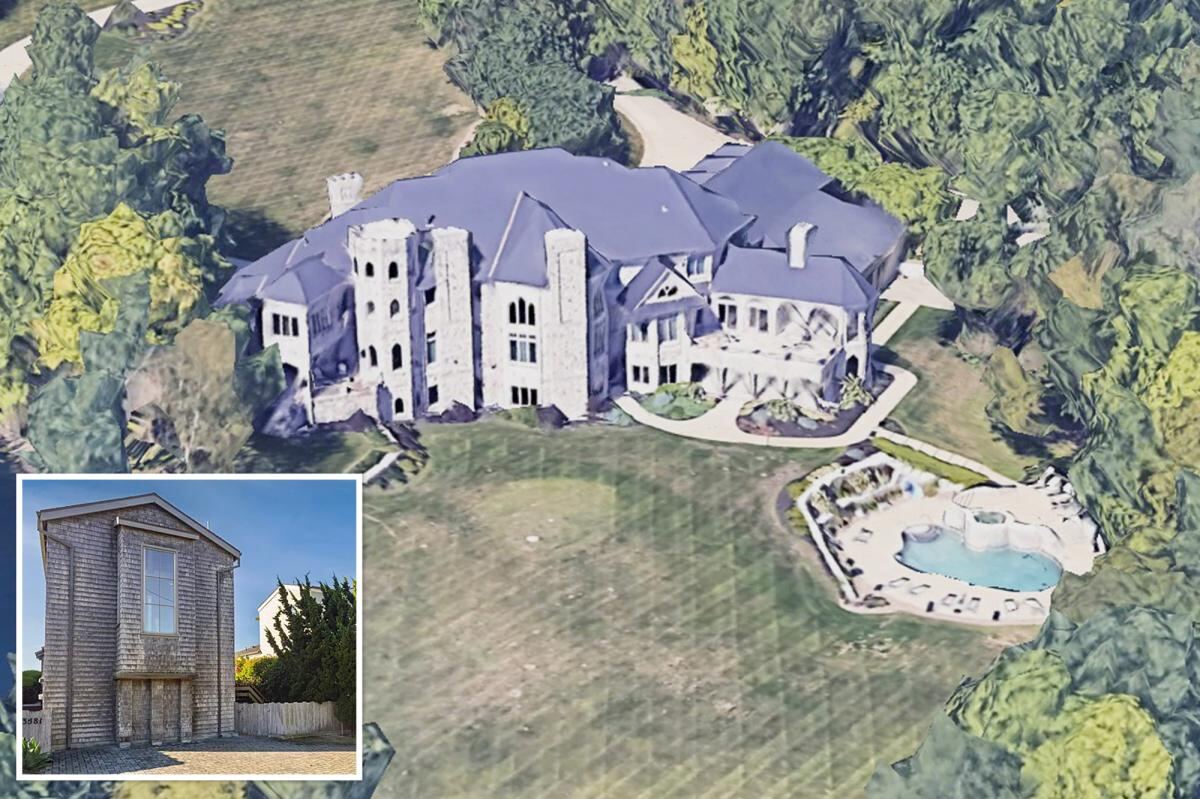
A $10.2 million Iowa estate with a private lake and castle-like architecture has become the unlikely benchmark for exposing California’s stratospheric real estate prices, after online observers began contrasting it with a nearly $10 million Santa Barbara County home less than one-sixth its size.
Dawn Ameling, one of the Iowa property’s owners, told The Wall Street Journal she initially mistook her own listing for West Coast luxury. “I assumed it was some $20 million estate in California,” she said. “Then I looked closer and thought, ‘Oh my gosh, this thing is in Iowa!'”

The Toddville mansion sits just north of Cedar Rapids on sprawling grounds that include a 15-acre lake, a separate pond, and miles of wooded terrain. Its fossilized stone facade and Italian villa-inspired landscaping frame five bedrooms, seven bathrooms, and a pool. At more than 13,000 square feet, it dwarfs a competing listing 1,600 miles away.
That California property, a $9.9 million Carpinteria beach house, offers 2,135 square feet with four bedrooms and three bathrooms. Its selling points, per the listing description, center on “spectacular harbor, islands & sunset views” and direct beach access via private steps to Serena Cove and Loon Point.

Danielle Hale, chief economist at Realtor.com, told the California Post the pairing did not surprise her. “There is a mantra in real estate: location, location, location. These two houses exemplify that,” she said.

Hale noted that buyer preference ultimately drives the comparison, but the Golden State property carries locational advantages the Iowa estate cannot replicate. She also pointed to market structure: the Santa Barbara area contains far more similarly priced competitors, while the Toddville castle faces scant regional comparison.

The economist tied the tight price gap directly to California’s broader market conditions. “These two properties show how disconnected from the rest of the US California home prices are,” she said.
Federal data underscores that disconnect. A Bureau of Economic Analysis report ranked California as the nation’s most expensive state by cost of living, while Iowa placed among the cheapest.

The Carpinteria home’s listing emphasizes its oceanside terrace with “more than enough room for family and friends,” an enclosed glass windbreak terrace, and a gated walk-up courtyard. Its open floor plan and beachside entry deck target buyers prioritizing Pacific coastline over square footage.

Ameling’s property, by contrast, trades coastal access for scale and seclusion. The updated landscaping and fossilized stone construction aim for European estate aesthetics in rural Iowa.

Hale observed that the Iowa home’s sheer size advantage still leaves room for buyer subjectivity. Even with 13,000 square feet against 2,135, she said, “it is largely up to buyers to determine which house they prefer.”
The side-by-side listings have circulated widely as a case study in regional housing inequality, with social media users highlighting what the same expenditure yields in different markets. The contrast arrives as California maintains its position atop national cost-of-living rankings despite ongoing outmigration to lower-cost states.

Hale theorized that limited comparable inventory in rural Iowa allows the mansion to command a premium without local competition, whereas Carpinteria’s $10 million tier faces dense alternative inventory. The dynamic, she indicated, compounds with California’s baseline price inflation to produce nearly equivalent tags for radically different properties.
The two homes remain on the market as their parallel listings continue drawing national attention to the geographic divide in American housing value.