

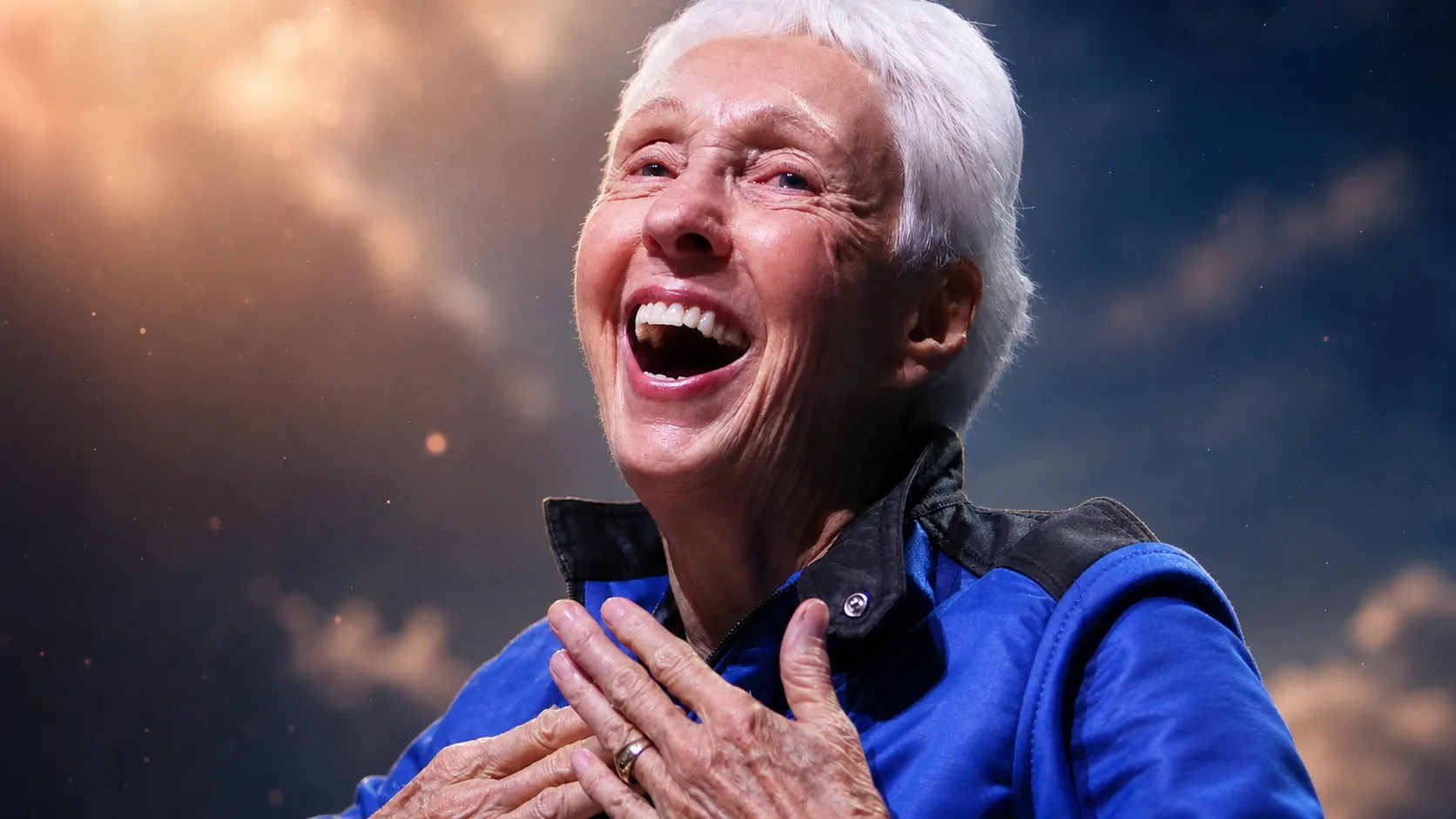
Wally Funk, the pioneering aviator who broke barriers in aviation for decades before finally reaching space at age 82, has died at 87. Funk died Wednesday at her home in Grapevine, Texas, according to Grapevine City Councilwoman Duff O’Dell, who said she was by Funk’s side. O’Dell said Funk had fallen a couple of times recently and had an infection in her leg that took its toll.
Funk’s life was defined by a relentless pursuit of excellence in a field that systematically excluded women. Born Mary Wallace Funk on February 1, 1939, she earned her pilot’s license at age 17 after joining the women’s flying club at Stephens College in Columbia, Missouri, where she was a student at just 16. Her passion for aviation only intensified from there. She went on to become the first female civilian flight instructor at Fort Sill, Oklahoma, the first female inspector for the Federal Aviation Administration, and the first female air safety investigator for the National Transportation Safety Board. Throughout her career, she logged more than 19,600 flying hours and taught more than 3,000 people how to fly.
But Funk’s greatest aspiration was to become an astronaut. In February 1961, she volunteered for NASA’s “Women in Space” program, a privately funded effort designed to test whether women’s bodies could withstand the rigors of spaceflight. At just 21 years old, she was the youngest of the 13 women selected, later known as the Mercury 13, who underwent the same grueling physical and psychological tests as NASA’s seven male Mercury astronauts. Funk excelled across the board, sometimes outperforming the men. During one sensory deprivation test, she remained in a tank for 10 hours and 35 minutes, longer than astronaut John Glenn. On several tests, she scored better than Glenn.
Yet despite her extraordinary qualifications, Funk and the other women of the Mercury 13 were denied the opportunity to become astronauts. NASA would not select its first class of female astronauts until 1978, and when Funk applied multiple times after that, she was turned down for lacking an engineering degree and experience as a military test pilot. “I got a hold of NASA four times, I said, ‘I want to become an astronaut.’ But nobody would take me,” Funk said in a video released by Blue Origin in 2021. “I didn’t think that I would ever get to go up.”
Undeterred, Funk forged a distinguished career in aviation. She became a pioneering flight instructor, an FAA field examiner, and an accident investigator for the National Transportation Safety Board, investigating hundreds of aviation incidents. She was inducted into the Women in Aviation International Pioneer Hall of Fame in 1995 and received numerous awards and honors recognizing her groundbreaking achievements.
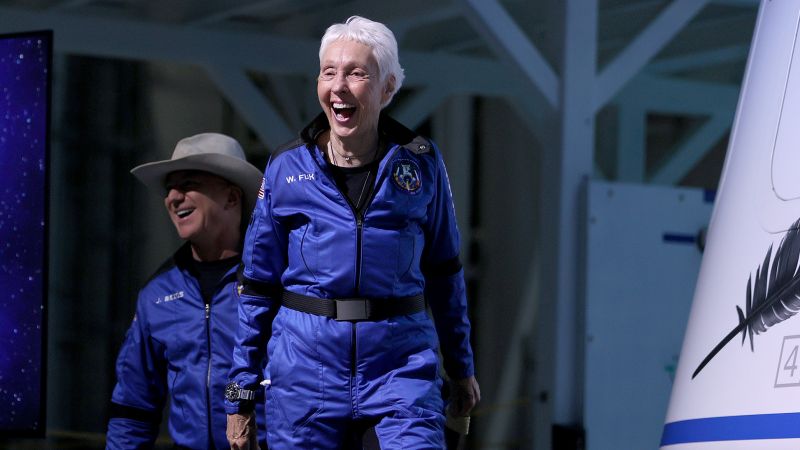
For six decades, Funk never abandoned her dream of spaceflight. In 2012, she even put down a deposit with Virgin Galactic to fly to space, using money from her book and film royalties. Finally, in 2021, Amazon founder Jeff Bezos invited Funk to join the first crewed flight of his space tourism company, Blue Origin, as an honored guest. On July 20, 2021, at age 82, Funk became the oldest person ever to travel to space. She flew aboard Blue Origin’s New Shepard spacecraft along with Bezos, his brother Mark, and 18-year-old Oliver Daemen. The 11-minute suborbital flight took her more than 2,500 miles per hour, more than three times the speed of sound.
When the capsule landed in the West Texas desert, Funk emerged with a broad smile and her arms open wide, clearly overjoyed. During the brief moments of weightlessness in space, she said it was “the greatest feeling” and that she had “done about three turns, or somersaults.” She reflected on the long journey to that moment: “I’ve been waiting a long time to finally get it up there, and I’ve done a lot of astronaut training through the world — Russia, America — and I could always beat the guys on what they were doing because I was a stronger and I’ve always done everything on my own.”
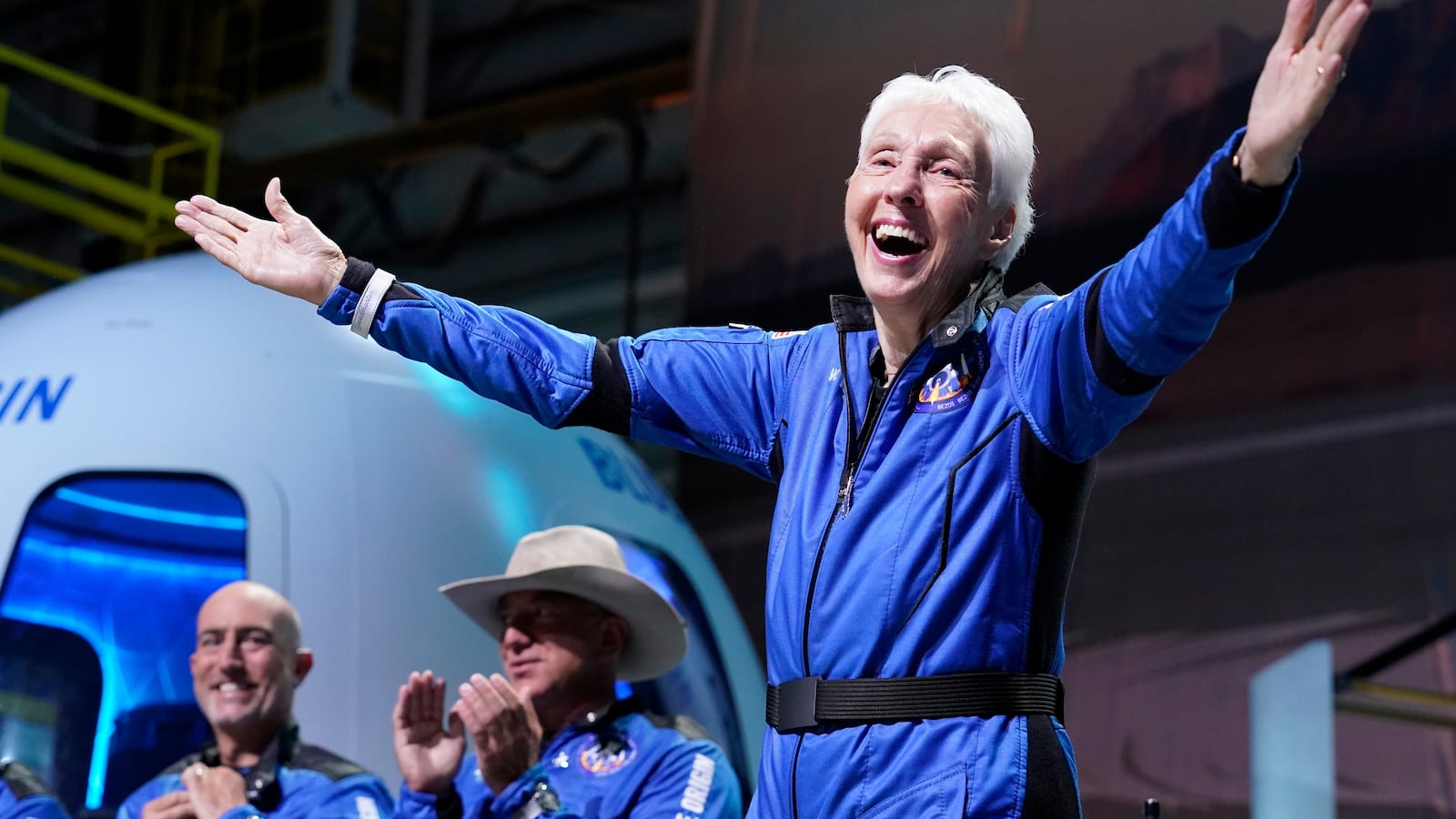
With that flight, Funk made history as the oldest woman to travel to space, a Guinness World Record. She remained the only member of the Mercury 13 to ever reach space. Although her record as the oldest person to reach space was surpassed later that year by actor William Shatner at age 90, Funk’s achievement was widely celebrated as a triumph of perseverance and determination over systemic discrimination.
In her final years, Funk lived in Grapevine, Texas, where she was recognized as a beloved resident and community icon. She received numerous posthumous honors, including induction into the International Space Hall of Fame at the New Mexico Museum of Space History. Blue Origin paid tribute to her on social media, saying she was “a pioneer in every sense of the word” and calling the moment of her spaceflight “six decades in the making.”
Grapevine City Councilwoman Duff O’Dell, who was close to Funk, described her as “the most eternally optimistic person” she had ever met. “She was told by many, many, many men, ‘No, you can’t do this. No you can’t do that,'” O’Dell said. “And she never got mad about it. She just was more determined.”
Funk’s life embodied a simple belief she held dear: that determination and skill should matter more than gender. “Doesn’t matter what you are, you can still do it if you want to do it,” she once said, “and I like to do things that nobody’s ever done before.”