

Walmart is cutting back on self-checkout at certain locations as retail theft remains a growing issue across the US.
After years of expanding self-service lanes, the company is now reassessing how customers move through its stores, with some sites removing the machines entirely.
One recent example is a store in South Philadelphia, where self-checkout stations were taken out, according to the Philadelphia Inquirer.
A Walmart spokesperson said the update is aimed at improving the shopping experience, with the goal of reducing wait times, strengthening customer support, and making the front-end run more smoothly.
The change also comes as Walmart continues its broader store refresh program, with plans to remodel more than 650 locations. Instead of leaning further into self-service, some remodels are emphasizing a return to more traditional staffed registers.
So why the reversal?
Many retailers argue self-checkout has become a major weak spot for loss prevention.
Whether it’s intentional non-scanning or “accidental” errors, companies say the systems can be easier to exploit than manned lanes, pushing them to ask whether the convenience is worth the cost.
A LendingTree survey conducted in 2025 reported that 27% of shoppers said they had purposely stolen while using self-checkout, while 36% said they had done it unintentionally.
Other industry figures suggest self-checkout shrink can climb as high as 4% of transactions, compared with roughly 0.2% at staffed registers, underscoring why retailers see these lanes as higher risk.
A separate 2025 National Retail Federation report put total retail shrink at $90 billion, with theft continuing to be a key contributor to the losses faced by US stores.
Retail analytics firm Everseen has also pointed to skip-scanning—when items aren’t rung up correctly—as one of the most frequent self-checkout issues, costing companies billions annually.
And in an industry analysis referenced by retail security company Solink, self-checkout loss rates were found to be up to 16 times higher than staffed lanes in some situations.
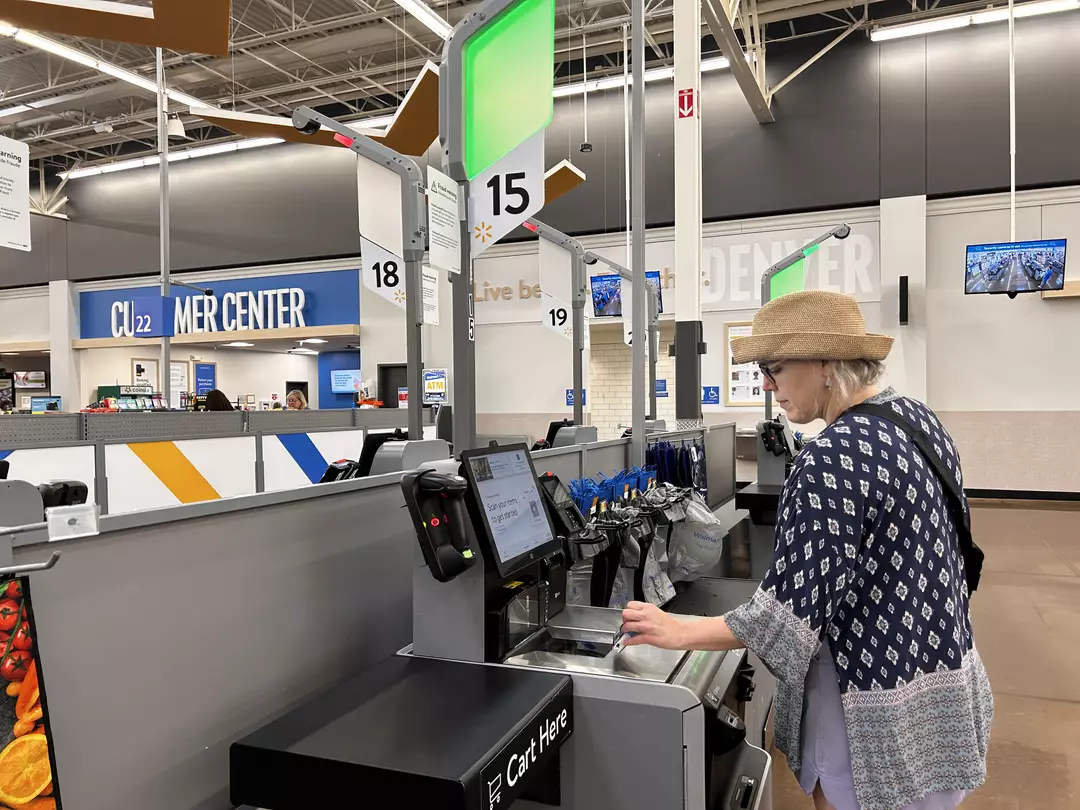
Walmart isn’t the only chain adjusting its approach.
Other major retailers, including Target, Costco, and Dollar General, have also tightened self-checkout policies or removed the kiosks in select stores.
In some places, customers are restricted to around 10 to 15 items when using self-checkout, while additional employees are assigned to supervise the area.
From a shopper’s perspective, self-checkout hasn’t always delivered the speed it promised. Malfunctions, repeated rescans, and bottlenecks can turn the “faster” option into a slow one—especially during busy hours.
Now, policymakers are getting more involved as well.
With theft concerns continuing, several states are weighing new rules aimed at limiting misuse of self-checkout. These proposals range from item caps to staffing requirements intended to reduce opportunities for abuse.
Even with the pullback, self-checkout likely isn’t going away entirely. Walmart is still building out alternatives such as Scan & Go, while also changing store layouts as part of its wider modernization plans.
However, store-level adjustments have been underway for some time, and many retailers say they haven’t been enough on their own. That’s part of why lawmakers are looking at new restrictions.
States including California, Connecticut, Massachusetts, New York, Ohio, Rhode Island, and Washington are considering measures focused on self-checkout, such as limits on item counts, minimum staffing levels, and requirements to maintain a certain balance between staffed and self-service lanes.
Whether those proposals become law or not, the direction is increasingly clear: the self-checkout model that spread rapidly over the last decade is being scaled back, and retailers are still figuring out what comes next.
New self-checkout rules being considered in the US
Self-checkout disputes have been building for years, with TikTok videos frequently highlighting tricks and hacks, including the ‘banana trick’ and ‘passaround’ – and no, we’re not telling you them.
One recent viral clip showed a TikToker swipe a pen, and ‘leave’ with a stove. Even if the stunt was done for attention, it has added fuel to calls for clearer limits and stronger oversight around how self-checkout stations are operated.