

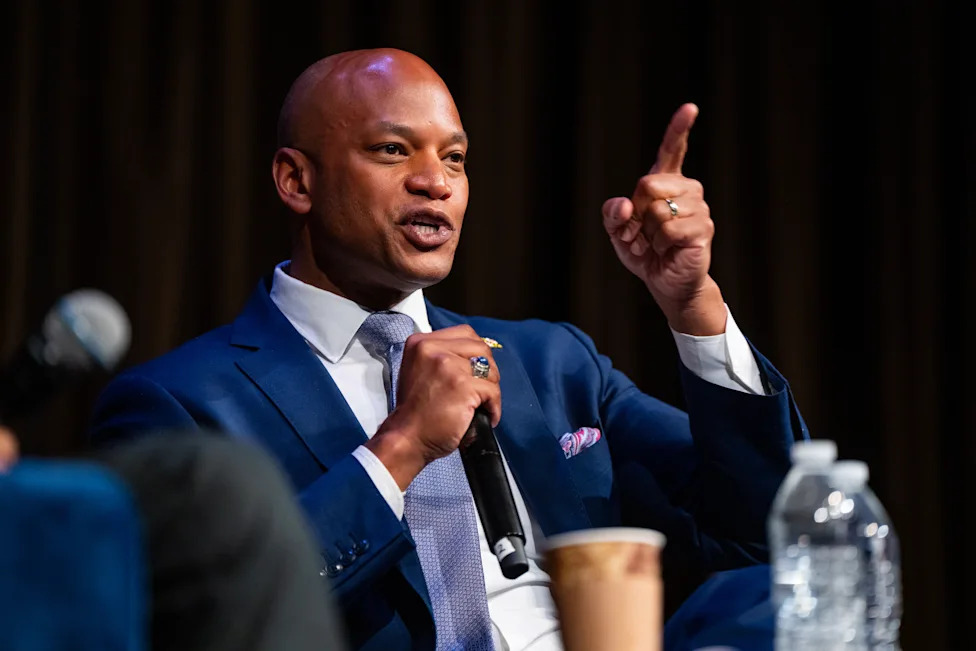
Governor Wes Moore of Maryland said he is “very concerned” that President Donald Trump will use the power of the federal government to interfere with the midterm elections this fall as the Republican tries to maintain his grip on power during the final two years of his administration.
Moore made his remarks in Oklahoma City as he assumed the chair of the National Governors Association on Saturday, one of the most prominent roles among the nation’s governors. The 47-year-old leader is considered a potential contender for the Democratic presidential race in 2028, though he has ruled out such speculation, saying he will not “get distracted” before the November elections.
In interviews during the NGA meeting, the Democratic governor detailed specific concerns about Trump’s administration. He said Trump is attempting to restrict voting by mail, obtain voter information from states, and possibly deploy federal troops or agents to polling places. Moore characterized these efforts as an abuse of federal power that threatens the constitutional framework for state-controlled elections.
“I don’t think that the president is trying to hide the ball on this,” Moore said. “It’s not even am I concerned about what the president could do? I’m concerned about what he’s already doing in broad daylight.”
When asked about his approach to Trump, Moore said “the president of the United States seems to consistently take an ideological view when it comes to securing the future of this country.” Moore noted his enjoyment working with governors from both parties and stressed the bipartisan nature of the National Governors Association.
Moore argued there is a critical role for the NGA, a bipartisan group, to ensure states maintain their constitutional authority to oversee elections as they were designed to do. His concerns were echoed by Democratic Governor Josh Stein of North Carolina, who leads one of the most politically competitive states with a marquee Senate race this fall. “I don’t think you can be a clear-thinking person and not be concerned because all the signals are very worrisome,” Stein said in an interview.

The White House did not directly respond to Moore’s characterization of Trump’s election interference efforts. However, White House spokeswoman Abigail Jackson issued a statement redirecting the criticism toward Democrats, saying that “if Democrats really cared about securing our elections, they would pass the SAVE America Act,” referring to a strict proof-of-citizenship voting bill that is stalled in the Senate.
Moore’s rise to national prominence comes at a complex moment for the Democratic Party. At home in Maryland, where he is seeking reelection this fall, he has at times struggled to win over Democrats in the legislature. That body reconvenes next week to consider a constitutional amendment on redistricting after an earlier effort he backed fell short. At the national level, the Democratic National Committee is in turmoil, with a string of democratic socialists winning primaries from New York City to Denver, prompting debate over whether the party is moving too far to the left and threatening potential victories in the fall.
Moore is positioning himself as a bridge-builder within his party while maintaining focus on his legislative agenda. As NGA chair, he is launching a centerpiece initiative called “Service United,” a campaign designed to build communities and draw young people into the workforce through service-oriented work. The “Service United” campaign opens with $10 million in philanthropic support to build on similar work Moore has done in Maryland, including a $5 million expansion of an apprenticeship program announced this week.
Moore said the initiative could be a pillar of a future campaign. “Service will save us as a society because I know service saved me,” he said, recalling his time in the Army.
The governor has become increasingly reflective about the role of states in governance. Moore noted that he used to associate states’ rights arguments with segregationists like Bull Connor, the infamous public safety commissioner in Birmingham, Alabama, who turned fire hoses and dogs on peaceful protesters during the Civil Rights era. Now, Moore said, the Trump era has reshaped his views and reinforced “the importance of having actually strong governors.”
Moore will face a significant test in his new role navigating the management of this year’s elections without denting the bipartisan tone that typically defines the National Governors Association. He will be in the middle of Republicans who are calling for tougher election rules, particularly around voter identification and deadlines for mail ballots, and fellow Democrats who warn of voter suppression. His handling of these divisions could prove crucial to his national political future.