

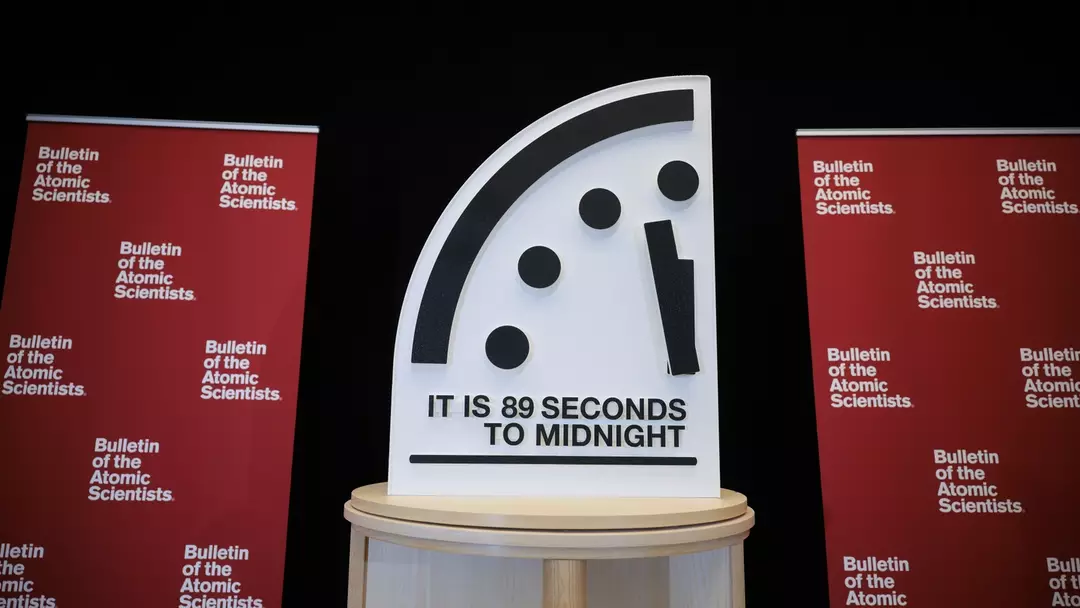
Nuclear and climate scientists have convened today to update the Doomsday Clock, a measure indicating how close humanity is to a global catastrophe of its own making.
In a time where global concerns are already high, the Doomsday Clock serves as a reminder of the potential ‘end of civilization’.
This clock is not a fictional concept from literature or ancient prophecies; rather, it was established by the Bulletin of Atomic Scientists, the group responsible for developing the first atomic bombs.
Formed by scientists from the Manhattan Project after World War II, this group introduced the Doomsday Clock as a symbolic representation of humanity’s proximity to a large-scale disaster.
The mechanism of the clock involves adjusting its hands closer to or further from midnight—the closer it gets, the nearer we are to potential devastation. A greater distance suggests progress in mitigating risks to our world.
Today, January 27, the Bulletin’s Science and Security Board meets to decide if adjustments to the clock are necessary.
The last modification of the clock factored in issues like the misuse of artificial intelligence (AI) and biological threats, ongoing conflicts in places like Ukraine and Gaza, and climate change.
Consequently, the clock is currently set at 89 seconds to midnight (1 minute and 29 seconds)—the nearest it has ever been to reaching midnight.
Thankfully, midnight on the clock does not mean the immediate end of the world, such as a nuclear war or an asteroid impact. It signifies a theoretical point of no return for humanity.
The Doomsday Clock is adjusted annually by the Science and Security Board.
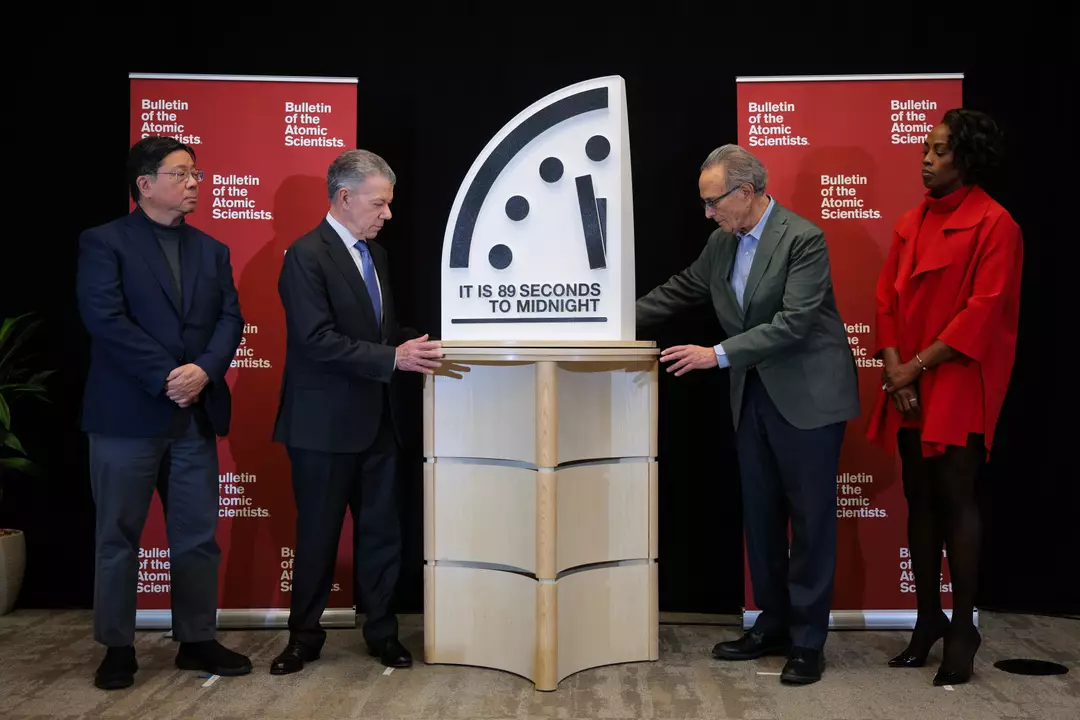
The meeting about the clock’s status is reportedly taking place at the Bulletin of Atomic Scientists’ headquarters in Washington, DC.
This involves experts in nuclear and climate science discussing the likelihood of a man-made global disaster.
Participants include Jon Wolfsthal, director of global risk at the Federation of American Scientists; Robert Latiff, a retired US Air Force major general and adjunct professor at the University of Notre Dame; and Jill Hruby, former Under Secretary for Nuclear Security at the Department of Energy.
An announcement about the clock’s position is expected around 9am local time.
While experts have already made predictions, if you’re interested in a countdown similar to New Year’s Eve, you can watch the live update of the Doomsday Clock setting.