

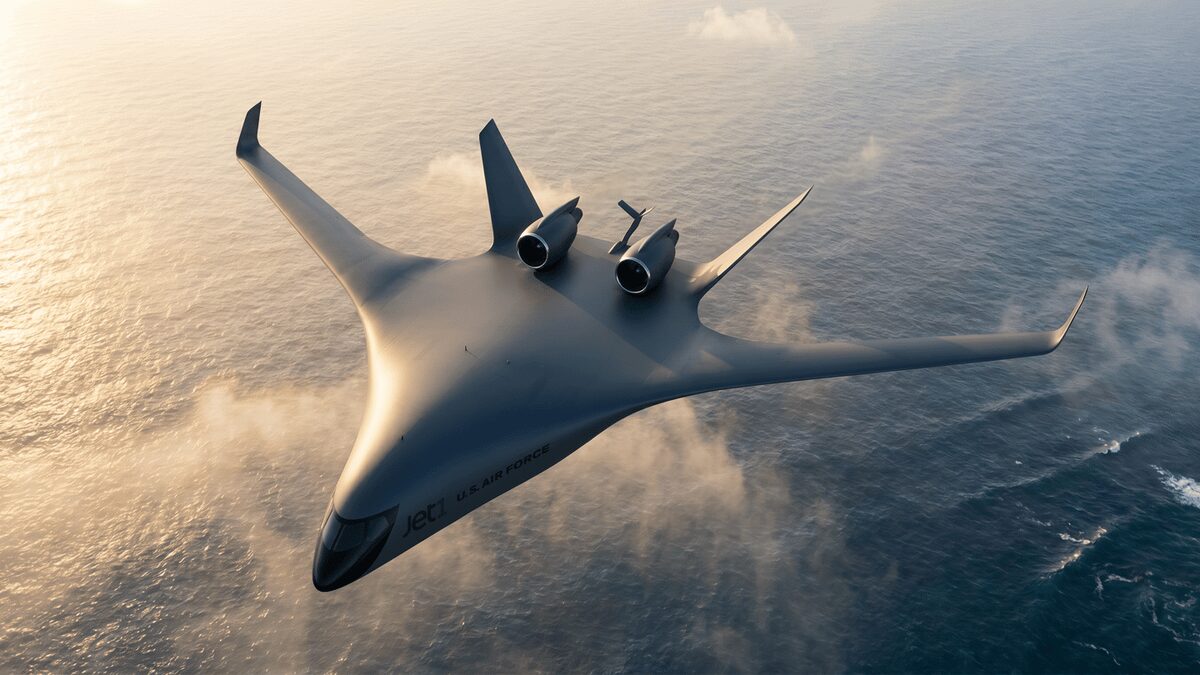
JetZero has secured up to $3 billion in potential federal financing as it pushes toward test flights of its windowless, one-winged Z4 aircraft.
The Long Beach, California-based startup signed a letter of interest with the Export-Import Bank of the United States at the Farnborough International Airshow in late July 2026, exploring financing support for its planned $4.7 billion manufacturing campus in Greensboro, North Carolina. The preliminary agreement could cover construction of manufacturing facilities, production systems, equipment and other eligible project costs through the bank’s Make More in America Initiative, though it does not constitute a funding commitment.
“This Letter of Interest marks an important step toward building the most advanced aerospace manufacturing campus in the country and bringing tens of thousands of high-quality jobs to North Carolina,” Tom O’Leary, JetZero CEO and co-founder, said in a statement.
The Z4 uses a blended-wing-body design that merges the fuselage and wings into a single lifting surface, eliminating the distinct tube-and-wing configuration found on conventional airliners. The company says this “all-wing” approach will cut fuel burn by up to 50 percent compared with similarly sized aircraft in service today, while the flattened, manta-ray-like shape expands interior space for approximately 250 passengers across routes of up to 5,000 nautical miles.
Pietro Cervellera, senior vice president of aerospace and defense at Altair, praised the engineering partnership in a statement. “Altair is delighted that JetZero, a true pioneer in the world of aerospace today, is leveraging our simulation and AI technology to push limits in airplane design,” he said. “JetZero’s vision is to reshape aviation to usher in a more efficient, more sustainable aerospace industry – we share this same vision.”
The aircraft’s engines will be mounted at the rear, which JetZero says will reduce noise for passengers and for communities near airports. The wider airframe also allows for larger boarding doors, direct access to six cabin zones, and dedicated overhead bin space for every passenger.
Airline interest has been building steadily. United Airlines has a conditional agreement for 100 Z4 aircraft plus 100 options, while Alaska Airlines invested in the company and secured undisclosed purchase options. Delta Air Lines is working with JetZero through its Sustainable Skies Lab, providing operational expertise and contributing to cabin design.
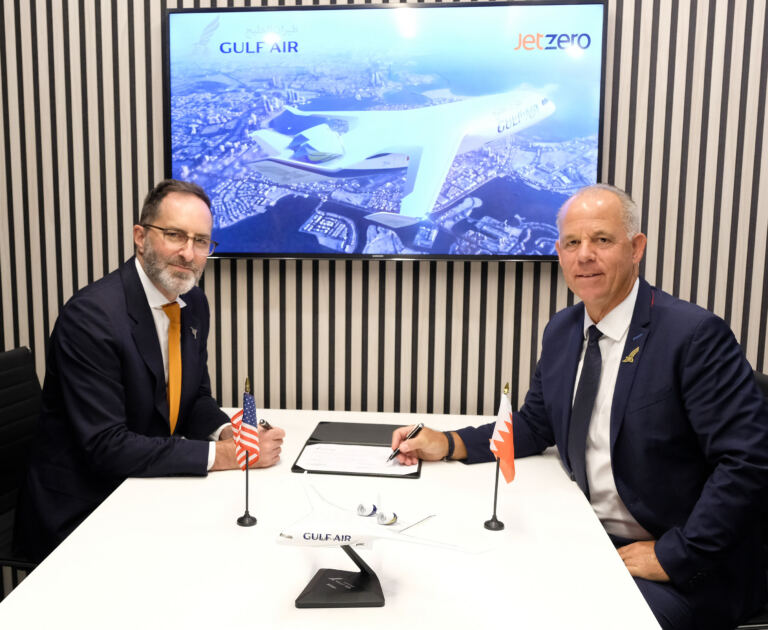
At Farnborough, Gulf Air became the first Middle Eastern carrier to commit, signing a letter of intent for an undisclosed number of aircraft with preferential delivery positions in the early 2030s. Japan Airlines also announced support, joining JetZero’s airline advisory group to collaborate on flight operations, cabin layout, maintenance and ground handling.
“Collaborating with JetZero on the Z4 aligns perfectly with our commitment to sustainable innovation,” Takao Suzuki, Executive Officer for Corporate Strategy at Japan Airlines, said in a statement, tying the move to the carrier’s net-zero-by-2050 target.
Martin Gauss, Chief Executive Officer of Gulf Air, stated: “At Gulf Air, we are always looking for ways to innovate and shape the future of air travel for our passengers and our airline. The Z4 represents a significant step change in aircraft efficiency, combining up to 50% lower fuel burn with a completely new passenger experience.”
The concept has drawn comparisons to revolutionary designs of the past. The Wall Street Journal described it as a “blended wing aircraft” and noted that “if JetZero can cross the line, the blended-wing aircraft would mark the biggest shift in passenger-jetliner design since the supersonic Concorde.”
Concept art circulated showing the sleek, flattened aircraft in flight with no visible windows and a spacious interior described as resembling a “living room in the sky.” The rendering highlighted how the blended-wing shape creates a wide, open cabin space fundamentally different from the narrow tube of conventional airliners, with seating layouts and amenities that cannot exist on traditional aircraft. The images sparked immediate online fascination with the futuristic aesthetic and the promise of a transformed passenger experience.
JetZero broke ground on its 8 million square foot manufacturing facility in Greensboro on June 15, with production initially focused on testing and certification. The company expects to invest $4.7 billion and create more than 14,500 jobs in Guilford County over the next decade, supported by what North Carolina officials called the largest state incentive package ever offered to a startup.
“Today we are the future of flight,” North Carolina Governor Josh Stein remarked at the groundbreaking ceremony. He noted that the state’s aviation industry already contributes about $88 billion annually to its economy.
The U.S. Air Force awarded JetZero a $235 million contract in 2023 to help accelerate development of a full-scale demonstrator aircraft, with first flight targeted for late 2027. The demonstrator is being built by California-based Scaled Composites.
Daniel Da Silva, JetZero president and chief operating officer, said at an AIAA Aviation Forum panel in Las Vegas that he does not anticipate the first commercial variant until at least 2030. The company is currently studying engine options, with Pratt & Whitney PW2000s selected for the demonstrator and higher-thrust production engines under evaluation.
Sangita Sharma, director of Delta’s Sustainable Skies Lab, told attendees at the same panel about the crew’s enthusiasm for the cabin possibilities. “The aircraft interior, the new shape of this aircraft, gives so much space for the crew to deliver a next-level customer experience, and also for the employee experience,” she said. “Our flight attendants are so excited about the possibility of delivering service like this. Just think about how much more personalized and white glove it can be.”
JetZero plans to make an engine decision for the production Z4 within the next year as it continues toward its late 2027 demonstrator first flight target.