

Warning: This article contains discussion of domestic violence which some readers may find distressing.
Lori Glass has spent years sitting with men who have assaulted their partners, men who struggle to remember the last time they cried in front of anyone, and men who have arrived repeating Andrew Tate talking points almost verbatim.
When she is asked what lies beneath the behaviour of many of the men she supports, she does not point first to rage. Instead, she says the root is something much more basic.
Her message lands at a time when loneliness and disconnection are being treated as a serious public health issue. The U.S. Surgeon General has warned that social isolation can harm health in ways comparable to other major risk factors, and the World Health Organization says suicide remains a major global health problem, with men dying by suicide at more than twice the rate of women worldwide.
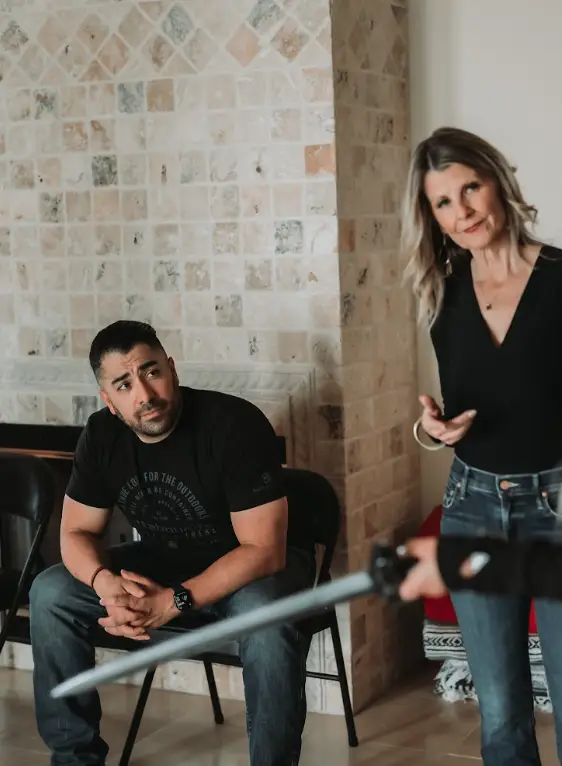
Glass created the relationship coaching programme PIVOT, which hosts five-day retreats for men at what she refers to as her ‘Glass House’. She is also firm that the events should be described accurately.
“They’re not camps, they’re Men’s Retreats, and the difference is important,” Lori Glass, founder of relationship coaching programme PIVOT, said.
“Nobody is sent here. Every man in that room chose to come, and that choice is where the change begins.”
Each retreat lasts five days and brings together small groups of men whose lives often look completely different from one another.
Yet once the conversations begin, Glass says similar themes emerge again and again, leading her to a striking conclusion about the men who seek out her help.
Through PIVOT, she has worked with men labelled ‘unemotional, avoidant, narcissistic, codependent’, as well as men living with anxiety, depression, and grief they have never voiced. Some are dealing with failed marriages.
Others, she says, have been drawn into the manosphere and picked up the rhetoric of personalities such as Andrew Tate without fully understanding what pulled them there.
So what does she believe she is really seeing when these men arrive?
“Men are missing men,” she said.
She said that reality shows up in painful ways, including in the story of one man in his forties who had eight groomsmen at his wedding ten years before but now had ‘no one he could call at two in the morning’.
Glass also described men who rely entirely on their partner as their only emotional support, placing enormous pressure on that relationship, as well as sons who grew up looking up to their fathers without ever hearing them admit fear.
“Modern life has removed most of those places and replaced them with laptops or mobile devices,” Glass explained. “So what walks into our retreats is often competence on the outside and silence on the inside.”
She has spent considerable time with men who come to the retreats after immersing themselves in what she calls ‘Tate-style spaces online’, and she says the tone they bring with them is easy to identify.
“It sounds like certainty. It sounds rehearsed,” she said. “He arrives with borrowed language, slogans about women, about status, about what a man has to be, and it comes out fast because it’s armor, and armor is easier to hand someone than a wound.”
Rather than debating that worldview directly, Glass says she tries to get underneath it by asking about a man’s father or the first person who broke his heart.
“Everything starts to change,” she said. “The voice slows down. It gets younger. The slogans stop, because slogans are for audiences, and he’s no longer performing for one.”
She stressed that her work is not about stripping away defences by force.
“We never tear a man’s armor off. We help him heal the wound it was covering, and then he sets it down himself.”
When speaking about why figures like Tate appeal to some boys and young men, Glass said parents should avoid responding with shame.
“Shaming him for listening confirms the exact story he’s being sold, that nobody understands him,” she said. “Your son isn’t necessarily looking for someone unhealthy to follow. He’s looking for a man to become.”
Glass said that even men who admit to violence against a partner or child are not automatically excluded from the retreats, though she is emphatic that accountability remains central.
“I will never excuse violence, and understanding a man is not the same as excusing his behavior,” she said. “When a man who has harmed his partner or his children sits in front of me and faces his own shame and guilt and owns it, I see someone whose change makes everyone around him safer, and I will do that work.”
For her, the deciding factor is not what a man has done in the past, but whether he is willing to take responsibility.
“If a man blames everyone else, minimizes what happened, or wants me to co-sign his story, the work cannot happen, and I’ll tell him so.”
She also said her own life experiences remain deeply connected to the work she does. Glass shared that her father drowned in front of her in a canoeing accident when she was a toddler. Later, when she was a teenager, her mother died by suicide after “disappearing into her grief and into alcohol.” She has also spoken about sexual abuse in her past.
“I searched for help for years and couldn’t find what I needed, so I built it,” she said. “My losses became my life’s work, and that is the greatest privilege of my life, helping people with transformational healing.”
Glass believes the emotional foundations taught at her retreats should be introduced in schools, saying boys often learn detailed language for hobbies and performance, but not for their inner lives.
“We would never send a child into the world unable to read words,” she said. “We send millions out unable to read themselves and their emotions, and then we act surprised by the loneliness and the anger.”
In her view, much of it comes back to men reaching adulthood without ever being shown how to understand or express what they feel, then finally beginning that process together in a room with other men.
“It takes exactly one man to stop the cycle,” she said. “One man, one home, one decision that stops with him.”